In Russia, it is planned to build a high‑temperature gas‑cooled reactor (HTGR reactor), which will become the basis for a nuclear energy‑technological station (NETS). The HTGR reactor unit (thermal power — 200 MW) is designed to generate high‑potential heat (the temperature of the helium coolant at the exit from the core is 850 °C) for large‑scale hydrogen production. Among the unique elements of the HTGR are fuel compacts containing microfuel elements. At MEPhI, a facility is being developed to monitor the uranium content in these innovative fuel elements. We are discussing how this work is progressing with Tatyana Aleeva, an associate professor at the Department of Theoretical and Experimental Physics of Nuclear Reactors.

Tatyana Aleeva
– Tatyana Borisovna, could you tell us what your research group is working on?
– We are developing a facility designed for non‑destructive monitoring of the uranium content in a batch of fresh fuel compacts for the HTGR reactor. The reactor has not yet been built; it is still in the design stage. The fuel elements for it are so‑called compacts.
– Could you explain what it looks like?
– The compacts look like graphite cylinders 5 cm high and 12.5 mm in diameter. The compacts are filled with micro-fuel elements — that is, balls with cores made of uranium dioxide in a multi‑layer ceramic shell, and these micro-fuel elements are distributed throughout the graphite matrix. One of the tasks we face is to determine how much uranium is in a batch of compacts.
– At what stage should this control be carried out?
– Based on the results of the fuel production technological chain. That is, before these compacts are placed in the fuel assembly.
– On what principles does this device operate?
– The device is based on the active neutron method. That is, the batch of compacts will be irradiated with an external neutron source. The neutrons will cause uranium fission, and we will record the fission neutrons. Depending on the intensity of the response, you will see how much uranium is present. There may be cases where, условно speaking, not enough “was put in.”
– And why do such situations arise?
– Because the production of fuel compacts is a complex, multi‑stage innovative technology, and there is a variation in the diameters of the microfuel rods and their number in a single compact. After all, the outer diameter of a microfuel rod is less than a millimeter, while the diameter of the uranium dioxide core is 0.5 mm. One compact contains about four thousand microfuel rods. And, accordingly, there may be a shortage of micro‑vents, or perhaps the number will be sufficient, but the amount of uranium in an individual micro‑vent will not be sufficient. I’m not even talking about the uranium enrichment, which may differ from the declared value.
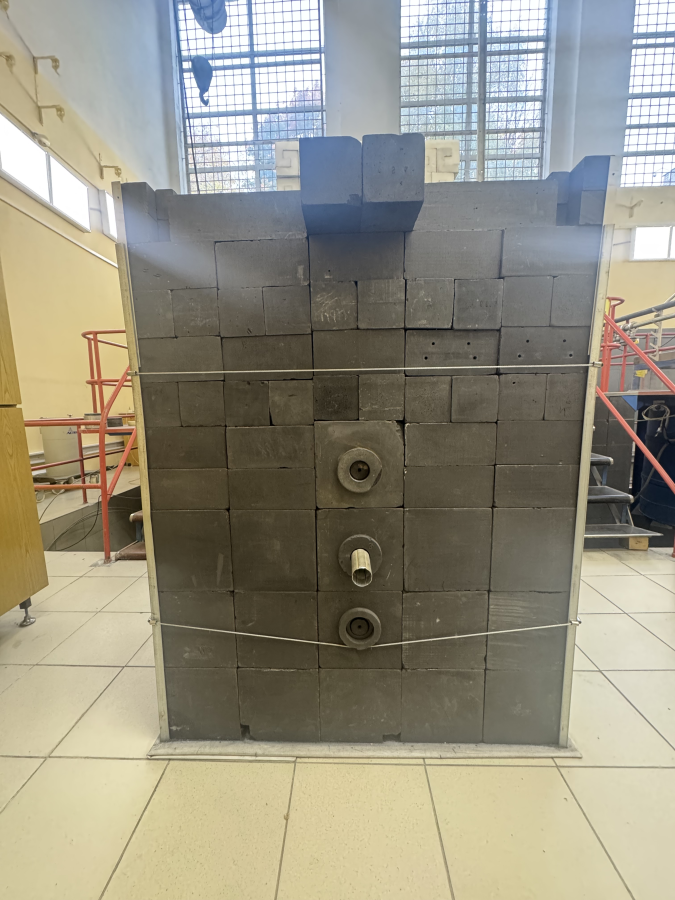
Experimental setup
– How will the neutron flux be generated?
– We have assembled an experimental setup. It includes a graphite cube weighing about 3 tons and a plutonium‑beryllium neutron source located inside it. This is a radioisotope neutron source based on the alpha‑n reaction. Neutrons with a hard energy spectrum are emitted; the average neutron energy is about 4.5 MeV. To increase the probability of the 235U fission reaction, the neutrons need to be slowed down. Graphite is a well‑known neutron moderator. Neutrons travel through the graphite, lose their energy when they scatter off carbon nuclei, and then enter the measurement cavity, where the batch of compacts is located. Next, a induced fission reaction occurs, and fast neutrons are emitted from the uranium in the batch of compacts.
– And how are they measured?
– Above this graphite cube is a detection unit. The detectors chosen are 3He neutron counters, which are located in a polyethylene moderator. In addition, between the graphite cube and the detection unit is a cadmium shield that absorbs thermal neutrons so that the neutrons that have already been slowed down by our radioisotope source do not reach the detection unit. This reduces the background noise from the external source, and we improve the signal‑to‑noise ratio, i.e., the ratio of the useful signal to background signals.
– Can we say that there is a certain standard for what the response power from a batch of compacts should be?
– In our experiments, almost all measurements are relative. That is, we compare our response with the response from a standard sample that has already been tested and certified, and for which there is a passport. And if the response in our measurement system is less than the response from the standard sample, it means that not enough uranium has been “added.”
– What scientific or technical challenges did you have to overcome during the design process? What was the most difficult part?
– The most difficult part was choosing the right materials, the geometry of our measurement system, selecting the source, and determining its position. In other words, we had to optimize the system in terms of materials and geometry to achieve the required accuracy of the results. To do this, we carried out preliminary neutron physics calculations and experimental studies.
– Is the very question of the emergence of such a device related to the fact that these microfuel rods are unique?
– Generally, yes. They contain a relatively small amount of uranium, and they require measurement systems with high sensitivity and high accuracy.
Konstantin Frumkin conducted the interview