The Laboratory of Geocosmic Research at the National Research Nuclear University MEPhI has created a prototype of equipment designed to detect energetic electrons pouring out of the Earth's outer radiation belt and causing auroras. The device will operate as part of the CubeSat 3U space platform from Geoscan LLC.
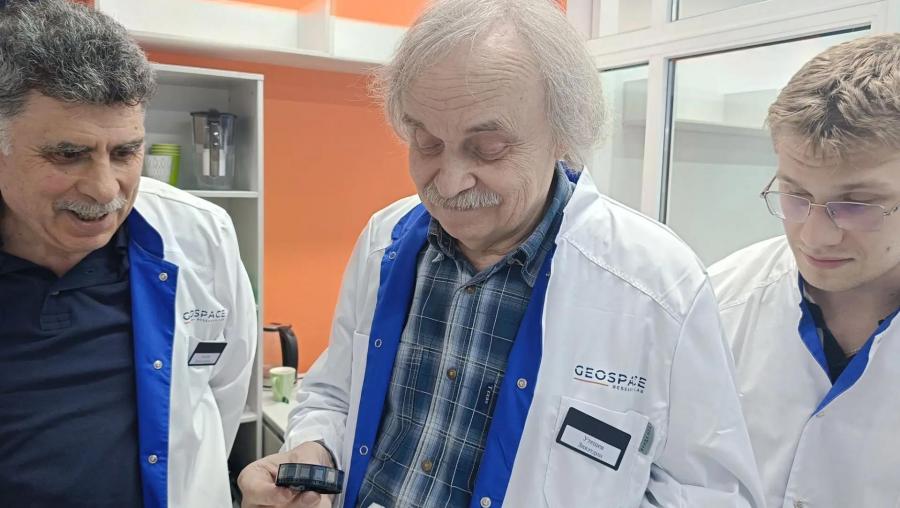
Monitoring of near‑Earth space, tracking the dynamics of Earth’s radiation belts, and forecasting space weather are tasks that are currently being addressed by instruments in orbit, developed in various countries. A version of such a device has been developed by the team at the Laboratory of Geospace Research at NIYAU MEPhI — staff members, students, and schoolchildren. Since the device is intended for a small spacecraft — a cubesat — it will have to operate under very strict constraints on size and power consumption. Nevertheless, excellent values have already been obtained for the key parameter — the device’s energy resolution.
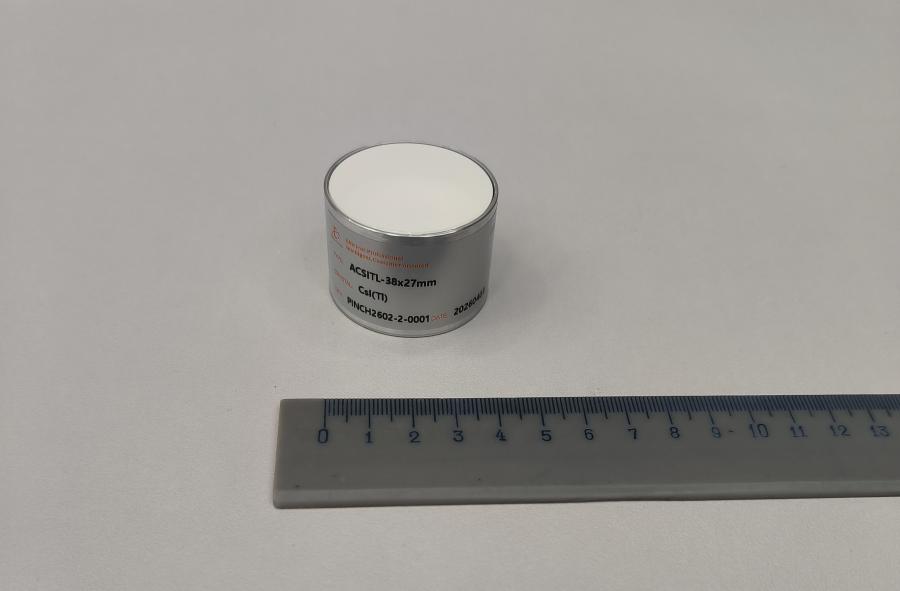
The heart of the detector is a thallium‑activated cesium iodide scintillation crystal (CsI(Tl)). Its operating principle is based on the conversion of ionizing radiation energy into visible light. When a gamma quantum or a charged particle enters the crystal, it transfers its energy to the lattice electrons. The crystal atoms become excited and then, returning to the ground state, emit photons — a flash of scintillation light. The intensity of this flash is proportional to the absorbed energy, which is what allows the energy of the incident radiation to be recovered.
The crystal based on cesium iodide is one of the most effective scintillators for detecting gamma radiation and charged particles. The crystal is weakly sensitive to humidity and has a decay time of about 700–900 nanoseconds. The latter is important for devices operating under high‑load conditions: a too‑long flash would limit the counting rate and increase the dead time, which would inevitably affect the statistics.
The light from the crystal is collected by silicon photomultipliers (SiPM), which convert photons into an electrical signal. The key task of the electronics is to register this signal with minimal losses and noise, since the number of collected photons directly determines the accuracy of energy measurement. However, CsI(Tl) has a feature that determines the complexity of the design: light propagates in the crystal in such a way that a significant portion of the photons is reflected from the side faces and exits through the face that is optically connected to the photodetector. If the SiPMs are positioned poorly, some of the light is lost, and the energy resolution decreases.
That is why the project team has considered a large number of SiPM placement options. It is necessary to collect as much light as possible from the crystal with a minimal number of photodetectors, since each channel requires its own electronics, and the space and power consumption in a cubesat are limited. Each configuration is a trade‑off between light collection efficiency, uniformity of response across the crystal volume, and the complexity of the electronics. Options with SiPMs placed at the edges or in a cross shape can provide better light collection with fewer channels, but they require more complex signal processing. The 2×2 configuration is simpler, but it collects less light.
Once the geometry was established, a new challenge emerged: SiPMs require precise control: the flash of light from an absorbed electron in the crystal lasts for nanoseconds, and capturing this signal without loss is not easy.
A proprietary analog data acquisition board was developed, which ensured the stabilization of the SiPM power supply voltage, which is very important, since temperature fluctuations in orbit shift the breakdown voltage and distort the energy measurement. In addition, the developed board provided low‑noise amplification and signal addition so that the useful signal would not be lost in the electronic noise.
And, of course, it was necessary to quickly receive signals from the front‑end electronics and process them. A programmable logic integrated circuit (FPGA) was suitable for this role — it is the computational core of the readout board, which converts weak and fast signals from the SiPM into scientific data. The FPGA provided signal digitization and selection.
The detector can register many events per second, but not all of them are useful. The FPGA checks each pulse directly in the data stream and decides whether to record it. This is crucial for a cubesat: the memory capacity and the data transmission channel to Earth are limited, and it is this selection that determines which data will reach the researchers.
The board was designed from scratch, tested, and refined by the laboratory staff, with the involvement of young people — both students and schoolchildren — who were encountering such complex electronic devices for the first time.
The assembled detector prototype, equipped with new electronics and a precisely designed geometry, has undergone calibration tests. The positive results of these tests indicate that the device can not only detect the presence of electrons but also determine their energy — which is important for various scientific tasks that will be addressed as part of the mission.
The project is being implemented as part of the Space‑Pi scientific and educational project, organized by the Innovation Promotion Fund with the support of the federal “Personnel for Space” project.