Our postgraduate student and young lecturer, Pavel Shapovalov, an assistant at the Department of Condensed Matter Physics, received two awards at once – for the best poster presentation (Best Poster) and for the best presentation by a young researcher (Best Young Researcher) – at the International Conference Channeling 2026, which was held in Italy at the end of September. Alexander Savchenko, an associate professor at the same department, received a special prize from the organizers of Channeling 2026 as the most active participant in the conference!
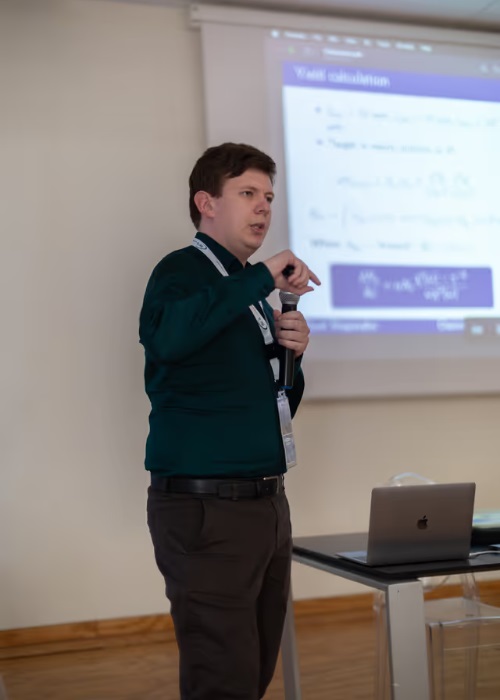
Pavel Shapovalov
Pavel Shapovalov's work is related to X-ray Cherenkov radiation in gas jets on accelerator storage rings. Congratulations to Pavel on this serious achievement!
The Channeling 2026 conference, well-known to researchers in accelerator-radiation physics, is organized by the Italian Institute of Nuclear Physics (INFN) and CERN. The conference has been held for more than 20 years, in even-numbered years, and always in Italy, in different parts of it. Professor Sultan Barasbievich Dabagov plays a key role in the organization of the event. The conference has become a platform for communication between scientists from various countries of the world: Italy, Great Britain, USA, China, Russia, Belarus, Ukraine, Armenia, Germany, Japan.
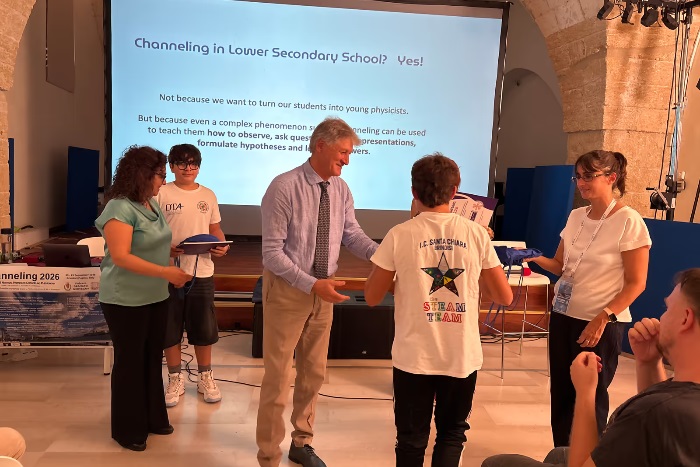
Sultan Barasbievich Dabagov
This time, four young researchers from the scientific team led by A.A. Tishchenko participated in the conference with presentations: postgraduate students Pavel Shapovalov and Dmitry Gavrilenko, assistant Damir Garaev (who had just a few days earlier defended his candidate’s dissertation in theoretical physics at MEPhI), and associate professor Alexander Savchenko — all employees of the International Scientific Laboratory No. 422 “Radiation of Charged Particles” and Department No. 67 “Physics of Condensed Media”, NESPI MEPhI.
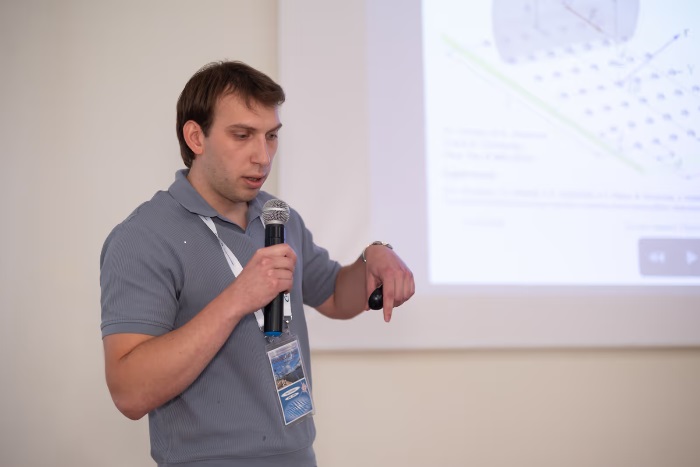
Damir Garaev
Damir Garaev spoke about Smith–Purcell radiation from a cluster of interacting subwavelength particles. This type of radiation is already used to generate powerful radio emission and is promising for diagnosing beams of ultra‑relativistic particles in accelerators, including colliders, synchrotrons, and free‑electron lasers. There were also reports devoted to the topic of the latest mega‑science project on a Compton radiation source (National Center for Physics and Mathematics), which was launched in Russia in January 2026.
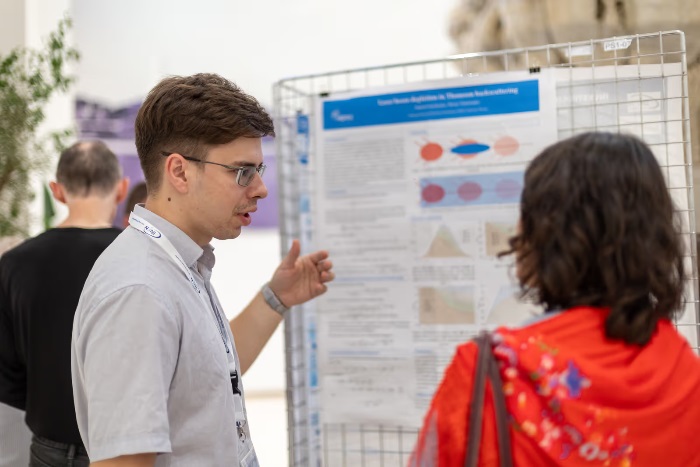
Dmitry Gavrilenko
Dmitry Gavrilenko spoke about the coherent regime of inverse Compton scattering (the coherent regime is the future of such sources: all existing ones today do not exploit the phenomenon of coherence and therefore do not achieve the maximum possible efficiency), and about the depletion of the electron beam when it interacts with a laser (this process can play an important role in beam dynamics in accelerators, determining the beam lifetime in the ring — that is, how long and how much this beam can emit, especially for the most powerful lasers).
Alexander Savchenko’s report was devoted to full‑scale computer modelling of the evolution of an electron beam in a ring‑type Compton source — we are carrying out this work in cooperation with the Moscow State University Research Institute of Nuclear Physics, specifically for the development of the so‑called “soft source” Compton radiation source (National Center for Physics and Mathematics).
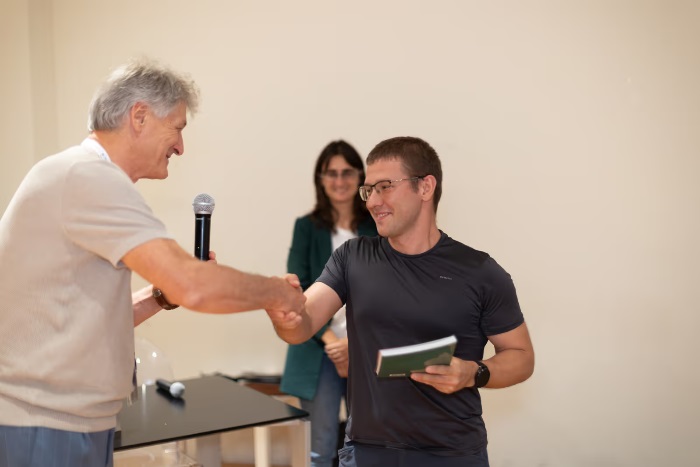
Alexander Savchenko
Pavel Shapovalov’s “prize‑winning” reports were also devoted to related issues — sources of X‑ray radiation, including the fashionable gas jets of today, the so‑called “gas jets”.
In addition, the following were actively discussed at the conference:
- crystal undulators – a new and interesting method for generating very hard X‑ray, practically gamma‑ray, radiation using the channeling phenomenon of relativistic electrons in crystals;
- the new X‑ray free‑electron laser SHINE (Shanghai), which was recently launched in China;
- the project for the future FCC circular collider and the AWAKE laser‑plasma experiment at CERN;
- the use of machine learning (the famous machine learning, which is now being rapidly adopted in almost all areas of physics) to optimize the parameters of laser‑plasma acceleration in carbon nanotubes.
In addition to a busy work schedule, our employees went on excursions to historical sites: the “white city” of Ostuni and Alberobello with its famous trulli houses (UNESCO World Heritage sites). The trip was very useful and interesting!