The Engineering and Physics Institute of Biomedicine (IPIB) of the National Research Nuclear University MEPhI held the first graduation of foreign students in the specialty “General Medicine”. Seventeen graduates received their diplomas and entered a new stage of their professional lives — now as doctors.
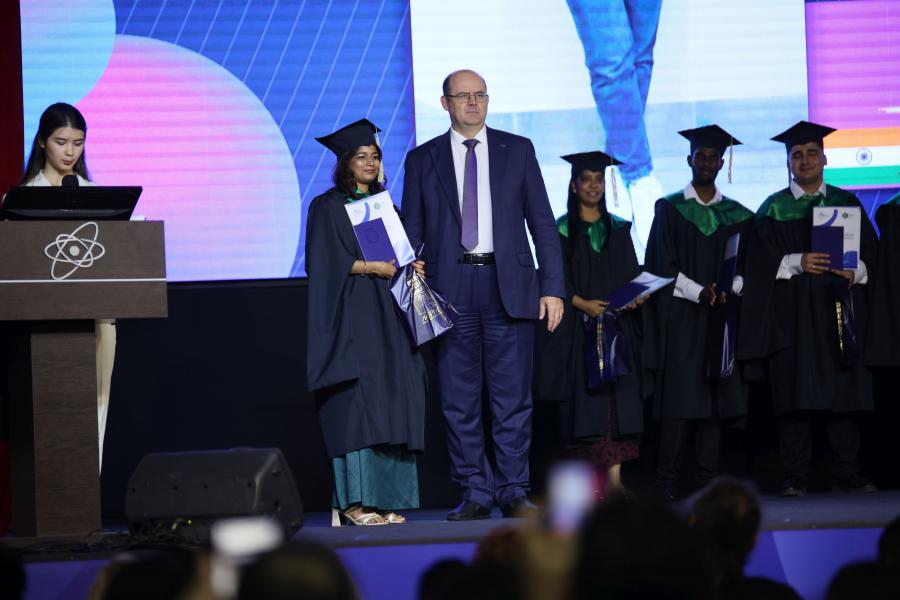
The first graduation was an important event not only for the graduates themselves but also for the IFIB. Several years ago, the idea of combining the MEPhI School of Engineering and Physics with medical education was a serious challenge. Today, its result is the first specialists who have completed the full cycle of training in the specialty “General Medicine” at the university.
Over the years of study, the graduates mastered fundamental disciplines, engaged in practical training in medical organizations, and worked alongside practicing doctors. Now they will be able to apply the knowledge and experience they have acquired in their professional activities.
“I don’t believe in medicine without a doctor”
A video message to the graduates was recorded by the Minister of Health of the Russian Federation, Mikhail Murashko.
“Medicine is not just a profession, it is a calling. Today you are entering a new stage in your lives. The diploma is not only a well‑deserved reward for your work, but also a symbol of society’s trust in you as future specialists. From this day on, you become part of a large professional community of doctors who stand guard over people’s health every day,” said Mikhail Murashko.
The graduates were also congratulated on their graduation by the rector of MEPhI, Doctor of Physical and Mathematical Sciences, Professor Vladimir Shevchenko, and the director of the Engineering and Physics Institute of Biomedicine, Candidate of Technical Sciences Alexander Garmash.
Vladimir Shevchenko noted that modern medicine is unthinkable without the widespread use of high technologies and the achievements of the natural sciences, and in the future, it may even be possible to use the quantum properties of matter in medical diagnostics.
At the same time, according to the rector, the development of technology does not change the core essence of the medical profession. “No matter how rapid scientific progress may be, there will never be medicine without a doctor. There is something very profound and enduring in the fact that medicine is the interaction of two people – a doctor and a patient”, Vladimir Shevchenko emphasized. He wished the graduates to become good doctors whom patients can trust.
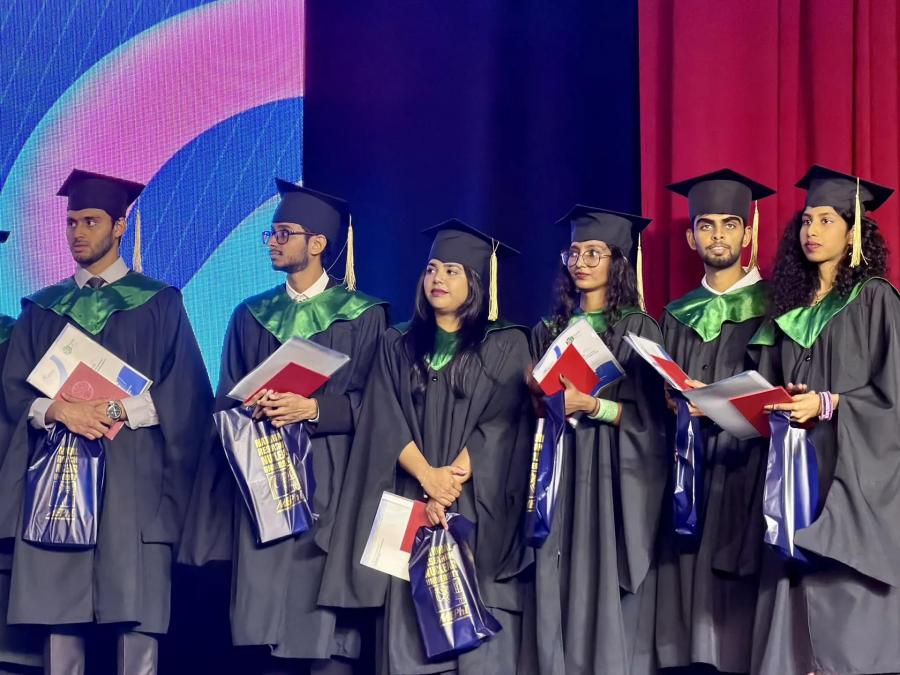
Engineering School and Medicine
Alexander Garmash thanked his colleagues who supported the idea of creating an educational environment at the Moscow MEPhI site that would bring engineers and doctors together. According to him, such collaboration opens up opportunities for the further development of new medical technologies.
The director of the IFIB also noted the contribution of the faculty members who came to work at the institute from leading fields of medicine. Among them are the ophthalmologist, Candidate of Medical Sciences Alexander Galchin, and the gastroenterologist, a hereditary doctor, one of the first Russian researchers of diseases associated with Helicobacter pylori, Candidate of Medical Sciences Nina Vasilyeva, Doctor of Medical Sciences, Professor Ekaterina Blinova.
“The graduates have proven that all the effort put into creating such a strong team of teachers was not in vain. They take prizes in international competitions and Olympiads, and I am confident that they will become excellent doctors,” said Alexander Garmash.
Practical training has become an important part of the graduates’ education. Elena Samyshina, Chief Physician of City Polyclinic No. 5 of the Moscow Department of Health, and Olga Lobanova, Deputy Chief Physician for Medical Affairs at the Moscow Regional Research Clinical Institute named after M.F. Vladimirsky, addressed them with parting words.
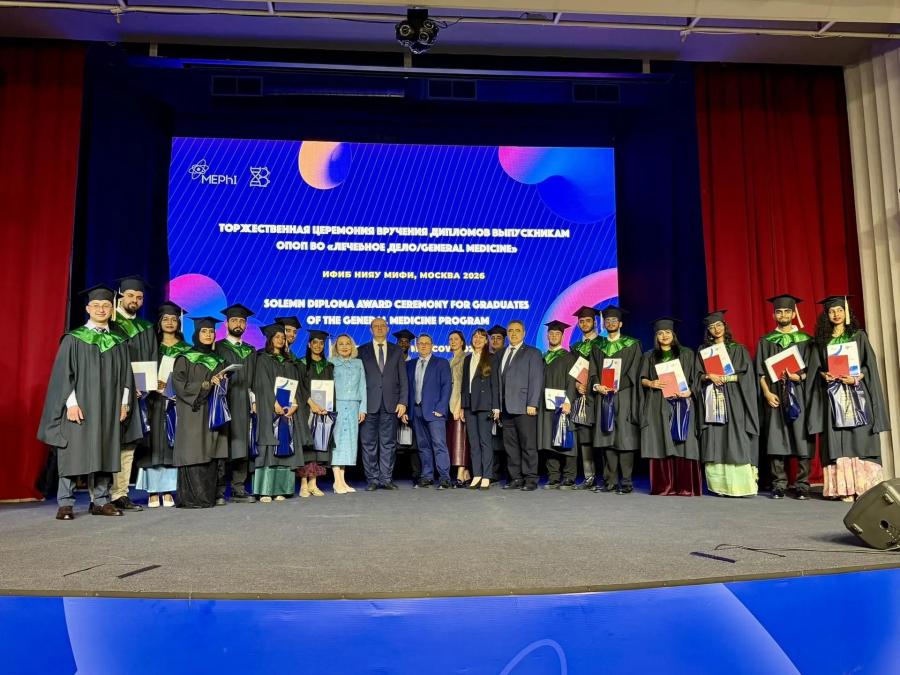
The beginning of a professional career
One of the highlights of the ceremony was the graduates taking the oath of a doctor. They vowed to honestly fulfill their professional duties, constantly improve their professional skills, follow the traditions of medicine, devote knowledge and skills to the prevention and treatment of diseases, and preserve and strengthen human health.
In their response, the graduates thanked the teachers for their knowledge and professional skills, the university for the unforgettable warm atmosphere that helped them learn and develop, and their classmates for their support and willingness to help in difficult times.
The first graduation of doctors marked a new stage in the history of IFIB. For 17 graduates, the years of study and practice came to an end. They embarked on a difficult, responsible path that requires constant development. “Medicine is not only a science, but also the art of caring for a person” — this idea resonates especially strongly on the day when yesterday’s students cross the threshold of professional life for the first time. Ahead of the graduates will be new knowledge, challenging decisions, their first independent victories, and experience that cannot be gained in a classroom. But the most important thing will always remain the person — the one for whom the profession of a doctor exists.
More photos here