It is important for a first‑year student to know that they are studying at a university whose graduates and staff have been awarded the main international and domestic science prizes. MEPhI continues to develop their research areas – and you will be able to join these studies and projects in the departments and research laboratories of the university’s institutes. Today we will tell you about MEPhI scientists who have received the Nobel Prize.
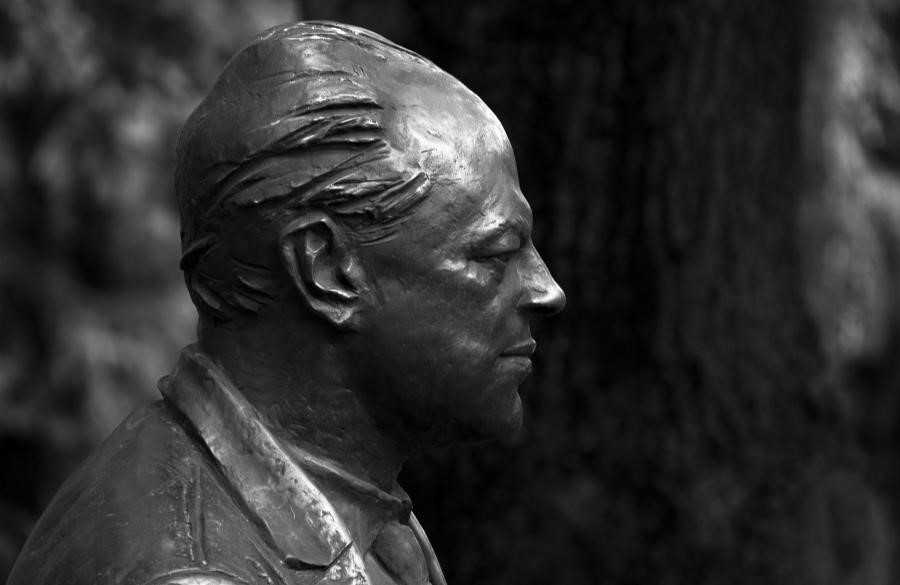
Nikolai Gennadyevich Basov. Photo by Polina Efanova
Nikolai Gennadievich Basov (1922-2001), graduate of MEPhI, Nobel Laureate (1964, for his work with A.M. Prokhorov and C.H. Townes, which formed the basis for the appearance of the first laser). In addition, Basov was the first to express the idea that a thermonuclear reaction could be created using a laser. He is the founder of a whole field of high–power lasers, including Basses, and was at the origin of the semiconductor laser, on which all telecommunications are based now.
In 1978, Nikolai Gennadyevich established and headed the Department of Quantum Electronics at MEPhI (now the Department of Laser Physics No. 37). Currently, our university is building the ELF laser complex – specifically for tasks in the field of thermonuclear fusion, the foundation of which was also laid by Basov’s work. It should be noted that, in general, all of laser physics stems from the works of our founding fathers, including Basov, and it is developing according to his “guidelines.”
Laser physics is very broad: a laser can cool matter to temperatures in the billionths of a Kelvin near absolute zero and heat it to temperatures exceeding those found in stars. A laser is a versatile tool. “ELF” will also be a unique universal device: it will make it possible to conduct research in materials science, thermonuclear fusion, and the search for new sources of charged particles, as well as in the field of fundamental science (including, with the help of “ELF,” it will be possible to experimentally study how stars develop on Earth by creating similar processes in it – on a smaller scale, but with the same physics).

Igor Evgenievich Tamm. Photo by Polina Efanova
Igor Evgenievich Tamm (1895–1971), founder (1946–1949) and first head of Department No. 22 of theoretical nuclear physics, creator of the school of theoretical physicists at MEPhI. The school – it is not an organization, but a specific ability to think about the subject – is considered one of the best in the country; its graduates are recognized worldwide. Moreover, this department has the largest number of academicians – from those working in nuclear centers and engaged in specialized tasks to scientists studying solid‑state physics, particle physics, and high‑energy physics – that is, the entire range of research in theoretical nuclear physics. It should be noted that this statistic became possible thanks to the educational method developed by I. E. Tamm: studying at MEPhI plus connections with the institutes of the Russian Academy of Sciences, where students go for internships and to write their research papers. This system has been preserved and is actively developing today.
I.E. Tamm received the Nobel Prize (1958) together with two other Russian Nobel laureates – Cherenkov and Frank. Cherenkov, together with Vavilov (1934), discovered the effect of a faint blue glow in transparent liquids when charged particles move through them at high speed. Today, Cherenkov radiation is actively used in nuclear medicine, astrophysics, space research, and biology; this effect allows scientists to “see” things that cannot be detected otherwise. I.M. Frank and I.E. Tamm later explained it.
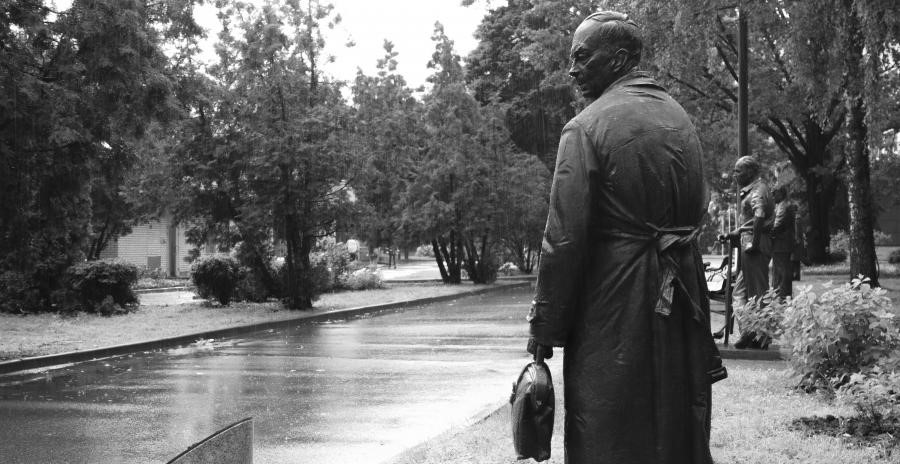
Ilya Mikhailovich Frank. Photo by Polina Efanova
Ilya Mikhailovich Frank (1908-1990) did not work with us for long, he worked in Dubna at JINR, was engaged in high–energy physics, and the Department of Experimental Nuclear Physics and Cosmophysics No. 7 and the Department of Experimental Methods of Nuclear Physics No. 11 (INPiT) successfully deal with this topic.
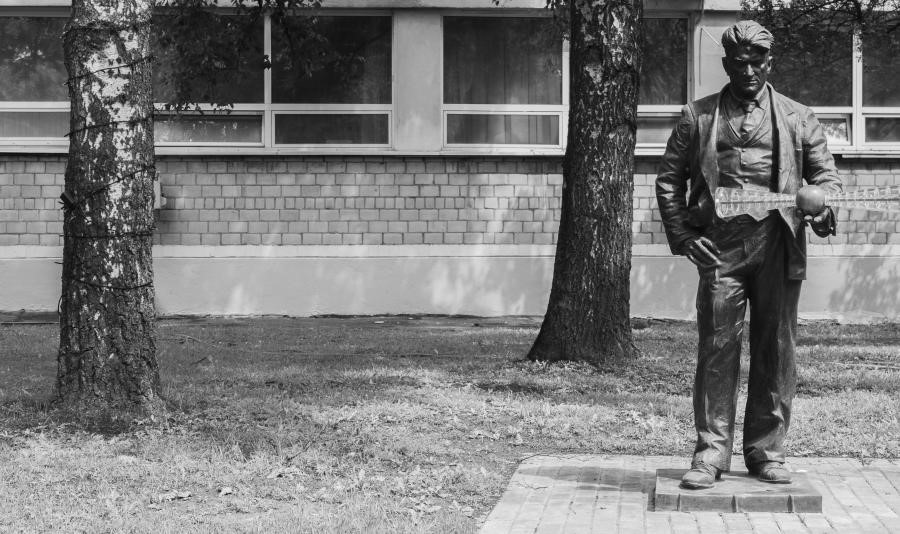
Pavel Alekseevich Cherenkov. Photo by Polina Efanova
Pavel Alekseevich Cherenkov (1904–1990) worked on accelerators after the discovery of radiation; he worked at MEPhI in the Department of Electrophysical Installations No. 14. MEPhI is developing the field of accelerator technologies very actively; we are building a Center for Accelerator Technologies and are also actively cooperating with the mega‑science facilities that are currently being built in Russia – these are SKIF (“Siberian Ring Source of Photons” in Novosibirsk) and SILA (a fourth‑generation synchrotron source in Protvino). For them, full calculations will be carried out at MEPhI; an injector has been made for “SILA”. For the inverse Compton radiation source (ICS), which is being built at the National Center for Physics and Mathematics (NCPM) in Sarov, we are building a photoinjector and performing calculations of beam dynamics in this accelerator. A great many graduates of Department No. 14 work at the Institute for Nuclear Research (Dubna). Work is nearing completion on the launch of the NICA nuclotron (Nuclotron-based Ion Collider facility) – one of the flagship domestic projects in the field of high‑energy physics. The MEPhI accelerator school is the strongest in Russia.
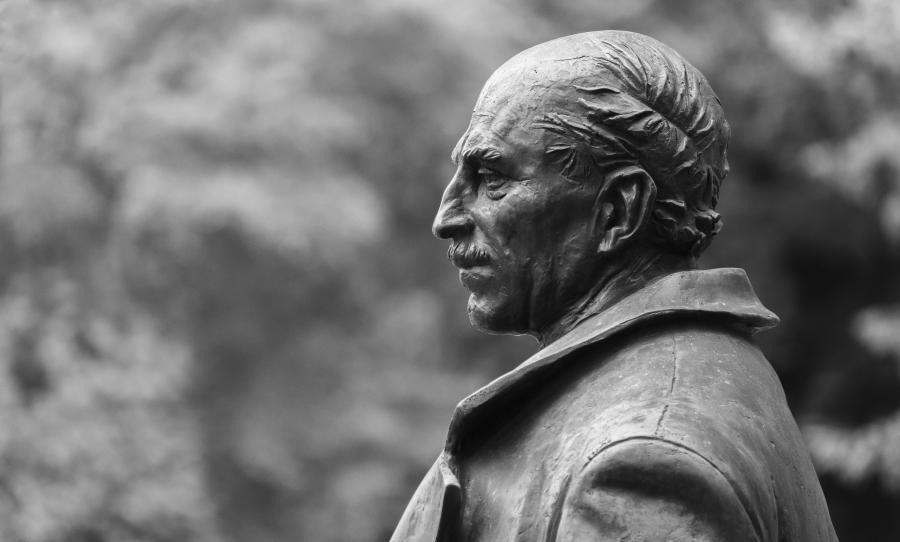
Nikolai Nikolaevich Semenov.Photo by Polina Efanova
Nikolai Nikolaevich Semenov (1896–1986) received the Nobel Prize together with S. Hinshelwood (1956) for developing the theory of chain reactions and studying the mechanisms of chemical transformations. He applied the approach to chemical reactions to develop the theory of chain nuclear reactions. At MEPhI, he founded the Department of Rapidly Proceeding Processes (1951) – now it is the Department of Chemical Physics No. 4, one of the oldest departments at the university.
Semenov’s ideas are being actively developed because the theory of the physics of fast‑flow processes requires large computational capacities, new mathematics, and new numerical approaches to solving problems. MEPhI also has a strong physical and chemical school, linked to the federal centers in Sarov and Snezhinsk.

Andrei Dmitrievich Sakharov. Photo by Polina Efanova
Andrei Dmitrievich Sakharov (1921–1989) also worked at MEPhI for a short time – just a year before leaving for Sarov in 1950, where he was involved in the thermonuclear project. It is said that he even gave lectures there, just like his teacher Tamm. Sakharov received the Nobel Prize (1975) for his work on peace, during a period when he had moved away from science and become a dissident, but, according to many, his contribution to the thermonuclear project was apparently decisive. He was the leading theorist in the development of the thermonuclear bomb for the test site, and the project’s head, Yu. B. Khariton, made sure very carefully that the person who had come up with the main idea later oversaw the entire experiment.
Interestingly, Sakharov was involved not only in nuclear topics – which everyone knows about – but also in astrophysics and cosmology; he had several strong papers on the baryon asymmetry of the Universe, baryon number, the hypothesis of hidden mass, and models of the expanding Universe. MEPhI has developed a very strong school of theoretical astrophysics: it includes Department of Elementary Particle Physics No. 40 and Department of Theoretical Nuclear Physics No. 32 – they focus on problems in theoretical physics and the evolution of the Universe.
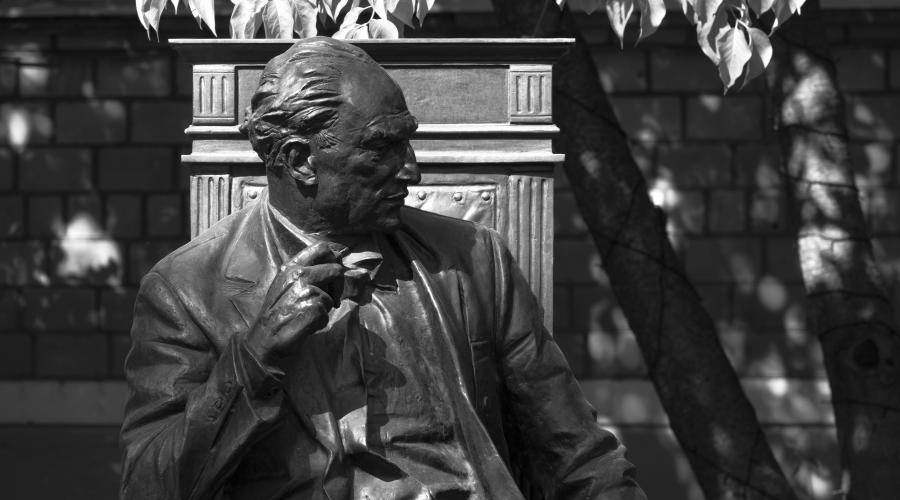
Vitaly Lazarevich Ginzburg. Photo by Polina Efanova
Vitaly Lazarevich Ginzburg (1916–2009) did not teach at our institute, so his monument is located on the other side of the avenue – where we can see the father of the atomic project. He received the Nobel Prize (2003) jointly with A. A. Abrikosov and E. Leggett for their pioneering contribution to the theory of superconductors and superfluids. However, he did not work on superconductivity for long, and his main interest was plasma physics. Ginzburg was supposed to work at MEPhI, but he didn’t meet the family background requirements – his wife had been repressed. However, his ideas were very important for the nuclear university: he understood how to produce tritium for a thermonuclear charge. In addition, Ginzburg’s work in the field of superconductivity is also important to us – MEPhI has a focus on this area: a department of superconductivity physics was established there (now these problems are being studied by a strong research group at the Department of Solid State Physics and Nanosystems No. 70)..
Today, research in the field of high‑temperature superconductivity has ceased to be just fundamental science – it is actually entering industry, which can already produce large quantities of superconducting cable. Its application will bring about a completely revolutionary change in technology – the ability to create frictionless bearings through levitation (when the magnetic field is displaced and objects can float in the air). This is being pursued all over the world. There are a lot of inquiries about superconductivity and thermonuclear fusion, because the new generation of facilities (with tokamaks) for thermonuclear fusion will be built on the basis of high‑temperature superconductors. Again, returning to MEPhI, the third generation of the MIFIST tokamak will also be superconducting. In the future, when the cost of 1 km of superconducting cable becomes affordable, it will be possible to create levitation transport – for example, this is what the European Maglev project (magnetic levitation) is working on; an experimental train has been launched in Japan.
Thanks to the developments at MEPhI, the superconducting magnets installed on the NIKA facility have been increased in size by developing a technology to increase the current. Currently, MEPhI is developing switches based on high‑temperature superconductors, which will make it possible to effectively suppress emergency surges in power grids – this is one of the serious problems when transmitting energy at high voltage. In general, the use of high‑temperature superconductors (HTS) is the main trend in modern thermonuclear fusion. HTS magnets make it possible to create powerful magnetic fields with smaller equipment, which makes future reactors more compact, cheaper, and more efficient than older projects based on low‑temperature conductors.
So, no matter which of our Nobel laureates we are talking about, we can say that their work lives on and continues to develop at MEPhI.