The project team, led by Yulia Shaltaeva — head of the laboratory and senior lecturer at the Department of Micro- and Nanoelectronics at the National Research Nuclear University MEPhI — has developed a prototype of the mobile remotely controlled “Polkan” robot. The team includes students from the National Research Nuclear University MEPhI. The robot is designed to inspect suspicious objects and detect traces of hazardous substances on their surface.

The robot is a remotely controlled robotic platform equipped with a manipulator and an analytical module. The operator directs “Polkan” to a suspicious object, after which the robot uses the manipulator to take a sample from its surface. The collected sample is then sent to the analytical module on board the robot. The analytical module is equipped with the “Segment” device manufactured by the Yuzhnopolimetal‑Holding (YPH) group of companies; it examines the sample taken from the surface using the ion mobility spectrometry method, which makes it possible to detect and identify substances in the sample.
As Yulia Shaltaeva explained, the ion mobility spectrometer can “smell” — analyze volatile substances in the air near a suspicious object. However, this approach has limitations when detecting low‑volatility hazardous substances that remain on the surface of an object. In such cases, the robot remotely takes a sample, allowing the bomb disposal expert to conduct the examination from a safe distance.
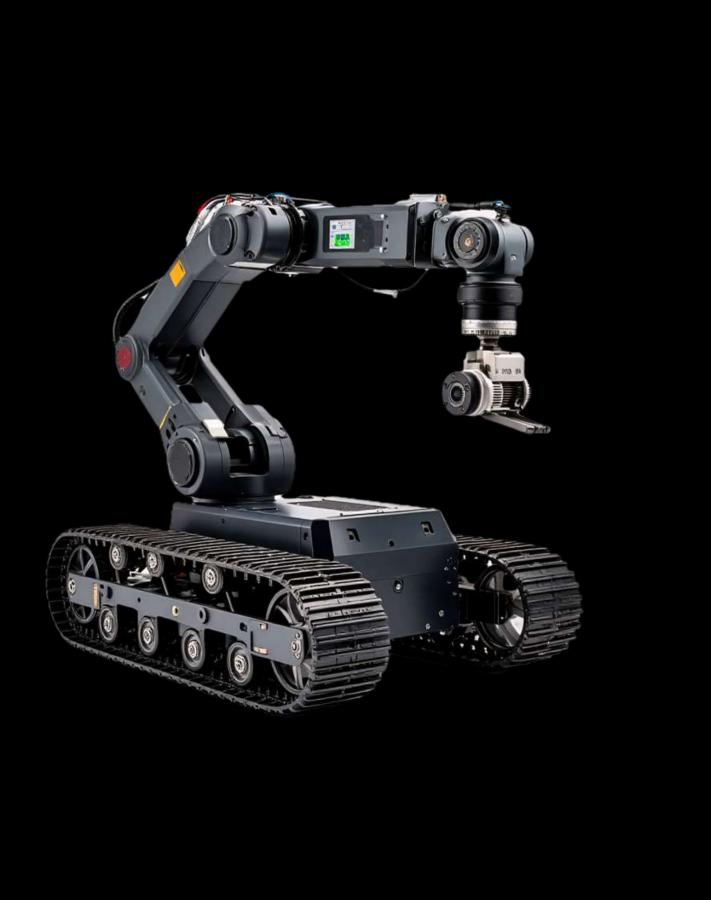
The name “Polkan” is related to the fact that the robot is supposed to perform functions similar to those of a service dog. The created prototype “Polkan‑0” currently demonstrates the general principles of the device’s operation. According to the creators’ plans, the pre‑production prototype “Polkan‑1” should be ready by the end of 2026. After that, further tests will be required, along with the procedures for preparing such a technical product for production and operation.
The project’s partner is the Yuzhpolimetal‑Holding group of companies (YPH), which produces inspection and analytical equipment. The project is also being developed with the support of the MEPhI NUST MISIS Technology Projects Accelerator.