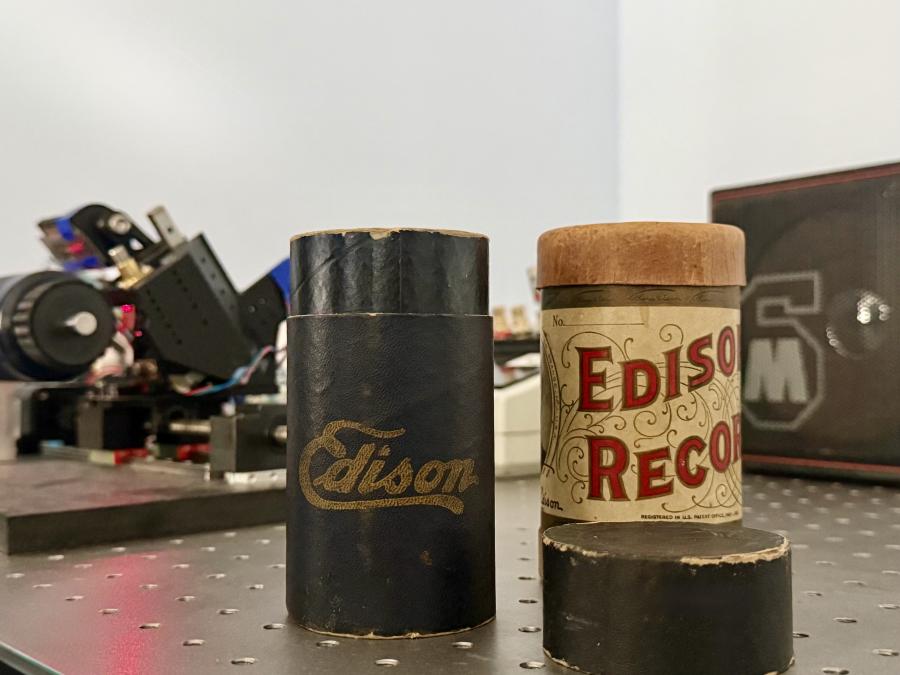
Since the second half of the 1880s, Thomas Edison's company began mass production of phonographs, the first commercially successful recording devices. They were recorded on cylinders (rollers), usually with a wax coating. Today, phonograph rollers are unique monuments of sound history, but, unfortunately, it is impossible to reproduce them in an authentic way – a century-old wax simply cannot withstand the touch of a metal phonograph needle. In order to hear voices and sounds recorded more than a century ago, modern technologies are needed – for example, those that would replace a metal needle with a laser beam during sound reproduction. This technical problem was solved at the National Research Nuclear University MEPhI. We are talking about a unique project with Andrey Mikhailyuk, a researcher at the Laboratory of Laser Diagnostics at the Institute of Laser and Plasma Technologies at the National Research Nuclear University MEPhI, and Roman Romanov, the initiator of the project, General Director of the Anton Rubinstein Heritage Center. The interview was published in the Kommersant newspaper.
– Roman, how did this project begin?
R.R. It began with listening to a phonograph recording of Pyotr Tchaikovsky persuading the great pianist and founder of Russia's first conservatory, Anton Rubinstein, to immortalize his piano playing. This is probably the first audio recording in Russia. On this recording, we hear Tchaikovsky's voice for the first time, and there are literally a few words by Rubinstein himself. He says, "Yes, it's a wonderful thing," meaning the phonograph. This recording prompted us to search: maybe somewhere in the archive there is a second roller on which Rubinstein's game is recorded. We went to St. Petersburg, to the Pushkin House phonogram archive, but it turned out that Rubinstein could not be persuaded to play. A dramatic story unfolded there. At some point, Rubinstein agreed, but the phonograph refused, and the recording did not take place. And the next time they tried to persuade him again, he refused on principle – his mistakes could get on the record, and he would not want posterity to judge his game by them.
This was our first touch to the world of phonographic recordings in Russia. Further – more: It turned out that archives and museum collections contain thousands of phonographs recorded in the late 19th and early 20th centuries. They were recorded by both individual enthusiasts and folklore expeditions; special studios were created where poets and writers came and read their works on a phonograph. Among them are the Institute of the Living Word and the Office of Speech Culture. As a result, we have discovered a whole world of unique recordings, many of which have not yet been listened to by anyone. Now these phonographs are more than a hundred years old, and no keeper would dare to reproduce them on an authentic phonograph – a needle can simply destroy a fragile medium.

Roman Romanov
– And how did this project start for MEPhI?
A.M. For us, it started as another optical diagnostic task. After all, our laboratory is called the laboratory of laser diagnostics. We are engaged in carrying out any measurements using laser systems. This includes interferometry, measurements of displacements, velocity, plasma density, and much more.
– What was your task?
A.M. In fact, the goal is to create an analog phonograph that could work in real time and with which it would be possible to capture sound from existing wax rollers. It is important that these rollers were created before the advent of the vast industry of records, which were already more standardized, and were produced by professional recording companies. Phonographs were more of an entertainment for people who were passionate about technological progress. Most of the rollers were produced in standard cases, which make it completely impossible to determine their contents. If the roller itself is not specially marked in any way, it is almost impossible to find out what is written on it.
– Technically, what difficulties have you encountered?
A.M. The task was not the easiest in terms of technical implementation, because after all, laser radiation is very different from a needle. The rollers are imperfect. The path that the needle pushes through can be very curved, it is never straight. By the way, it's the same story on the records. When the sound is read from the roller by the phonograph needle, the reading occurs due to the fact that the needle has some degree of freedom, and the needle itself follows all the bends of the track. But it also affects the track. Laser radiation does not affect the track, but laser radiation does not know when the track is curved and when it is not curved. Therefore, the most interesting part of the developed device is the feedback system that keeps the laser radiation on the track. And now, no matter how the track bends, the laser radiation always tends to adjust. Therefore, if, for example, we look at how the recording is played, we can see that our laser system is constantly oscillating back and forth. It is she who is trying to stay on the track by rotating the micrometer screw of the linear positioner.
– How does this feedback system work?
A.M. The fact is that when laser radiation hits the track, it is reflected from it. And depending on the angle of inclination of the roller surface, the point on the detector that the radiation hits changes. If the system detects an offset along one of the axes, which we have identified as responsible for the position of the track, it tries to return with the help of drives. All this happens in real time, taking into account the fact that the roller is constantly rotating at a certain speed.

Andrey Mikhailyuk
– Can we say that your system works on the principle of radar? The beam is reflected and detected by the detector?
A.M. I would say that not according to the principle of radar, but rather according to the principle of translocation sensors. This is a method of measuring the shape of a surface that records the deflections of a reflected beam. In fact, we measure the shape of a surface, converting this surface shape into sound on the fly.
– And where did the software for converting the shape of a surface into sound come from? Did it have to be developed or was it ready-made?
A.M. The software had to be developed, but basically we just needed to calculate the correspondence between the beam displacement on the detector and the sound frequency. A sound of a certain frequency is recorded on the roller. The frequency is directly related to the slope of the track. The stronger the slope, the higher the frequency. That's actually what's being fixed.
– Were these slope and frequency ratios determined during the work?
A.M. I don't know if we can say that we were lucky, but it all worked out almost immediately. That is, literally a direct analog signal from the sensor was already producing sound.
– Which laser was chosen to solve this problem?
A.M. The simplest semiconductor laser is the same type used in conventional laser pointers. The task did not impose any special requirements on the radiation parameters, and this turned out to be an advantage: such a laser is not inferior in its characteristics to the lasers used in CD-ROM drives, while being extremely simple, low cost and completely safe – both for the operator and for the scanned objects.
– Have you read anything about similar developments in other countries while working on this device?
A.M. There were similar devices. There is a Japanese device of this kind, it was produced in 1986 in a single copy. As far as I know, there were no such devices in Russia. There are devices that, for example, can read the entire shape of the roller surface. These are sophisticated confocal microscopes. When we first got these rollers, we studied them with microscopes, looked at the distance between the tracks, what depth, found out all this, which was unknown, and carried out all these measurements on the equipment available at MEPhI.
– Could you handle the next stage? I mean by processing the sounds themselves, cleaning them up, maybe reconstructing them?
A.M. We did some minimal processing, it's not very difficult. The sound is recorded, uploaded to an audio editor, and then you can clean up the noise.
– Wax is a very delicate and very fusible material. Does the laser not heat it? I understand that a needle would destroy it a lot, but a laser, after 100 uses, won't destroy it too?
A.M. No, it was specially calculated, of course. This is a fairly low-power laser, even when focused. Moreover, we do not fully focus the radiation, because in this case there is a lot of extraneous noise. Still, we try to somehow correlate with the size of the needle, with the size of the track.
– Roman, at what stage is the project now? Has the serial processing of the rollers already begun, or are you just working on the technology?
R.R. The technology is currently being tested. In addition, we are waiting for a large batch of a wide variety of backgrounds — with their help it will be possible to fine-tune the device. Soon we will have a phonograph on which we can hear the reference sound, with which we will then compare the sound received from the device.
We had an important event the other day. Colleagues from the Tolstoy Museum brought us the backdrops, which were recorded by Lev Nikolaevich himself in Yasnaya Polyana. He used a phonograph as a dictaphone, read letters to his loved ones, and then they were deciphered by his secretaries. There is a recording of Tolstoy's voice in English, as well as rolls with unknown content.
There are not even hundreds, but thousands of rollers in museum collections all over the country. Among them, there are those that have really never been played and are still waiting in the wings. We decided to name the device "Wonderful thing": these were the words spoken by Anton Grigorievich Rubinstein during the recording, as he described the phonograph.
– What are your future plans when the technology is more or less in working order?
R.R. We have a lot of plans and hopes. Colleagues from the museums where the rollers are kept are aware of our development, and we are open to cooperation. As soon as we complete work on the device itself — this "Wonderful Thing" — we will be ready to digitize the recordings. In the future, we would like to create a public audio collection together with our museum colleagues, and perhaps post it on the portal. In addition, we plan to equip our Rubinstein Center with a special place for playing and listening to recordings.
We are currently designing the building, and one of the halls will be equipped with an immersive sound system, which is an advanced sound recording and reproduction technology. Our goal is to combine the first recordings made more than a hundred years ago with modern sound solutions: to capture sound from 150—year-old phonographs using a laser phonograph and reproduce it on systems of the 21st century.
These can be collective auditions with scientific comments, because many recordings will be opened for the first time. For the first time, it will be possible to hear the materials of folklore expeditions, which were carried out in large numbers in the 1920s and 1930s. There were cases when enthusiasts brought phonographs to record the last tolls of famous bell towers, which were in danger of destruction. Behind this is the abyss of our national sound heritage, which must definitely be manifested. Now it is silent: the rollers are in storage and waiting for them to be reproduced.
And then there is a huge scientific work ahead: attribution and processing. The rollers are in varying degrees of preservation, they were recorded and stored in different ways. There is work ahead for years: the return of words, sounds, music and, in fact, the very people who once made these recordings.
– Can MEPhI produce a device that will work in the museum?
A.M. Of course. We are actually engaged in instrument engineering. It is a common thing for us to produce ready—made devices. The new device is compact and mobile, and it can be used directly in the storage areas of the backdrops.