The properties of any material depend not only on its chemical composition, but also on its structure. In recent decades, so called amorphous materials that do not have an ordered crystal lattice have been increasingly used in various fields of technology (the most famous example of an amorphous body is ordinary glass). One of the Russian research centers working with such materials is the Laboratory of Rapidly Hardened Materials at the National Research Nuclear University MEPhI. The Kommersant edition published an interview with Alexey Suchkov, one of the heads of the laboratory, Associate professor of the Department of Physical Problems of Materials Science at MEPhI.
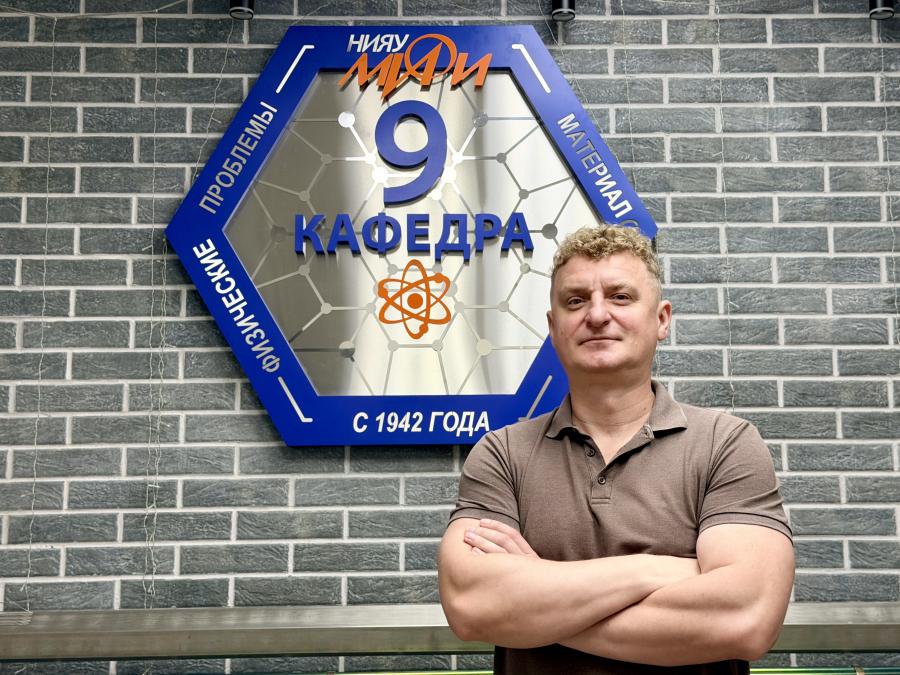
– Alexey, what does your laboratory do first?
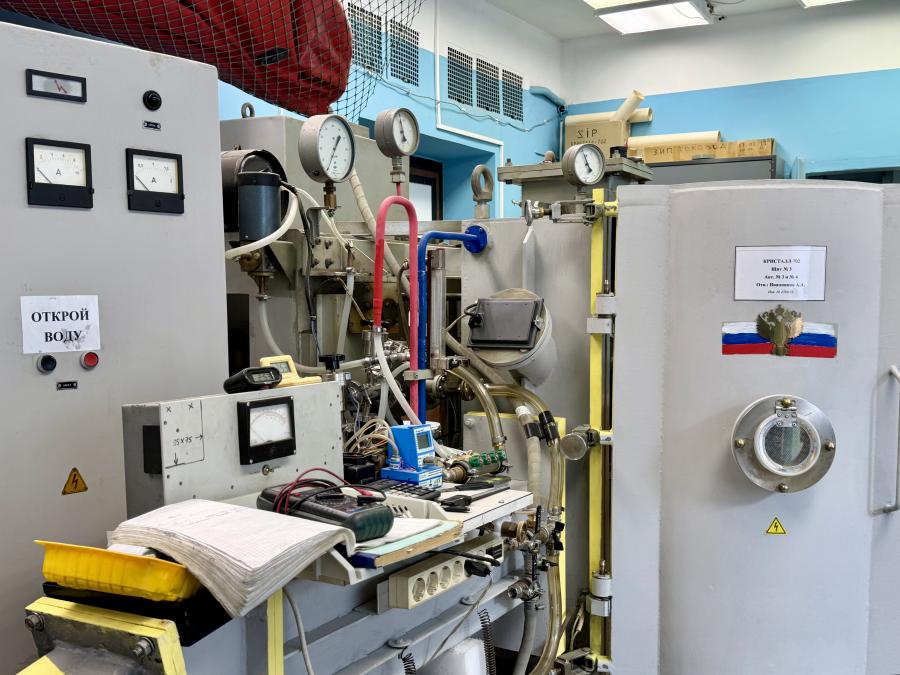
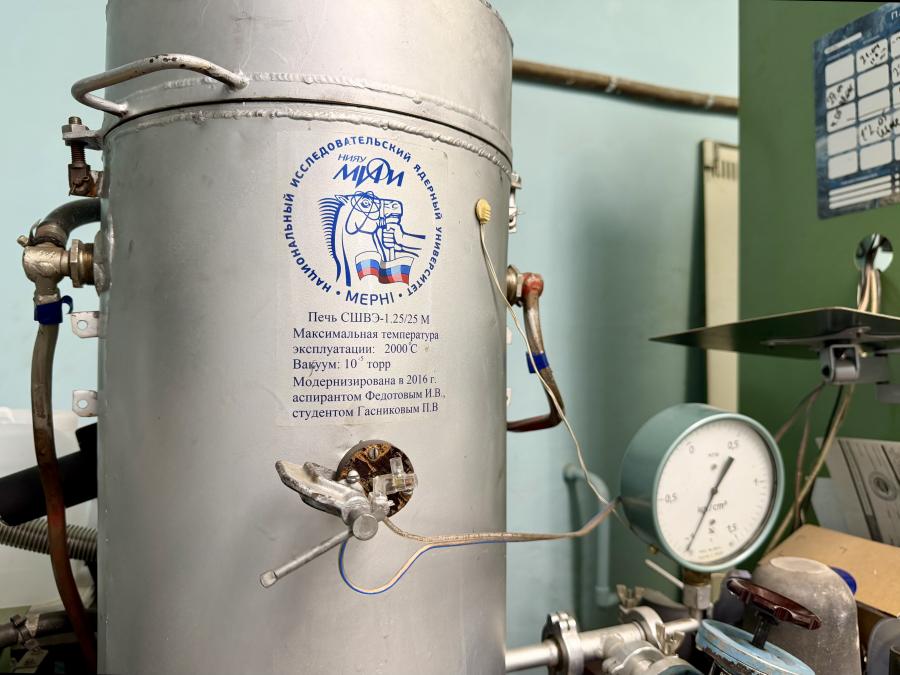
– Our laboratory develops unique special purpose alloys. We are talking about various materials in a quick-quenched state that are used in heavy industry, from reactor engineering to rocket engineering. We can say that we create them in the same way that people cook soup according to a certain recipe: we take a pinch of one or the other, cut metals in a certain proportion and load everything into a melting furnace. There, the metals melt, mix, and form a homogeneous melt. This melt is then poured into a mold and solidified into an ingot. But ingots are not the final product: a number of technological manipulations need to be carried out with them. We can make ingots of any composition, but we mainly develop alloys based on aluminum, copper, titanium, zirconium, nickel and iron. First of all, we are interested in materials that are widely used in space, rocket engineering, energy, etc.
– And what do you do with the ingots?
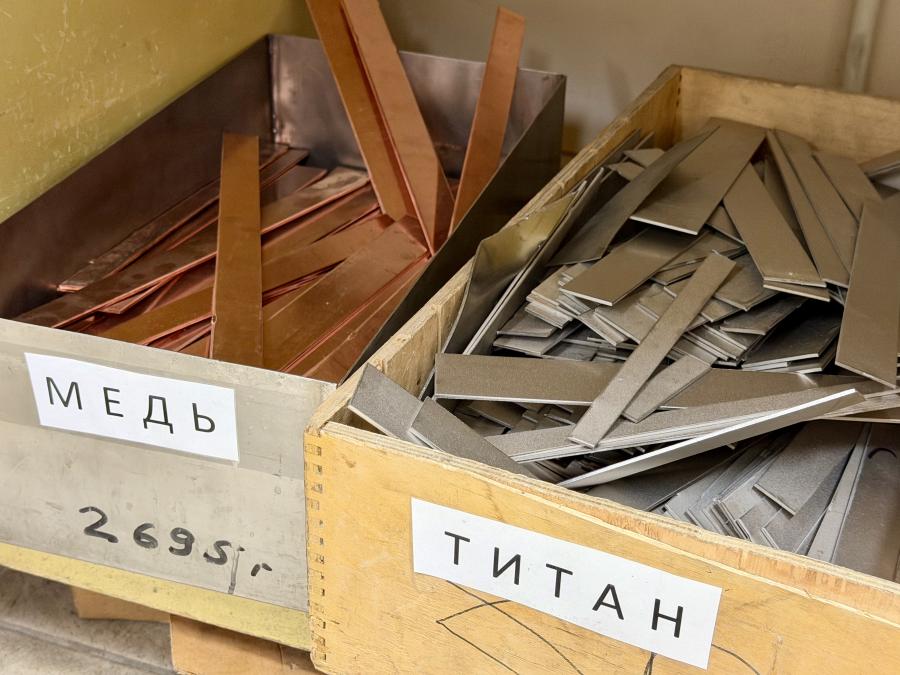
– Using ultrafast melt quenching, we process ingots into ribbons. The melt is squeezed onto a rotating copper disk, where the metal solidifies into a ribbon. At the same time, cooling occurs at a rate of ten thousand to a million degrees per second. As a result, the ingot turns into an elegant ribbon with a special atomic structure.
– What is its special feature?
– Initially, the ingot was in a crystalline state – this always happens in metallurgical production when the molten metal cools down. But if you cool the melt very quickly, at a speed of up to a million degrees per second, you get a material with the most interesting structural features: it retains the structure of a supercooled liquid – an amorphous structure. And crystalline and amorphous alloys differ dramatically in their properties. The ingot is brittle, the tape is flexible and elastic. The strength of an amorphous alloy can be up to 10 times higher than a crystalline alloy of the same chemical composition. In addition, amorphous alloys are elastic, and their corrosion resistance is much higher, since there are no grain boundaries in the amorphous material – the electrochemical mechanisms of corrosion proceed much more slowly. The fact is that in a crystalline material, a galvanic pair effect occurs between the grains, which does not occur in an amorphous material. Such a tape can be crumpled, torn, and cut like paper, although in a crystalline state the same material would be brittle. And this tape can be used for its intended purpose.
– And where can it be used?
– First of all, we develop alloys for soldering, that is, we create solders. Of course, not the lead and tin ones that are sold on the market, these are special purpose solders for making compounds of elements that work in extremely aggressive conditions.: at high temperatures, sometimes over 1000 °C, under radiation or mechanical stress, in an aggressive corrosive environment. An example is the anode of an X-ray tube. This is a disk made of molybdenum combined with graphite; it operates at a temperature of one and a half thousand degrees and rotates at a speed of 9,000 revolutions per minute. Can you imagine what kind of loads this product takes on? The boundary between molybdenum and graphite is completely soldered – and this is possible only with the use of such solders.
Another interesting application is in a fusion reactor. An experimental thermonuclear reactor, the ITER, is being built in France. It has energy – stressed elements – the so-called first wall and divertors, which take on maximum thermal loads, especially when plasma is disrupted or under the influence of powerful neutron fluxes. The metal parts of the reactor heat up sharply, they can even melt, so the most refractory metal is used for their manufacture – tungsten. But for cooling, it must be attached to a heat-dissipating base, which uses chromium-zirconium bronze. The problem is that tungsten and copper have very different physical properties: the coefficient of thermal expansion varies by a factor of five. With sudden thermal shocks, tungsten and copper expand in different ways, which can cause the joint to rupture. And this difficult task is also solved with the help of a specially designed solder.
– MEPhI is primarily associated with nuclear energy. Does it also need amorphous materials?
– For example, in the core of nuclear reactors, the so – called CDR is used – zirconium spacing grids that keep fuel elements (fuel rods) at a strictly defined distance from each other. Each element of such a grid is now individually spot-welded. We also proposed a technology using tape solders. With the help of such tapes, anti-freeze filters can also be manufactured, which are elements installed in the reactor fuel assembly. Their task is to capture foreign particles (corrosion products, etc.) that can enter the coolant (usually water) during equipment maintenance. In aviation, these solders are used to make blades for gas turbine engines. Of course, depending on the purpose, different materials are used: steels, zirconium alloys, ceramics, glasses, and refractory metals. A different solder alloy is developed for each task.
– And if the material is needed not in the form of a ribbon, but in the form of a powder?
– So, the tape needs to be turned into powder. There are different options. An ingot can also be converted into powder, but it will have slightly different properties. If the tape is heated, the material will change from an amorphous state to a crystalline one, since by its nature the metal tends to be in a crystalline state – this is a minimum of free energy. When heated, the atoms begin to rearrange and diffuse, the amorphous structure smoothly turns into a crystalline one, and the material becomes brittle. Then such a tape can simply be mechanically ground. The size of the granules varies depending on the purpose, but granules smaller than 400 micrometers are traditionally used. This powder can already be soldered. You can mix the powder with the paste and apply solder from the tube; then the product heats up, the solder itself is tightened into the gaps due to capillary forces – an all-in-one joint is obtained.
– But the activity of your laboratory is not limited to solders?
– The main application for such powders is soldering, of course. But we noticed that there are technologies that give powder granules a spherical shape. In general, after grinding, the particles have a so-called fragmented shape. However, additive technologies, including 3D metal printing, are very popular now. Additive technologies use exclusively spherical powders, the particles of which have the shape of a ball, and the closer to the ideal, the better, since the bulk density and fluidity of the powder will be maximum. We thought: why not try to make our powders spherical? And since our technologies make it possible to obtain these alloys in an amorphous state, why not obtain powders with which you can print using SLM – selective laser melting technology?
– Why did the question of 3D printers arise at all?
– The task was to try to print a product of decent volume, while preserving the amorphous structure. The problem is that traditional casting methods can only produce small millimeter –sized products from amorphous alloys. The largest thickness is obtained from palladium by traditional casting – 80 millimeters (ingot diameter), but palladium is a precious metal, and the price of the product will be very high. Therefore, scientists around the world are creating systems that allow casting products from alloys with an amorphous structure. And since we create such zirconium-based alloys for solders in our laboratory, we decided to work out the powder production technology, combine it with SLM technology and try to grow something interesting. And, in principle, we succeeded: we passed the first stage – we received the powder. Next, the technology of the so-called plasma spheridization, which is available at the Baykov Institute of Metallurgy, is used. We drive the powder through the plasma: each particle, passing through the plasma, melts and, by minimizing energy, takes the form of a drop, that is, a ball. The result is the same powder, but with spherical particles, which has a very high fluidity – such a powder behaves literally like a liquid.
– And this powder can already be used in 3D printers?
– In principle, yes. Of course, we conducted a lot of experiments. We decided to get complex geometry on a 3D printer: we took cellular and gyroid structures, tried to print them, and showed that the finished products are completely amorphous. Their ultimate strength reaches 2 MPa, which is 4-5 times greater than that of ordinary corrosion-resistant steels. This is a unique material.
– Where can this be applied?
– In a wide variety of fields: for the production of prosthetics, for creating elastic elements in technical systems, for example, mechanical drives. In the world, amorphous materials are now widely used in the manufacture of electrical equipment – laptops, smartphones, tablets. All of them are packed with a lot of amorphous materials inside. Those smartphone elements that open and close are made of amorphous materials, because they have very good fatigue properties: the material can work for millions and even billions of cycles on compression and stretching without loss of properties. In addition, such materials, as I have already said, do not have grain boundaries in their structure, which means that impurities do not form at the boundaries, and therefore they can be used in cryogenic conditions, for example, in the Arctic. One of the problems there is that materials become brittle at ultra-low temperatures. This is especially true in open space, when spacecraft are sent to asteroids: in the sun – plus 200 ° C, and in the shade – minus 200 ° C. This "thermal jock" is playing a cruel joke with the materials. In principle, amorphous materials can also be used here. Therefore, our task is to develop and scale these technologies in our country.
– Is this a new direction?
– Back in the 1960s, all this was developing in the USSR, but the application was relatively narrow, mainly for winding transformer cores. The limitation was related to geometry: It was not possible to produce large products, so the direction could be said to have stopped developing – only the magnetic or resistive properties of amorphous alloys were used. But now that we have learned how to produce dimensional products, it seems to me that the attitude towards this class of materials will be greatly revised.