The development of the All-Russian Engineering Competition winner Elena Ermilova and the HSV Lazeran company will improve the effectiveness and safety of the treatment of diseases of the gastrointestinal tract and hepatobiliary system.
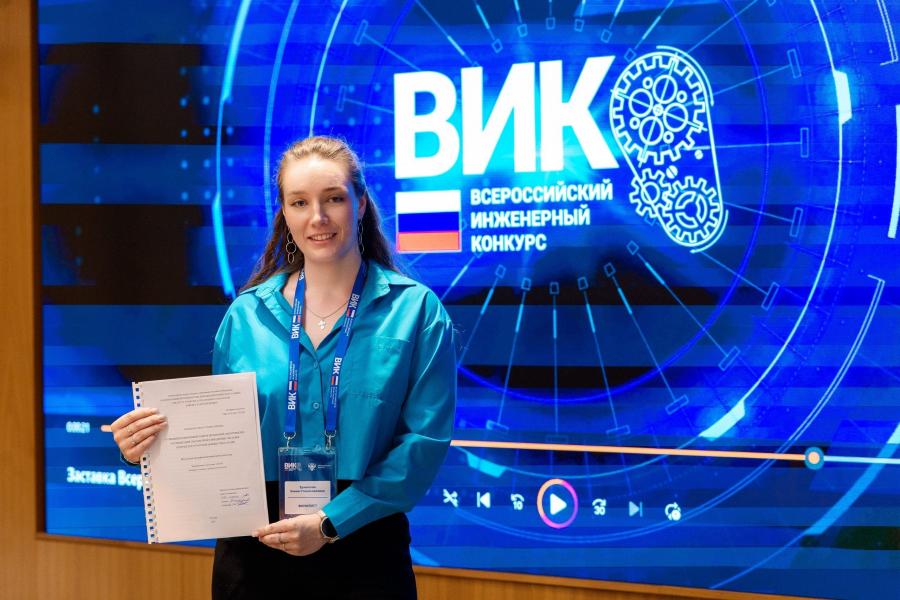
Elena Ermilova, a graduate of MEPhI, completed her master's degree at the Institute of Laser and Plasma Technologies, became the winner of the All-Russian Engineering Competition and found her dream job. The talented graduate spoke about her development, which will help make endoscopic operations more efficient and safer.
– Elena, how did you end up at MEPhI and why did you choose laser technology?
– I graduated with a red diploma from the Physics and Mathematics Lyceum in Korolev. I was sure that the first education should be technical – it is a base that helps to form systematic thinking. I chose between several universities, but the priority was, of course, MEPhI, because many of my friends had already studied at the nuclear university, and the reviews were very good. I entered LaPlaz for the specialty "Laser engineering and laser technologies". I'm sure it was the right choice. Already in the third year of undergraduate studies, students were involved in scientific activities. I went to the MEPhI Laser Center, came under the wing of Associate Professor Viktor Nikolaevich Petrovsky and began to study the processes of interaction of laser radiation with matter. After completing his bachelor's degree, Petrovsky talked so enthusiastically about how laser technologies are used in medicine that I became interested in this topic and began collaborating with HSV Laseruan, a large company that develops and manufactures industrial lasers. At the same time, she studied for a master's degree in the educational program "Laser Systems and Technologies", graduated from it and decided to participate in the All-Russian Engineering Competition with her master's thesis.
– Tell us more about the work itself!
– The work is really interesting and interdisciplinary. I act both as a research engineer and as a clinical specialist who interacts with both laser device developers and doctors. The use of laser technologies has become widespread in modern urology both for the destruction of calculi and for the surgical treatment of soft tissues. In particular, the domestic Urolase thulium fiber laser (HSV Laseruan) is used in the treatment of urolithiasis and surgical interventions on soft tissues, including in the treatment of benign prostatic hyperplasia.
A promising area of further application of the thulium fiber laser is endoscopic surgery, which covers a wide range of diseases associated with both the formation of bile nodules and pathological changes in soft tissues. Based on experience with endoscopists, they would like to use a thulium fiber laser to treat these diseases, but they do not yet really understand how to manage it. My task was to "explore this steppe" and introduce a laser into endoscopy. The expansion of the use of a thulium fiber laser in these areas requires the development of approaches to the selection and control of laser exposure parameters, taking into account the characteristics of various types of biological tissues. As part of my research, methods for optimizing and controlling laser exposure are being developed to improve the effectiveness and safety of treatment.
– What exactly have you researched?
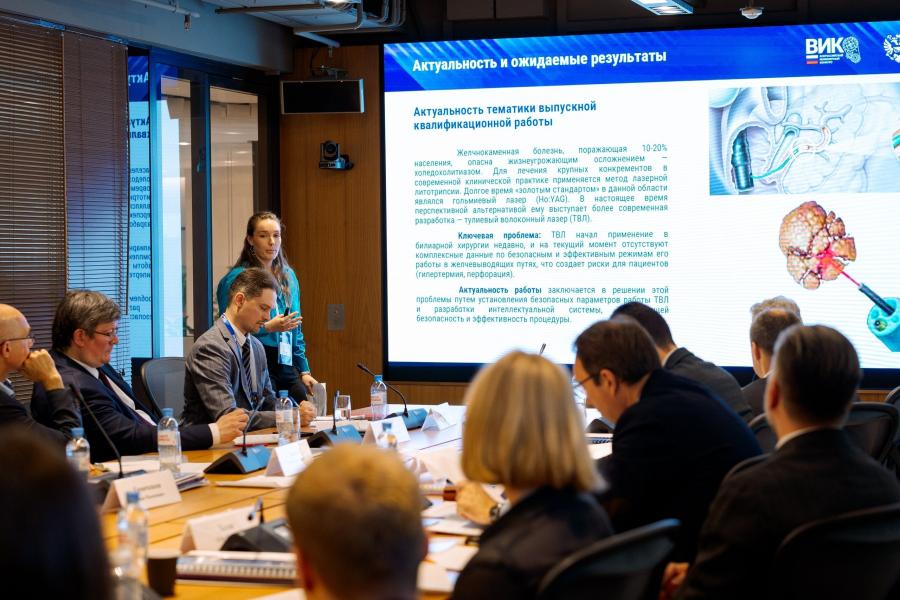
– It was necessary to choose safe modes for crushing gallstones (they differ in composition from urinary stones). The most important thing is to avoid hyperthermia of the surrounding tissues (there is fluid in the bile ducts, and when stones are destroyed by laser radiation, it can heat up to a critical temperature, which can cause tissue necrosis) and perforation (crushing a stone can accidentally touch the wall of the bile duct). In the laboratory, we selected modes that eliminate these two problems. At the same time, the modes should be not only safe, but also effective. Crushing a small stone for six hours is ineffective!
In the course of the research, it became clear that with effective therapy, the minimum risk of perforation still remains! And then the need to develop an optical feedback sensor was identified. It can distinguish soft tissues from stones due to the difference in their spectral characteristics. The sensor can stop the radiation supply in time when the laser is aimed at soft tissue. For example, we crush a stone, it splits into two halves, they flew apart, the walls of the biliary tract opened. In this case, the system itself blocks the radiation supply! Soft tissue damage is excluded!
– Probably, it was not so easy to train the system?
– Yes, in order to train the system, it was necessary to be present at the operations in order to collect as many signals as possible from soft tissues and stones of various compositions. We worked in clinical centers, collected and processed data.
By the way, it was this part of my work that impressed the VIC experts.
In addition, a classification of gallstones was carried out. It is very important to know which stone we are dealing with in order to choose the crushing mode as accurately as possible.
– Can the sensor be called an innovation and what does this development look like?
– There is one such sensor, the Tissue Sensor, developed by HSV Laseruan for stones and tissues of the urinary system, but it cannot be used directly in endoscopy due to differences in the spectral characteristics of these human systems. Therefore, an intelligent system had to be re-developed for the biliary system. From this point of view, the sensor is certainly innovative.
This is not a separate box. The sensor is embedded in the laser device, "sewn" into its software. The doctor works with the usual way during the operation – the medical fiber instrument is aimed at the stone, the radiation is applied by pressing the pedal connected to the device, and in case of danger, the sensor simply blocks the emission when the pedal is clamped. As soon as there is a stone again in front of the end of the fiber instrument, the radiation will be applied again – this saves the time of the operating doctor and increases the safety of the procedure.
– This year, more than 13 thousand applications were submitted to the All-Russian Engineering Competition! The competition is serious. What do you think is the secret of your victory?
– It seems to me that the jury especially noted those works that can quickly find application in a particular field. Developments that have the potential to be introduced into production are appreciated. They gave extra points for this.

– And when will a laser with a new sensor enter medical practice?
– I hope the sensor will be implemented within a year. We are already conducting clinical trials of the sensor at the medical center.
– How will you develop the project?
– I would like to popularize the use of laser technologies in endoscopy, enter new clinical centers, prove the effectiveness of using this particular laser for crushing gallstones, and demonstrate the benefits of using optical sensors during surgery.
– And how do you plan to develop yourself?
– They say that many finalists of the All-Russian Engineering Competition receive interesting offers from employers. "That's right. I immediately received a job offer from the Shvabe Holding. But I'm still loyal to my company. I want to finish the project. The result of the project is a new laser for endoscopic projects equipped with optical feedback. I also plan to continue my postgraduate studies and further develop my topic as part of my PhD work.
– What do you wish the freshmen?
– Be active! Get involved in sports, science, and creativity! While I was studying, I was a member of the MEPhI women's national volleyball team. Sport is an excellent means of psychological relief. I also advise all students to participate in scientific conferences and engineering competitions, make scientific reports, take internships, and join the scientific community. There are plenty of opportunities for this at the nuclear university.