The staff of the Department of Physico-Technical Problems of Quantum Metrology at the National Research Nuclear University MEPhI received a grant for the implementation of the project "Laser cooling of thorium-232 anions in application to quantum computing and precision spectroscopy."
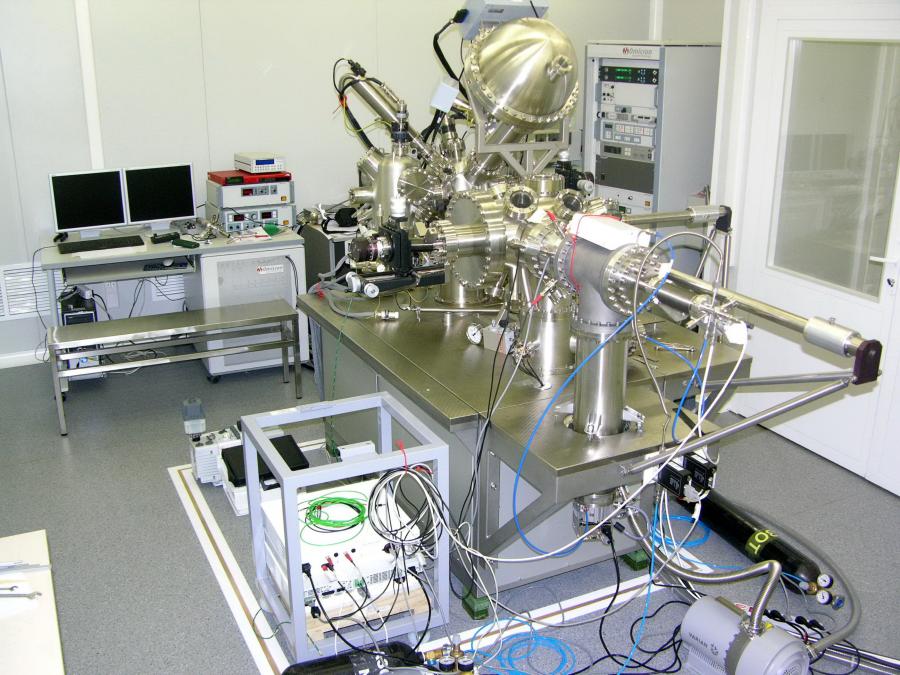
In the laboratory of the Department "Physical and technical problems of quantum Metrology"
Among the challenges facing modern quantum physics today, the problem of cooling negative ions (anions) – atoms that have an excessive negative electric charge - occupies an important place. The binding energy of this charge is significantly lower than for neutral atoms, and even more so for ions, which is a challenge for specialists involved in laser cooling. This is due to the fact that the cooling transitions for anions lie in the near and far infrared range, while having a small width. Meanwhile, the production of ultracold anions could be of great importance, in particular, for the development of quantum computing and quantum sensors.
Ultracold negative ions can become important elements in the creation of quantum computers, ultra-precise clocks and other precision devices. The unique properties of ultracold anions (for example, the presence of only one weakly bound electron) can provide advantages in sensitivity to new physical effects.
At the same time, thorium (Th⁻) anions (negatively charged ions) are considered to be among the most promising candidates for laser cooling. It has been experimentally established that the lifetime of one of the key excited states of Th is only 30 microseconds, which is three times shorter than previous calculations, which makes it extremely attractive for this technology. In other words, it is much easier and more efficient to cool thorium anions with a laser than many other elements.

Peter Borisyuk
The project is aimed at creating an experimental facility at MEPhI for direct laser cooling of thorium-232 anions in a Paul trap. The researchers plan to obtain thorium anions by laser ablation, confirm the composition of the beam using mass spectrometry, learn how to load and hold such ions in a trap, refine the spectral parameters of the necessary transitions, and then implement Doppler cooling of thorium anions at a junction of about 2428.4 nanometers. The thorium-232 anion is considered as one of the most promising candidates for direct laser cooling of atomic anions: a cooling transition, a fast and practically closed cooling cycle has been experimentally confirmed for it, and the absence of an ultrathin structure in the thorium-232 isotope simplifies the laser circuit.
The expected result will be a new experimental platform for working with cold negative ions. At the first stage, the team plans to purchase, install, and test key equipment, obtain thorium-232 anions, and perform primary mass spectrometry. The next steps involve loading and holding anions in a Paul trap, hot plasma spectroscopy, laser cooling of the anion cloud, and then switching to a single anion or a short chain of anions. In the future, this platform can be used for precision spectroscopy, verification of theoretical calculations for heavy atomic systems, development of new approaches to quantum metrology and formation of a foundation for qubit applications, including the Zeeman qubit on thorium–232 or a circuit where thorium-232 is used as a cooling "thermostat" for thorium-229.
The grant in the amount of 100 million rubles was issued by the National Research Nuclear University MEPhI within the framework of the Priority 2030 program and is designed for three years. The project leader is Petr Viktorovich Borisyuk, Doctor of Physico-Mathematical Sciences, Associate Professor, Head of the Department of Physical and Technical Problems of Metrology (No. 78). The project team includes staff, engineers, graduate students and students of the department, which will simultaneously develop a new experimental platform and train specialists in the fields of quantum technologies and high-precision metrology.