In both scientific and popular science literature, it is increasingly possible to find the stable phrase «extreme states of matter». For many centuries, chemists have been studying the properties of substances that can be found in the world around us, and they seem to have learned everything or almost everything about them. To move science and technology further, not chemists, but chemical physicists need to see substances in extreme states that are not found on Earth, in our everyday life, and even in most technological processes. The study and use of substances in such conditions is taught in some MEPhI educational programs, in particular the program «Technologies of extreme state of matter».
We are talking with Vladislav Ivanov, a graduate of MEPhI, director of the N.N. Semenov Federal Research Center for Chemical Physics, Doctor of Physico-Mathematical Sciences, about what specialists in extreme states of matter do and how to become such a specialist. It should be noted that the N.N. Semenov FITZ is a partner of MEPhI, where our students practice and where our graduates are employed. The interview was originally published in the «Kommersant» edition.
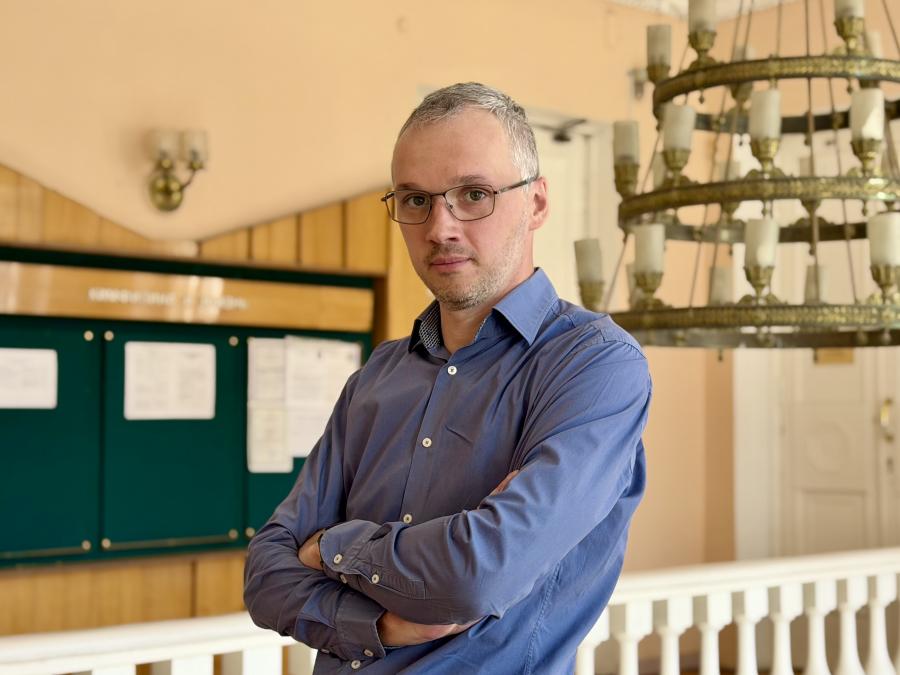
Vladislav Ivanov. Photo: Alice Khomich
When temperature and pressure change matter
– So, what is an «extreme state of matter»?
– These are states when new properties of a substance manifest themselves. When a substance is exposed to either very high pressure or very high temperature, then new physical laws and additional phenomena begin to manifest themselves inside this substance. For example, in the case of plasma states, free electrons arise in matter. If we are talking about ultrahigh pressures, then supercritical states arise when a substance is no longer a liquid, a gas, or a solid, but some kind of intermediate state.
– And what is the task of the science of extreme states of matter?
– It consists in investigating the laws by which a substance behaves in extreme conditions and finding applications for such a substance. Find applications that will improve our lives.
– What are the applied aspects of this science in this regard? How, for example, does the scientific study of extreme conditions translate into technology?
– About open technologies, for example, we can say that waste recycling technologies are actively developing now, using extreme states of matter. For example, waste is processed with superheated steam, which is a very good oxidizer. And most importantly, this ultra-high-temperature steam, that is, steam heated to temperatures above 2,500 degrees Celsius, allows the processing of organic substances into synthesis gas without the formation of harmful oxides. It is also possible to obtain hydrogen for hydrogen energy, or you can use synthesis gas for reforming and make fertilizers from it or burn it in thermal power plants. Another example: our institute is developing a technology for surface hardening of structural steels. The task is to create a technology that will create pressure above the plastic deformations of structural steels in order to strengthen, say, blades for a gas turbine engine and, accordingly, improve the characteristics of such engines.
– From your example, can we conclude that when a substance is in an extreme state and returns back, it already changes its properties?
– Not always. It depends on how extreme the condition is. Of course, if at the moment when a substance is in an extreme state, some irreversible chemical reactions begin to occur in it, then some irreversible processes are already possible when one substance has turned into another.
– Can we say that you, experts in the extreme state of matter, have any favorite substances?
– Still, more often we are talking about complexes of substances, or about some phenomena. We have all our favorite substances.
– Is chemical physics mostly the science of extreme conditions?
– No, not really. This is just a part of chemical physics. In general, chemical physics is a very wide field of activity, including, for example, the creation of various catalysts, the study of how these catalysts work, there is also the chemical physics of polymers, the creation of new materials, and much more.
Substance and Computer
– Is mathematical modeling now a very important part of the science of extreme conditions?
– Of course, almost everything that is currently being developed first goes through the stage of mathematical modeling in order to at least roughly understand what is happening inside. After that, experimental installations are already being created, but further technology refinement is also being paired with mathematical modeling. Mathematical modeling is now very well developed, but it does not always allow us to fully simulate the processes that occur. Usually an experiment is set up, this is a normal practice. An experiment is being conducted, some questions arise, mathematical modeling is being performed, and some of these questions are being resolved. This is an iterative process that leads to a result.
– And what place do artificial intelligence elements occupy in your research?
– Nowadays, in general, in science, artificial intelligence elements most often play the role of tools that help analyze large amounts of data obtained from experimental installations. In other words, it's just speeding up data processing.
Where do they train «extreme» physicists?
– MEPhI has an educational program "Technologies of the extreme state of matter". What is the purpose of this program? Who is she cooking for?
– The fact is that when we go into an extreme state of matter, the most complex physics begins there, and those specialists who are trained in this particular program must study the most complex complex phenomena. Therefore, the training of such specialists involves studying the basics of physics in general, and gas dynamics, and electromagnetism. As a result, the student gets a broad outlook in terms of physics, which can already be applied in various fields. At the same time, I think the most important thing is the general physics course that is taught at the beginning. This is the base, and then students go deeper into the various areas that are in this educational program, and already study certain aspects of physics.
– Where can a specialist in extreme states of matter find a job?
– Of course, these are Rosatom enterprises, as they are closely involved in various extreme conditions. Plus, of course, these are high-tech companies, including the chemical industry. And, of course, a lot of guys come to our institute, Here we do not only fundamental science, but also very interesting applied things. That's why, actually, I myself, having graduated from MEPhI, came here.
– Are students interning at your institute? What are they doing, for example?
– It all depends on the student's wishes. Basically, we listen to what they want. Someone wants, for example, to do some computer stuff, programming. We have a very wide field of activity, ranging from writing controller control programs for conducting experiments to programming for numerical simulation needs. Well, some of the guys are doing experimental work. It's not an easy job where you have to work a lot with your hands, but it's also very interesting.
What's the use of that?
– At the end of our conversation, can you tell us about any other research projects that are currently being implemented at your institute?
– We have a lot of interesting projects, from studying some elementary processes, for example, to building new catalytic systems, which is very important for the chemical industry. As you know, the chemical industry is used almost everywhere in our country. Everything we see around us, polymers, rubber, artificial materials, all petrochemicals, is the chemical industry, and catalysts are used almost everywhere. We also have various projects related to the development of new nanomaterials, for example, for new sensors, gas detectors, and so on. The next direction is the development of materials with new properties. These are usually composite materials for a wide range of applications, ranging from ultralight tanks to all kinds of polymer materials with fillers. Then we have a direction for the study of laser optics and femtosecond laser diagnostics. We are currently developing a new direction in the study of battery operation. This includes the reliability of batteries and their safety, including fire safety. What I was directly involved in was the development of new combustion chambers for jet engines. We also have quite serious successes there. We are already conducting tests.
– And all this has to do with the science of extreme conditions?
– Of course.
Interviewed by Konstantin Frumkin