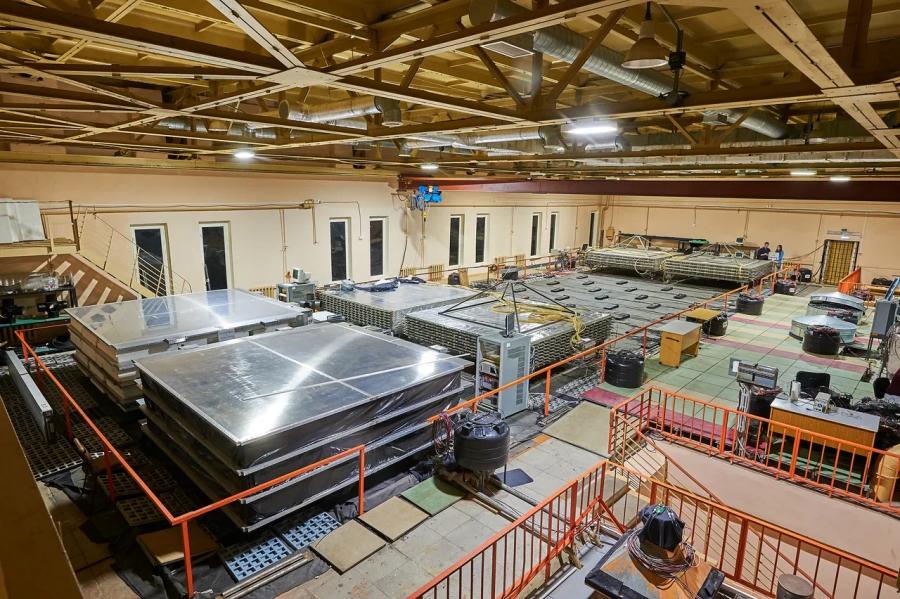
In November last year, the detectors of the Experimental complex NEVOD, located at MEPhI, recorded a powerful surge of secondary cosmic radiation. This event, called GLE 77, was the first in history to be recorded by devices that were originally designed to solve problems of fundamental physics. An article about this has been published in the latest issue of the Astrophysical Journal .
What happened and why is it important?
Imagine: The Sun threw out a powerful stream of particles that rushed towards the Earth. When they crashed into the planet's atmosphere, a shower of secondary particles, including neutrons, was born. It was this wave that the SEINE detectors "saw". Such phenomena — they are called ground-based increases in the cosmic ray flux, or Ground Level Enhancement (GLE) — are quite rare. And here, for the first time, it was detected by two independent installations, consisting of a total of 108 neutron detectors.
The increase began almost simultaneously at two installations — PRISMA-36 and URANUS — at 10:15 GMT. The jump was sharp and obvious: on PRISMA, the neutron count jumped by 20 percent, on URANIUM — by 24 percent. These values were reached about an hour and a half after the start. For comparison, the standard neutron monitor at the Moscow station, which is located about thirty kilometers from MEPhI, showed an increase of about 20 percent. It's almost a perfect match. And in Antarctica, at the SOPO station, the instruments showed a double excess over the background by more than 100 percent. This dual nature of the event is of particular interest from the point of view of studying solar activity.
How does it work?
The main trick of the MEPhI installations is a special scintillator. It is a substance that, when hit by a neutron, flares up differently than from a charged particle. The glow lasts longer, and the electronics manage to distinguish the "right" signal from the background noise. Roughly speaking, the detector sees the difference between a hammer blow and a light touch of the palm — and records only what looks like a hammer.
The PRISMA-36 installation is hidden inside the building, under a concrete roof. URANUS, on the contrary, stands on roofs in the open air — this explains the slightly higher response, it does not interfere with the overlap.
The GLE 77 event was triggered by an X5.1 class solar flare, which is, by astronomical standards, a strong, though not exceptional event. The GOES satellite recorded its beginning at 09:49 UT, the peak at 10:04, and already at 10:10 the Earth's instruments began to feel the breath of the star. The stream of particles from the Sun was large enough and had such energy that it not only generated nuclear reactions in the atmosphere, but flashed it to the surface of the Earth. The detectors registered the echoes of these processes in the form of neutrons.
The GLE 77 event was triggered by an X5.1 class solar flare, which is, by astronomical standards, a strong, though not exceptional event. The GOES satellite recorded its beginning at 09:49 UT, the peak at 10:04, and already at 10:10 the Earth's instruments began to feel the breath of the star. The stream of particles from the Sun was large enough and had such energy that it not only generated nuclear reactions in the atmosphere, but flashed it to the surface of the Earth. The detectors registered the echoes of these processes in the form of neutrons.