A third-year student of the National Research Nuclear University MEPhI (Russia) Dmitry Sevastyanov has invented a device for the detection of hydrocarbon gases on the basis of a smartphone.
The device can be used by any person, who assumes that there are fumes in the predisposed for it premises. Primarily the device is intended for the staff who conducts various works in the basement areas of buildings, constructions and engineering communications. In case of poor ventilation these places are subjected to the potential danger of hydrocarbon gases accumulation.
The device allows to identify and determine the concentration of such hazardous and flammable gases like methane, propane, carbon monoxide, and hydrogen. The cost of the proposed device is far below of used at the enterprises portable gas analyzers. Currently, organisations use expensive analyzers to determine the volume ratio of dangerous gases and vapors in the air. Along with them, they use individual gas analyzers designed for measurement of concentration of only one or two gases at time.
"The device of Dmitry Sevastyanov allows to determine concentration of several gases (propane, methane, hydrogen, carbon monoxide), as well as to measure some physical parameters like temperature or humidity," notes his scientific supervisor, Associate Professor at the National Research Nuclear University MEPhI Natalia Ermolaeva.
According to the inventor, the mediation device is made on the basis of microcontroller module RobotDyn UNO – an Arduino UNO analog which is fully compatible with Android OS.
"The device consists of three hardware tools: a smartphone; a mediation device (Arduino module) in conjunction with sensors and a communication channel of the Arduino module with your smartphone,” describes his invention Dmitriy Sevastiyanov.
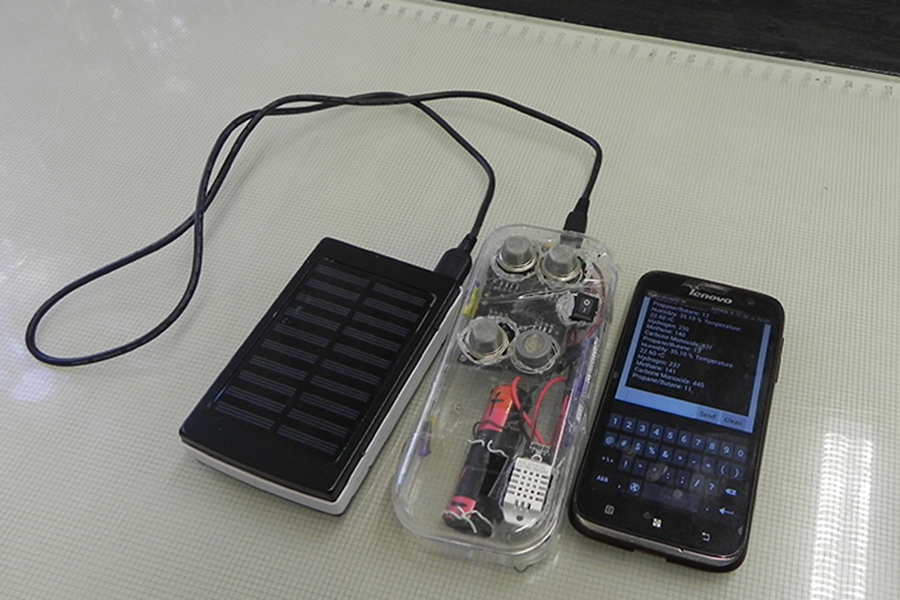
A smartphone-based hydrocarbon gas detector
The devise is easy to operate. First, the module switches on and connects to the smartphone. At that time a dialog box appears on the smartphone where the user selects measured value, for example concentration of methane.
Received data is sent over communication channel to the Arduino module. The module activates an appropriate sensor (in our case, a sensor to measure gas concentration) and handles received data. The result of processing is sent to smartphone and displayed on its screen.
Then, in the absence of commands from the user, the device cyclically makes measurement of the gas concentration. If the user selects a different measured value (for example, concentration of propane), the device will cyclically measure this value by the same algorithm.
Measuring functionality of the device is defined by a set of sensors connected to the module. It supports simultaneous operation of five sensors, each of which can be replaced by the principle of modularity. When you install a new sensor it is just need to modify the code and reprogram the module.