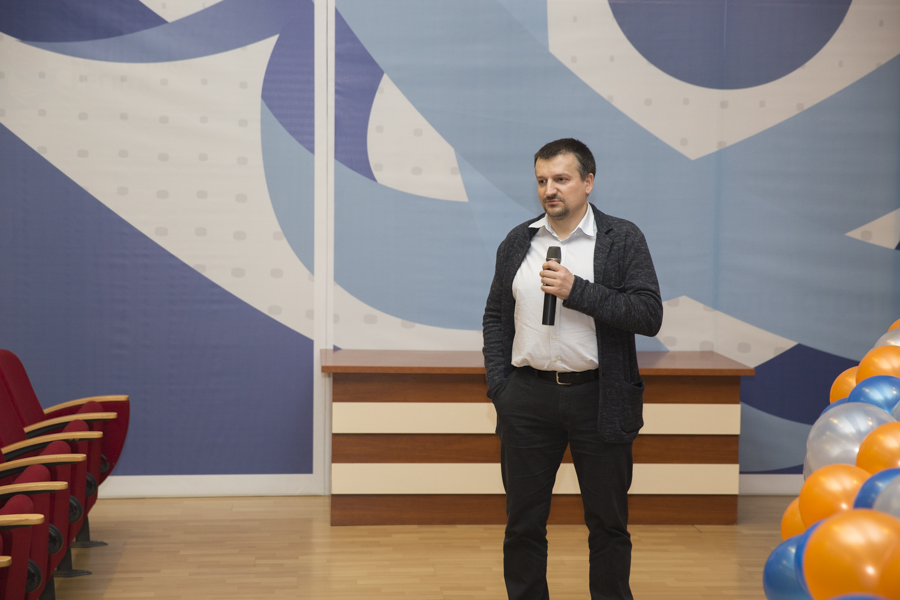
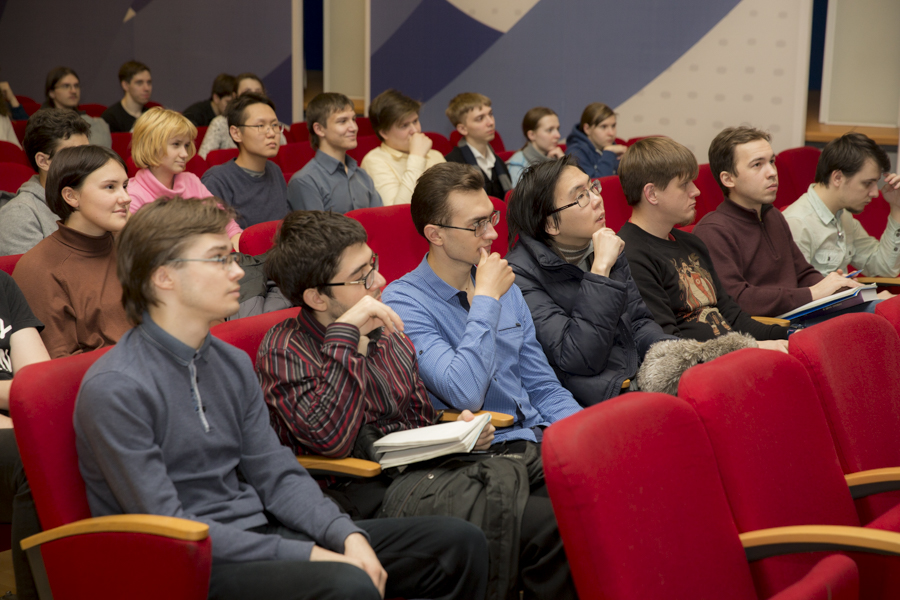
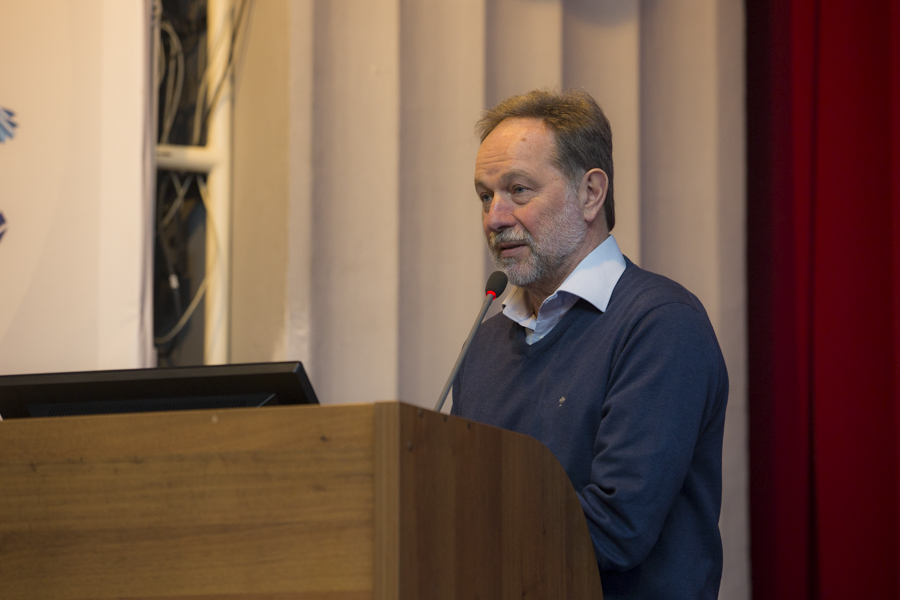
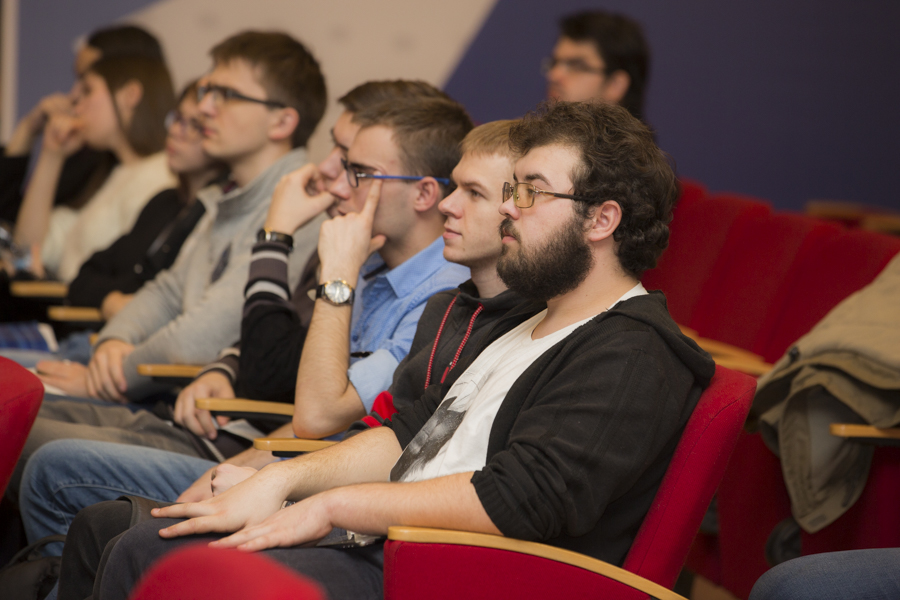
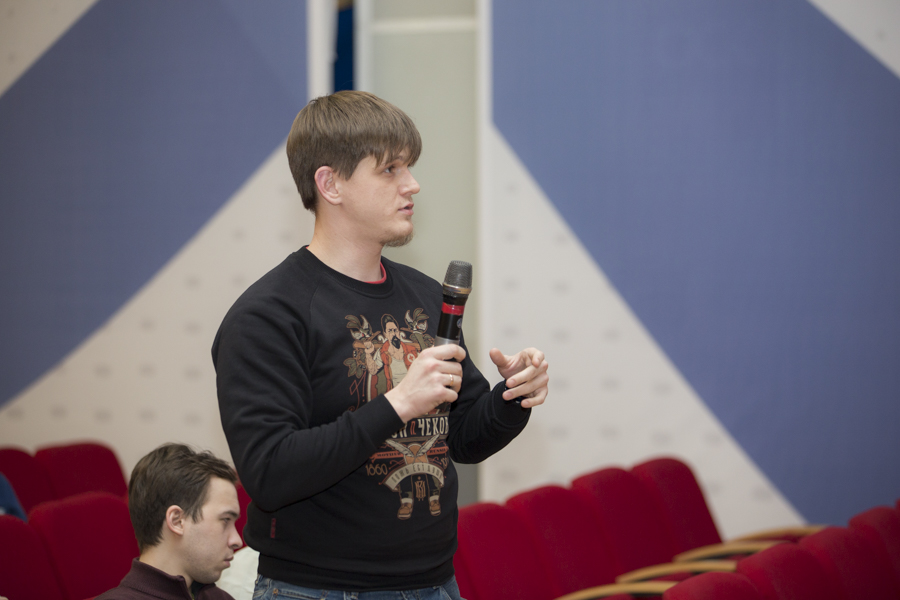
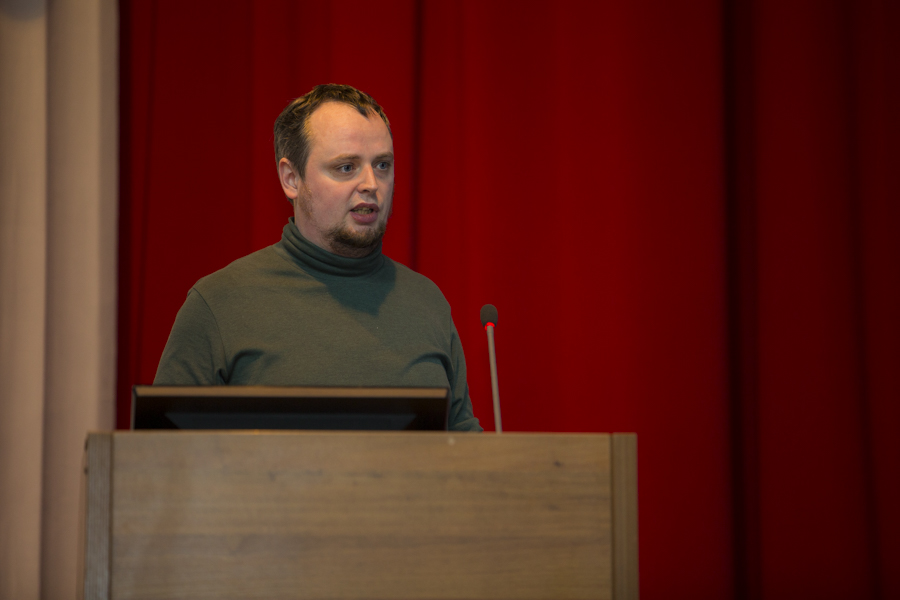
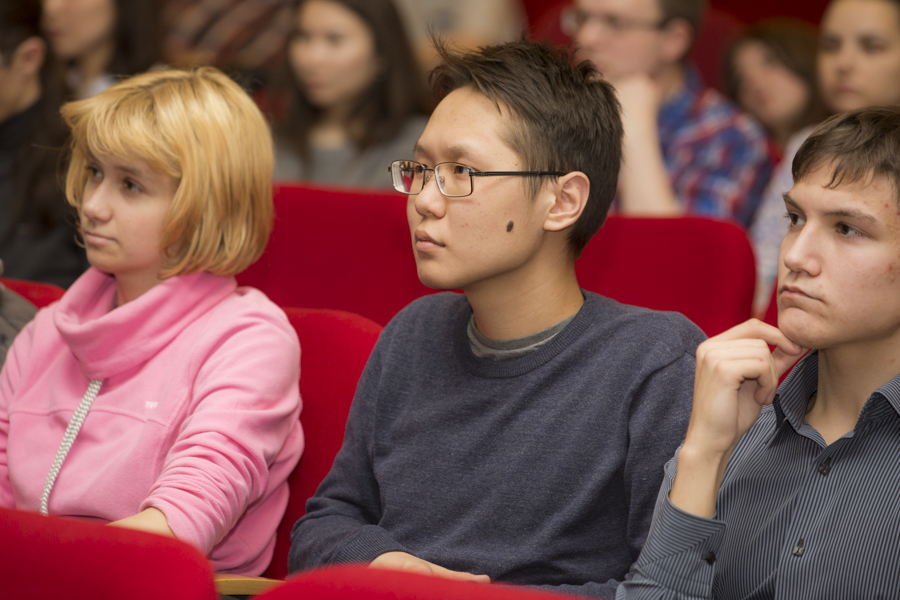
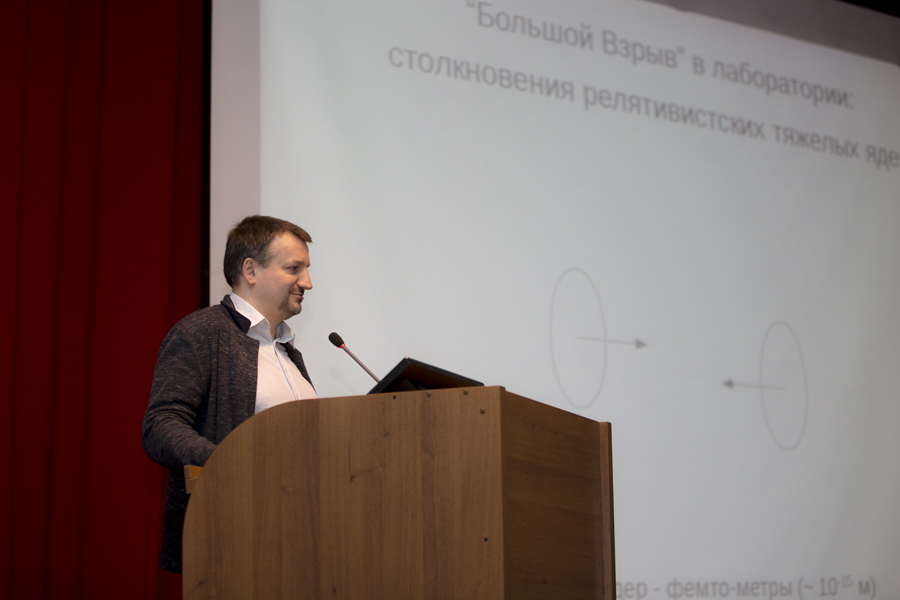
On the 1st of March the head of the international CBM collaboration (FAIR, Germany) Professor Peter Senger has held a public lecture on “Research programme of the mega-science projects CBM at FAIR and MPD at NICA” in MEPhI.
CMB collaboration (Compressed Baryonic Matter) involves Russian research centers and institutes, including MEPhI. Up to date, Russia's participation in the FAIR was more about technical support, for example, construction of the detectors, magnets and electronics. The previous visit of Peter Senger in MEPhI was aimed at strengthening of cooperation in the field of physical modelling and data analysis. It was decided to create a special group whose main participants should be young researchers, students, masters and postgraduates of the University.
So the lecture was focused on students and postgraduates who are interested in a successful academic career and research work in the analysis of experimental data obtained at the mega-science installations, in the modeling of physical processes, study of detectors efficiency and preparation of software packages for the analysis of large amounts of data (Big Data).
During the lecture Peter Senger told about the latest news on development of a universal detector CBM (Compressed Baryonic Matter) for the future accelerator complex FAIR and gave a brief overview of the program of the multipurpose detector at the future Collider NICA (Russia).
The research program of these experiments includes studies of extreme states of nuclear matter and phase transition to the quark-gluon plasma at high baryon density in nucleus-nucleus collisions; study of the structure and state equation of baryonic matter at densities comparable to the density of the cores of neutron stars; search for the boundaries between phases of baryon and quark-gluon matter; search for critical points and signs of restoration of chiral symmetry at high baryon density.
After the lecture, Associate Professor of the MEPhI Department №67 “Condensed matter physics”, the GSI employee I.V. Selyuzhenkov made a presentation on “Data processing in mega-science projects”.
A group headed by I.V. Selyuzhenkov is involved in several ongoing mega-science projects at the European centre for nuclear research CERN (Switzerland), Brookhavens national laboratory BNL (USA), GSI Helmholtz Centre for Heavy Ion Research (Germany), as well as in the preparation of future experiments at the Joint Institute for Nuclear Research JINR (Russia) and the Facility for Antiproton and Ion Research FAIR (Germany).
An employee of the Kurchatov Institute, who is also the engineer of the MEPhI Department №67, D.S. Blau told about the joint activities of MEPhI and Kurchatov Institute in international megaprojects ALICE (CERN) and CBM (FAIR, GSI) in data analysis and modelling. It should be noted that a joint study of heavy ion collisions and the quark-gluon plasma was highly appreciated by President Vladimir Putin and the Presidential Council for science and education – this year D.S. Blau became the laureate of the prize of the President of the Russian Federation.
In their reports speakers illustrated the opportunities that students receive participating in mega-science projects. In particular, it is an inexhaustible source of new questions in physics and cognition of the surrounding world; the long-term prospects for academic careers that ensure long-term international projects in Europe, USA and Russia; work in international collaborations. In addition, students acquire applied skills, such as programming, BigData analysis, can practice “scientific” English, receive ability to present and defend their results, prepare scientific publications, participate in international conferences, etc.
It should be reminded that the international scientific group MEPhI – GSI has announced a competitive recruitment of students, postgraduates and young scientists.