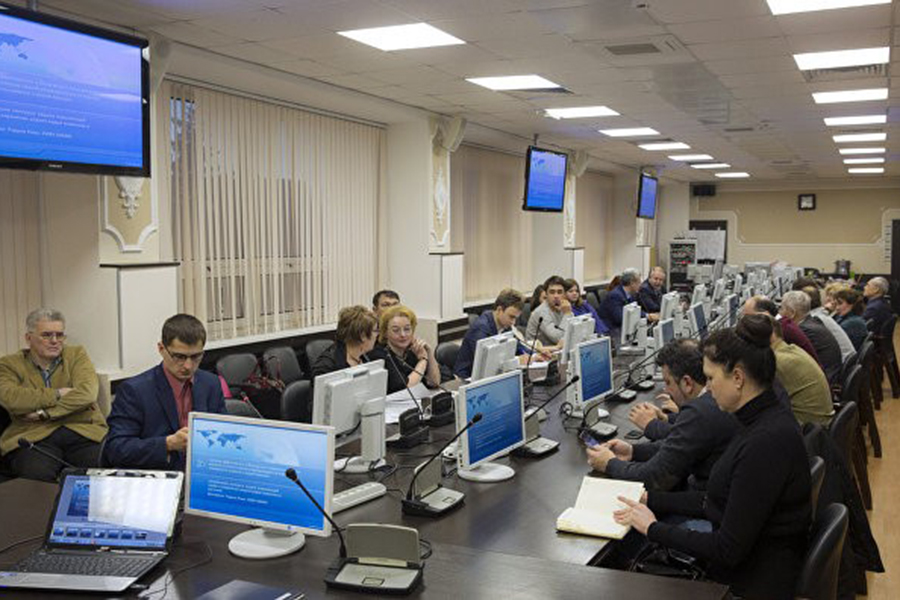
A meeting of university employees with representatives of project “Polar expedition “Kartesh” was held in MEPhI. Guests of the roundtable exchanged suggestions on cooperation in questions of the Arctic research.
A possibility of creation of the Arctic research on the basis of the university was discussed in December, and in the end of the last year an interuniversity contest of research works “MEPhI-Arctic” was announced, for participation in which it is necessary to suggest the idea of research of the Russian Arctic. The winners of the contest will take part in expeditions on “Kartesh” and will be able to realise their research projects.\
“Currently, no Russian university has a research fleet, able to conduct scientific work in the sea, not to mention the Arctic zone, it requires separate, very complicated events on the preparation of the vessel, crew, and research group,” said the Head of the project “Polar expedition “Kartesh” Sergey Bedash. He plans that in the future representatives of several universities will be able to take part in expeditions on “Kartesh”. The Heads of the expedition named 14 priority directions of scientific research in the Arctic: studying of air, water, ice, Ocean bottom, beachline, bioresources; Arctic medicine; engineering maintenance of economic activity and others. It is planned that in 2017 the vessel, on which scientists will be able to realise their project, will walk about 8000 nautical miles.
The Executive Head of the Centre of Marine Research at MSU Nikolay Shabalin, who participated in expeditions on “Kartesh”, noted that in Russia there is a lack of technologies of its own production, because of sanctions it is impossible to buy modern foreign equipment, and the developments of Russian engineers are at the level of the early 90-s of the XXth century. “MEPhI could overcome this gap. Material-technical basis is necessary for it, and MEPhI is one of a few universities which has it,” Shabalin thinks.
Associate Professor at the Department of Molecular Physics Alexey Sysoev has offered to study mass-spectrometry of isotopes in the Arctic. According to scientist, the study of bone and otoliths of fish, which are constantly in the same area, for the reconstruction of the anthropological impact may be prospective. Also, the Department offers to study the elemental composition of the environment and determine the origin of the contamination, using samples of water and ice, for further analysis in laboratories of MEPhI.
The Department of construction of devices and facilities has put forward an idea of creating a group of drones to detect oil spills. Apparatuses form a network, within which information is transmitted and sent to the operator for the prompt response. For the development of such a network a scientist needs about two years. However, the apparatuses are not able to detect the oil spill under the ice or in the ice.
Several ideas were proposed by the Department of Physical Problems and Materials, and their practice in the development of materials for extreme conditions has been confirmed by experience of cooperation with "Gazprom". Thus, they proposed to create a main pipe with layered texture inhomogeneity to reduce stress corrosion cracking and to develop materials with shape memory for repairing equipment in Arctic conditions, fast-quenched alloys for creation of a permanent link and repair, special steel with high corrosion wear resistance (can be used for cladding corpuses of reactors at oil platforms or drilling rigs).
Department of Biomedical Photonics suggested the idea of remote monitoring of the state of the waters of the Arctic seas, by the method of pulsed fluorescence filming in the near infrared range. Scientists propose, using a laser, placed on unmanned vehicles, to excite phytoplankton of chlorophyll in the Arctic seas. This method will make the assessment of the area.
Department of Laser Physics proposed a method for the absorption of IR spectroscopy, using a Fourier spectrometer. Such remote sensing will provide information on the state of CO gas, CO2, N2O, NO, NO2, SO2 and Arctic atmosphere in real time.
All proposed projects will be discussed with the Heads of "Polar expedition" Kartesh". Perhaps, during the expedition of 2017, some ideas will be brought to life that will promote the development of this promising trend at the university.