MEPhI and leading scientist Yuriy Rakovich, Professor at the University of the Basque Country and Donostia International Physics Center in San Sebastián (Spain) have won in the fifth contest for getting mega-grants of the RF Government. Professor Yuriy Rakovich is a famous scientist in physics of nanosystems, specialist in creation of plasmonic and hybrid structures, studying of linear and nonlinear effects in these structures, and usage of optical effects in sensing.
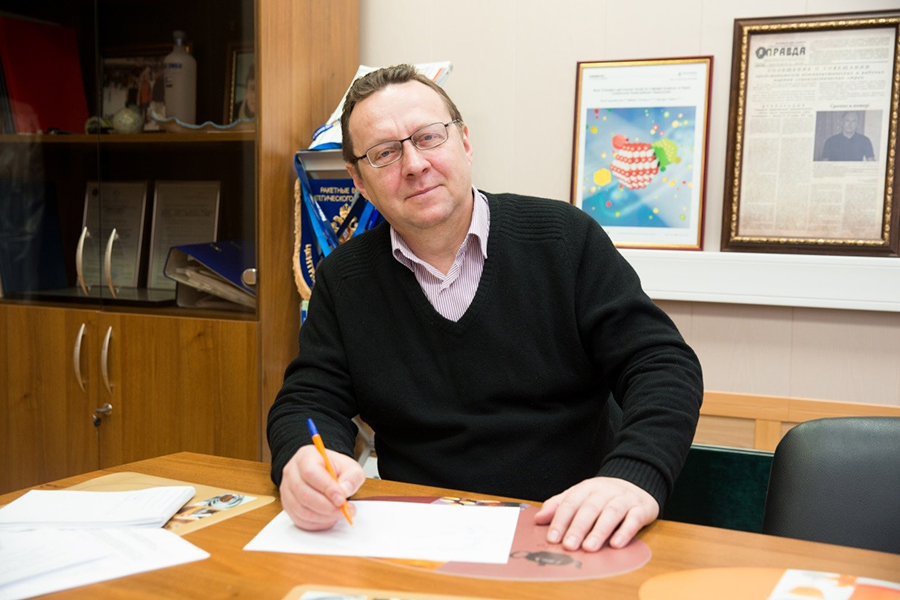
The Laboratory of Hybrid Photonic Nanomaterials, created under the supervision of the scientist, will make a unique “supremacy cluster” with the Laboratory of nano-bioengineering as a part of MEPhI Engineering-physical institute of biomedicine.
Integration of different scientific approaches, mutually adding and strengthening each other, significantly enhances the possibility of finding new effective methods of early diagnostics and treatment of different diseases, the scientist thinks. It has been proved that the most effective practice is scientific cooperation of scientists from different directions, for example, when physicists, biologists, and even philosophers unite for successful solution of some tasks.
The necessity of such practice has been mentioned at the meeting of the President of the RF with leading scientists, who get mega-grants for conducting scientific research in scientific and research institutions of the RF. Vladimir Putin said that the idea of cluster creation contains an attempt to organize at the multidisciplinary level interactive and the most effective approach to solving concrete scientific tasks.
The Head of the Laboratory Yuriy Rakovich spoke about the idea of the “supremacy cluster” creation in MEPhI and concrete developments, planned to be conducted for mega-grant means.
- I studied at the Department of nuclear physics of Belarusian State University, my PhD was about optical properties of nanomaterials. I worked at the University of Braga (Portugal), Trinity College (Dublin, Ireland), and since 2006 I have been Professor at the Faculty of physics of materials at the University of the Basque Country in San Sebastián (Spain). Our scientific cooperation with the Professor of the University of Reims (France) Igor Nabiev, who is currently the Head of Nano bioengineering Laboratory in MEPhI, started in early 2005, when we conducted a series of joint breakthrough works, which showed the possibility of the impact, with the help of nanostructures, on different aspect of biological systems’ functioning. So, when I learnt about the new wave of mega-grants’ competition, I decided to take part in it, to continue cooperation with Professor Nabiev within the supremacy cluster of mega-grant laboratories. I also knew that MEPhI provides opportunities for researchers, but, when I came to the University, I was struck by the level of equipment in the Laboratory of Bioengineering, created by Professor Nabiev, which, in my view, meets all the highest standards of modern Western laboratories.
Areas of research, that will be conducted in my laboratory of hybrid photonic nanomaterials, are related to sensory, i.e. determination of various biomarkers via phonon methods, as well as the creation of nanotechnology systems, which can directionally affect the properties of the selected biological systems. There are different approaches. The existing nano-bioengineering laboratory is engaged in semiconductor nanoparticles, while my laboratory creates a toxic metal (plasmon) structure connected with organic molecules. One use of such systems is the point delivery of the medicine to a place or cell in organism, affected by disease. So, we had done the work in which we took the aspirin molecules, tied them to nanoparticles and launched into the body of the mouse. And we showed that you can keep track of where the aspirin is moving up to the molecule.
The difference of my approach is that I'm trying to create a unique sensory system, which is based on the idea of so-called strong coupling. Strong connection is the situation, when you create a new hybrid state of matter. For example, a hybrid electronic or vibrational state of light and matter on which the light falls. If we make right resonance conditions, it will be neither light nor substance, but an intermediate state, which will have altered properties. Moreover, these properties of the substance can be controlled by using optical radiation (light).
In my laboratory of hybrid photonic nanomaterials competitive recruitment of MEPhI undergraduate and graduate students has been announced. Several successful candidates have already been enrolled in the lab for probation. Among the main selection criteria are not only excellent marks in MEPhI, but also a good level of English language, motivation and autonomy in achieving academic goals.
And, finally, the main reason why I decided to create the lab in MEPhI. Today, clearly, MEPhI is becoming one of the strongest universities in the world that provides an excellent education for students and graduate students in that particular field of science, which I do. So, the creation of the laboratory here, allows me quickly achieve the goals.
It should be added that the getting of mega-grant by Professor Yuriy Rakovich was not easy. The competition was extremely high: 542 leading scientists from 45 countries participated in the competition for 40 mega-grants (for all areas of scientific disciplines). Only two mega-grants have been allocated to research in the field of nanotechnology, the area, in which the project of Professor Yuriy Rakovich has won.