An optimized THz photoconducting antenna has been worked out in INTEL MEPhI. The device together with an optical setup will find application in non-contact medical diagnostics and at customs control for devices of identification and detection of plastic explosives, dangerous chemicals and drugs.
Currently, security control in public places provokes the development of methods of distant detection of explosives and other dangerous substances. The molecules of these specific organic substances have rotating and shared vibrational absorption lines in the THz frequency range which explains presence of characteristic spectral peculiarities in this field, by which they can be identified.
The development of THz-band from the point of view of technologies and devices has started recently, and applied research, aimed at raising of the efficiency and compactness of THz devices, are currently central.
“It turned out that existing commercial analogues - Zomega, Batop – fall behind a bit in parametres of photocurrent efficiency of transformation to THz capacity, which makes our device competitive. As the result of absence of commercial THz radiators in Russia, our project and its realization as an example of functioning oscillator will undoubtedly have positive influence on import phase-out,” said the Department of condensed matter physics Master’s degree student Sergey Nomoev.
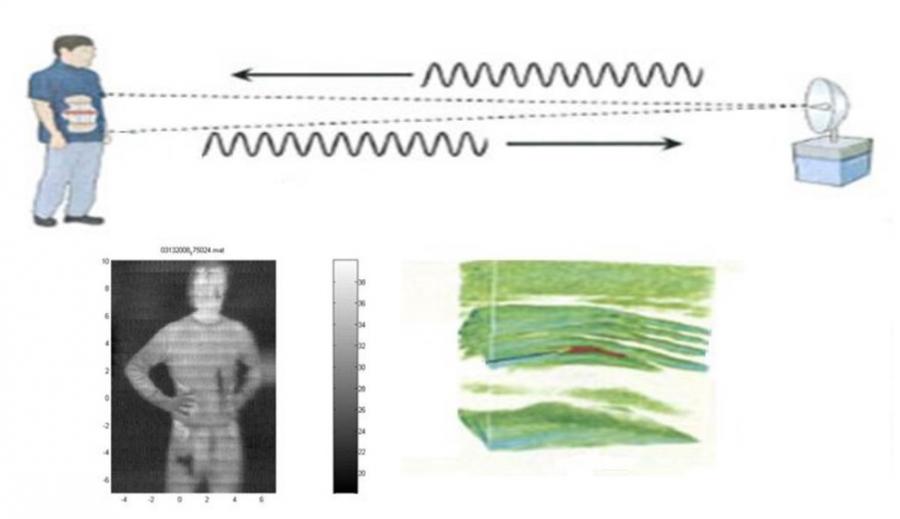
Explosives, hidden behind several layers of clothes, have been detected with the help of THz technology. THz picture detects hidden pistol
Moreover, THz technology unlike X-Ray radiation doesn’t ionize substance and doesn’t harm DNA molecules. Some frequencies of THz band can penetrate into biological tissue from the distance of several centimeters and reflect back. THz viewing allows detect epithelial cancer with the help of safer and less aggressive diagnostic systems. Also some systems of THz waves can be applied in stomatology for safer and more exact tooth picture than usual X-Ray analysis.
Thus, THz technology is a safe alternative to X-Ray methods of control and could significantly change the market of diagnostical medical equipment.