The Universe symmetries play a fundamental role in theoretical physics, as conservation law corresponds to each symmetry. For example, the homogeneity of time has a correspondence of the energy conservation principle; isotropy of space - law of conservation of angular momentum. In physics of elementary particles symmetries define possible interactions between particles.
One of the points of interest of quantum theories is symmetry violations, common for classical theories. For the first time such violation was detected while trying to calculate the width of decay of π0-meson into 2 photons: it turned out to be significantly larger than it was expected, on the grounds of symmetry between particles with positive and negative spin projections on the direction of movement (between “right” and “left” particles). This divergence was called chiral anomaly.
For the past 30 years chiral anomaly has been well-studied both from theoretical and experimental sides. However, until now there has been no experiment, where its influence could be observed directly, only as a part of other processes. Currently, such experiment is conducted in Serpukhov, in which probabilities of reaction K+ γ → K+ π0 and K+ γ → K0 π+are measured. Chiral anomaly makes a contribution to the first reaction, but its contribution is absolutely reduced to the second one. In the field of low energies the chiral anomaly contribution is dominating, and, in comparison of these reactions, it will manifest in the growing number of birth events of a neutral pi-meson.
Department №7 of experimental nuclear physics and cosmophysics employees M.I.Visotskiy and E.V.Zhemchugov have calculated reaction cross sections and made a theoretical prediction for the experiment results.
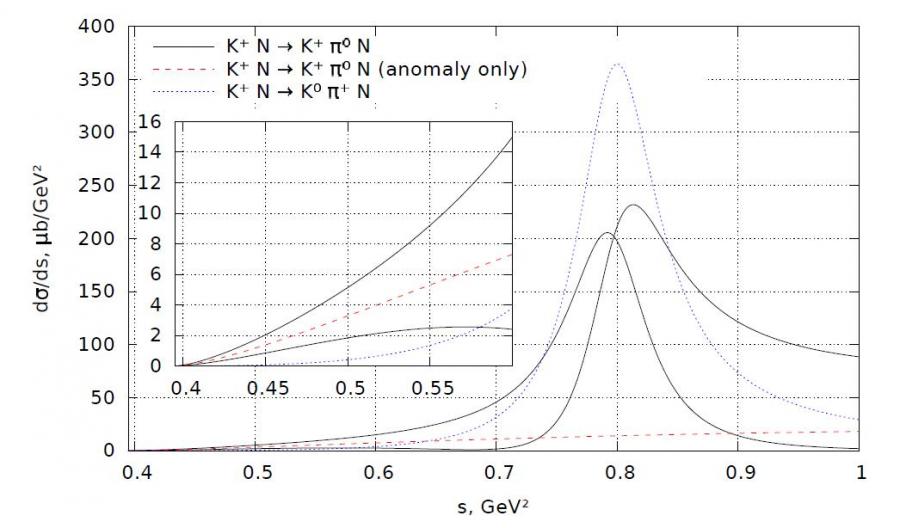
The difference of cross-sections depending on reaction. N – nucleus of 63Cu.
The results have been published in the «Physical Review D» in the article “Search for chiral anomaly in Kγ → Kπ reactions”.