Transition Radiation Tracker (TRT) is part of the ATLAS Inner Detector at the CERN LHC. Basic tracker element is named «straw». «Straw» is a simple gas detector: a long thin (~ 1 m in length) drift tube filled with a gas mixture. Anode is gold-plated tungsten wire passed inside the tube. Conductive layer on the inner surface of drift tube functions as cathode.
The principle of operation is simple: particle ionizes gas mixture and electrons which generated under the influence of a strong electric field drift to the anode and make a signal. The electric field inside the tube creates a potential about 1.5 kV.

Gaseous detector construction: 1 – anode, 2 – cathode, 3 – isolation, 4 – track
The TRT consists of about 350000 drift tubes, and scientists, receiving a signal from each reacted element, can not only determine particle, but also recreate its track.
An important factor for TRT work is correct gain of each drift tube. To control gain coefficient scientists, including scientific group from MEPhI, developed the Gas Gain Stabilization System (GGSS).
GGSS adjusts voltage depending on external factors and particle parameters. For example, when temperature in the tube changed, GGSS changes voltage on the correction value. Thereby gain coefficient is adaptively changing.
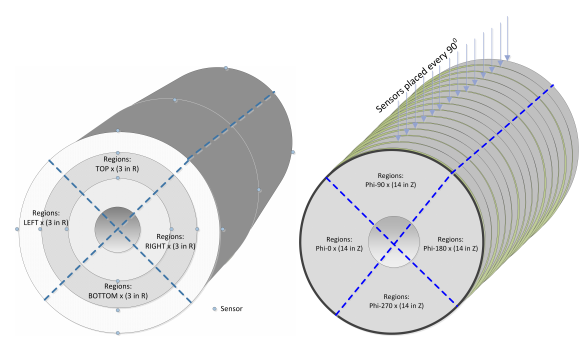
Temperature sensors disposition in TRT
GGSS also provides high voltage correction depending on the particle parameters. If peak after spectrum fitting is out of range, system reduces voltage, otherwise increases.
The system showed excellent performance during Run I (the first LHC work session) and currently continues to work in Run II.
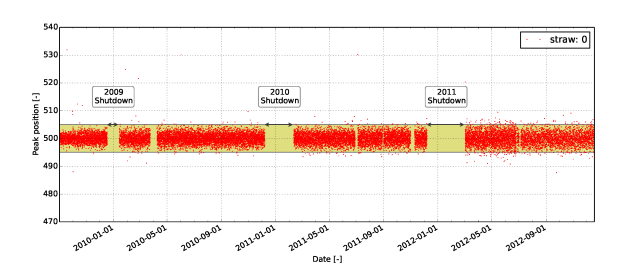
Peak position during the period from 09.2009 to 01.2013
Full text of the article is available here: http://iopscience.iop.org/article/10.1088/1748-0221/11/04/P04027/pdf