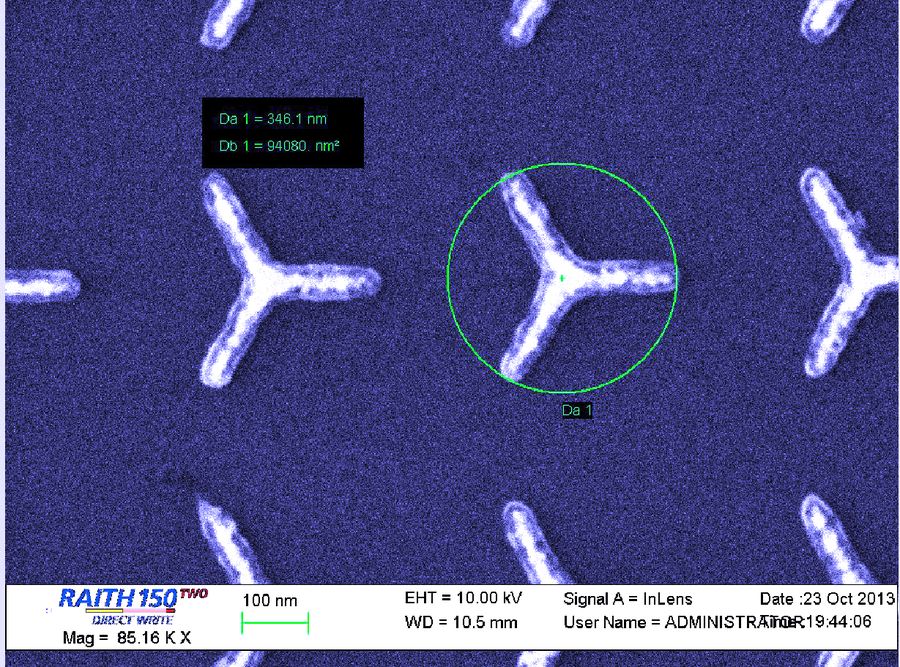
Scientists of MEPhI Institute of functional nuclear electronics and the University of Georgia (the USA) together have developed a new technology for creation of magnetic memory elements of nanometer sizes, which can be applied in cosmic and military equipment. The results of work have been published in the prestigious world scientific publication Journal of Applied Physics.
New magnetic elements are triangles with sides of several hundreds of nanometers, consisting of iron-nickel alloy. One of the main peculiarities of the new elements is that magnetic properties can be managed, changing the form of the triangle nanostructure – sides’ concavity and tops’ elongation. Such magnetic nanostructure can function as a logic cell because state of magnetization in its top is explained by the magnetization of two other tops.
Connection of nanomagnetic structures into a system (bidimensional chains) gives an opportunity to create an array of logic and memory, in which information readout happens with the usage of so-called magnet-tunneling contacts at nanostructure angles.
The advantages of logic and memory arrays on the basis of magnetic nanostructures are radiation resistance, high stability of information storage and energy efficiency. Their power consumption is supposed to be 0.1 microwatt, which is an order less than the power of the logic cell on the basis of CMOS transistors.
Logic/memory cell on the basis of a “nanotriangle” can be successfully used in cosmic and military industries, because it does not only have radiation resistance but also a small size. It can also be used in domestic sphere (in cell phones, computers), which will significantly lower energy consumption.