Relativistic magnetohydrodynamic (MHD) flows have turned out to be very effective for acceleration of particles and creation of jet emissions which can spread up to 100 kiloparsec (nearly 10 times more than the size of our Galaxy). MEPhI Department of molecular physics (№ 10) under the supervision of Professor of the Centre “Physics of nonequilibrium atomic systems and composites” F.A. Agaronian is realizing a project of the Russian scientific foundation “Properties of relativistic MHD flows and their influence on the acceleration of particles and generation of ultrahard radiation near black holes and pulsars”.
In 2015 H.E.S.S. collaboration, the member of which is F.A. Agaronian, represented results of observation of gamma radiation of ultrahigh energies from the galactic center at the International Conference on Cosmic Rays (Holland). Spectral properties and spatial division of the brightness let us assume that the radiation is generated by the protons of ultrahigh energies. For creation of such radiation primary range of high-energy protons should spread to energies of petaelectronvolt order. The power of this accelerator can reach up to 1040 erg/sec.
The participants of the project suggest to model in details processes which should be related to the interpretation of observed data H.E.S.S. The modelling includes 2D and 3D magnetohydrodynamic description of the wind formed by the substance flow from the accretion disk around supermassive black hole in the centre of Galaxy. To check the relevance of received MHD calculations for solving the problem of creation of cosmic rays, the acceleration of particles in detected hydrodynamic structures will be modelled.
The work is concentrated on two phenomena opened lately under the observation of pulsars. The employees of the project are planning to concentrate on the possibilities of regular plasma acceleration in chosen magnetosphere areas found in the work of MEPhI Professor Sergey Bogovalov (MNRAS, 2014) and under acceleration in current sheets formed in pulsar wind.
The group of scientists intents to detect the mechanism of cosmic rays’ acceleration by supermassive black holes. The solution of this issue is of high importance for solving the task of galactic cosmic rays’ origin. The data of H.E.S.S. observations allow assume that the biggest part of cosmic rays with the energy of less than 1 PeV is accelerated by central SMBH. If the conclusion turns out to be right, it will change the idea about the processes of cosmic rays’ acceleration by galactic sources and origin of cosmic rays in general.
“As a part of this project we suggest to check the prognosis more in detail with the help of modelling of pulsar wind and to compare the expected picture of radiation with the most relevant observed data”, noted Felix Agaronian.
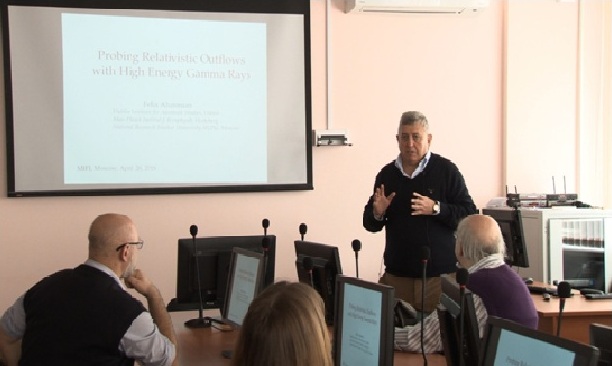
Above: Professor Agaronian gives a lecture to MEPhI employees and students
The energy question is actively discussed in Russia. As S.V. Bogovalov said, during the research interesting mechanisms can be found out, which provide for transformation of some forms of energy into another with phenomenal efficiency. It can have direct significance in application.
The project is conducted as a part of the International laboratory of extreme hydrodynamics, the supervisor of which is S.V. Bogovalov. According to the words of the CEO of the Centre “Physics of nonequilibrium atomic systems and composites” K.P. Alexeev, “this is a good realization of the Program of the university competitiveness raising, when together with foreign scientists we create laboratories of high level aimed at solving of fundamental problems and creation of energy technologies of the future”.