The development of high technology is closely connected with the miniaturization of actuating elements and micromechanical devices on their basis. Alloys, demonstrating the shape memory effect and ultra-elasticity, are perfect for completion of these tasks.
Existing micromanipulators are mostly technically complicated devices, requiring relatively large space and significant financial sources for installation, which impedes their large-scale implementation into production. That is why the creation of new microdevices based on other principles of work are of great interest.
Employees of the Department “Physics of solid body and nanosystems” (Associate Professor, PhD in physics and mathematics A.V. Sheliakov and student getting Master’s degree D.A. Rozhkov) have worked out a prototype of microgripper (microtweezers) on the basis of the reversible shape memory effect. For creation of microgripper TiNiCu alloy was used, received by the method of quenching from a fusion like an amorphic-crystal band nearly 40 μm thick, which tests the curve of the reversible shape memory effect.
Two 400-500 μm wide elements made from this band were connected so that the clearance space between them was from 20 to 100 μm in initial state, and under the heating higher than the temperature of reverse martensic transformation end the microgripper was close-ended. The grip length was nearly 800 μm.
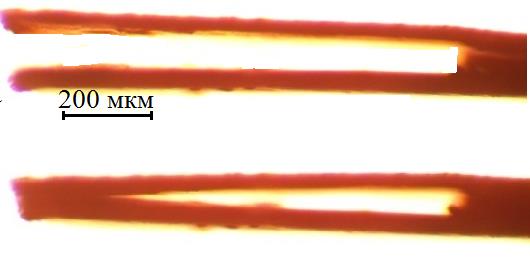
Fig.1. Visual appearance of microgripper in open and close conditions
In the work temporary functional characteristics of the twiggers were researched, and the connection between maximum switching frequency and fixed temperature scenarios was defined. It has been shown that the speed of microtwiggers’ operation depends a lot on the temperature of heating as well as prewarming. Under the optimal mode of manipulation the time of microgripping operation was nearly 1 sec.
“Existing analogues have a much more complicated construction and manipulation system, and larger sizes of microtwiggers’ grip. Moreover, our development allows precisely vary the width of grip for manipulation by microobjects of different size”, - claimed Denis Rozhkov.
The developed microtwiggers can be used, in particular, in microelectronics, robotics and microbiology to capture and replace microobjects of different origin of size from 1 to 100 μm.