Student of “Laser physics” Chair Daniil Ganin together with Physics Instrumentation Centre, RSA, Troitsk has worked out a technology and created a prototype of precision cutting machine for transparent materials including polymer coronary stents.
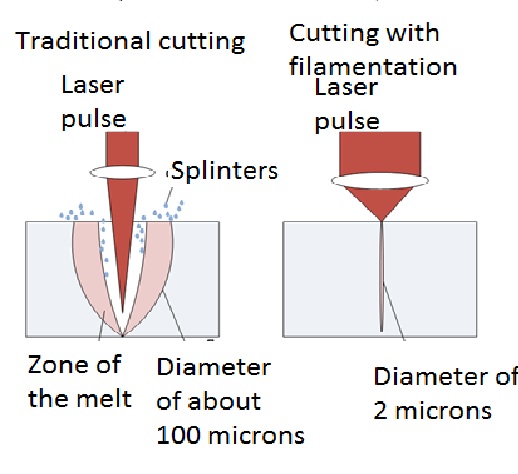
Nowadays transparent materials are cut by layer-by-layer laser ablation. The cutting width is not less than 30 microns. Materials can melt, the conicity of sections is large, and a small part of laser energy is absorbed by the substance. Moreover, it is hard to change optical system without changing cutting parameters.
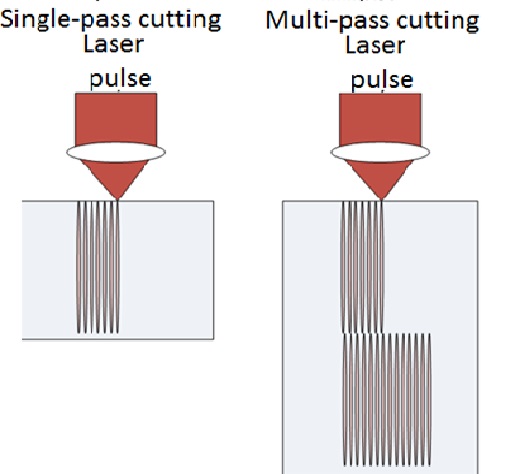
In the created technology processes of laser radiation filamentation are used (Kerr self-focusing, different types of spherical aberrations) in the volume of transparent dielectrics. In that case a radiation thread with the length of several microns and with a diameter of about two microns in the sample volume. Laser thread can be controlled by changing laser radiation parameters. Scanning the sample with this thread we can cut a sample of 100 microns at one pass. Herewith, the cutting width doesn’t exceed 5 microns. Energy efficiency is several times higher than in layer-by-layer laser ablation.
Nowadays the technology is successfully used in processing of quartz, glass, sapphire and different transparent polymers. Moreover, polymer stents have been cut from the material supplied by the largest Russian stent manufacturer. The implants are of a very high quality according to this company.
Biomedical technologies the development of which is directly related to human health is a dynamically developing sphere using femtosecond lasers. One of the main tasks of biomedical technologies is making coronary stents for treating coronary arteries. A stent is a tube from metal or polymer net placed in the affected artery for smooth blood circulation. The first stent approved for clinical practices appeared in USA in 1994. For the last decade laser technology of getting pipe materials has helped to create many commercial coronary stents.
Since then laser technics has developed significantly but the production of miniature devices still requires high-precise instruments. It has led to the creation of ultrashort pulse lasers in various spheres of technical sciences and in stent production.
Heat distortions which can be created by heat affected zone (HAZ) lead to cracking as the result of material fragility increasing. The quality of stents surface should be increased to avoid such cases.