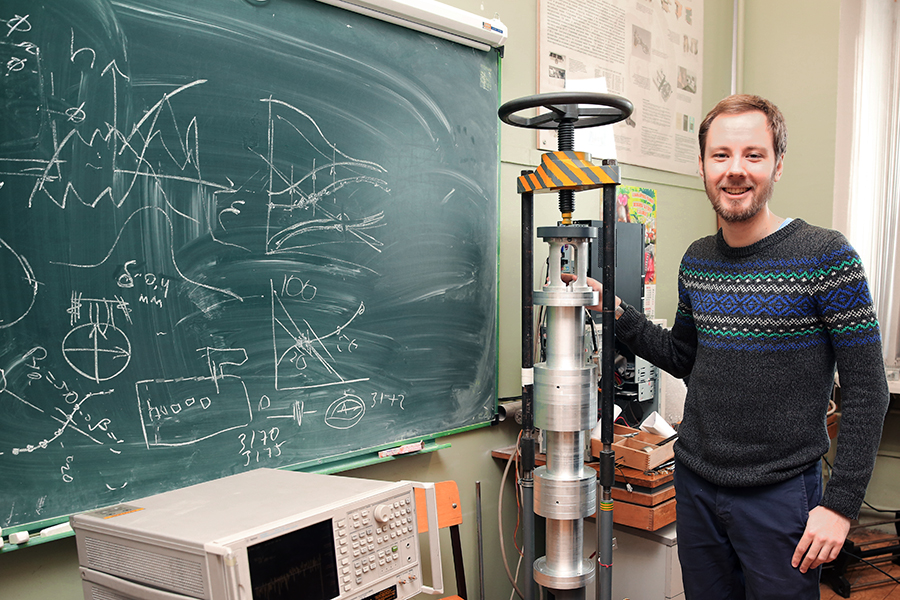
A post-graduate student of the Electrophysical facilities Department Yaroslav Shashkov has recently returned from 4-month internship in CERN. MEPhI has a long-term experience of participation in world collaborations doing research in particle physics, actively works with world’s largest scientific centres and organisations. For example, university employees work in the world's largest particle physics laboratory in the European Organization for Nuclear Research (CERN).
- Why did you choose to study in MEPhI?
- I can say that the LHC influenced my decision. At first I wanted to become an economist. But when in 2008 there was a talk on TV about the LHC start I got very interested. I started researching this topic and enterd the Electrophysical facilities Department. The accelerators are interesting because they unite different technologies for one purpose: vacuum and SHF technologies, magnets and plasma etc.
- Why were you offered the internship in CERN?
- 3 years ago our colleague from National Institute for Nuclear Physics in Fraskati (Italy) Mikhail Zobov offered our SHF laboratory to take part in the project of harmonic superconducting resonator development at 800 MHz for “The increasing of luminosity of the LHC (HL-LHC)” project. Luminosity is, roughly speaking, a number of collisions per time unit. The more it is, the quicker you get statistics and can confirm the Higgs boson discovery. Magnets, elements of vacuum system are replaced, so-called crab resonators are added in this project. My supervisor Nikolay Sobenin assigned me to do this project. We have designed several resonator design models and have performed detailed calculations of its parametres.
- For what purpose is the harmonic superconducting resonator development at 800 MHz used?
- It will be used for changing the beam length. It hasn’t been settled yet whether to increase or reduce it. Each of the regimes has its pros and cons. For example, enlargening can reduce significantly the amplitude of parasitic electromagnetic oscillations which the beam makes coming through any moment of the accelerator which may lead to the beam deviation and bumping into resonator walls. Parasitic waves should be taken into the load to avoid this so that they lose their energy.
- What problems have you faced during the research?
- There occurred a problem with the accelerating module of 800 MHz in SPS (Super Proton Synchrotron). CERN specialists made calculations which showed that the waves of the highest type have a significant role in the accelerating module with the growth of intensity and can put an end to the project of the growth of intensity.
- What are the results of your internship?
- We’ve made the documentation for the harmonic superconducting resonator working at 800 MHz construction. I’ve made a report at the 5th Joint HiLumi LHC-LARP Annual Meeting and submitted the findings at SRF’2015. We’ve started a new project as well.