The results of the competition for the development of student satellites, organized by the Ministry of Science and Higher Education of the Russian Federation, have been summed up. NRU MEPhI became one of the winners of the competitive selection! Grant support in the amount of more than 26 million rubles will be directed to the development of the innovative Svarog-2 space satellite and the creation of an open ecosystem for training personnel for the rocket and space industry at the university.
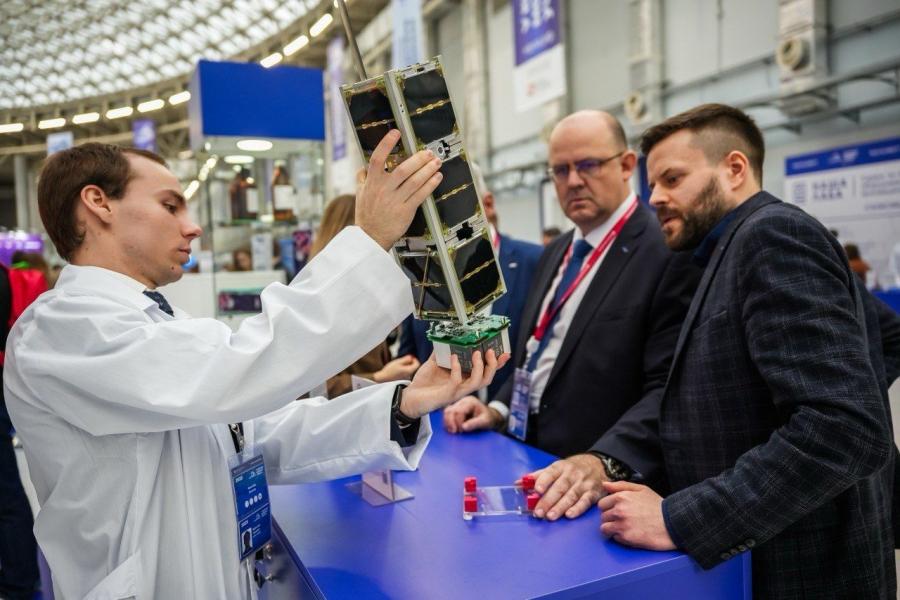
A large team of MEPhI scientists, which included students, scientists, engineers, mentors, experts from the university and the industrial partner of the project, undertook the implementation of the ambitious project to create a nanosatellite. The Center for Space Research and Technology, which was established at our university to address the major interdisciplinary challenges of the space industry, unites the competencies, technological groundwork and efforts of various university departments in achieving the goals of the project.
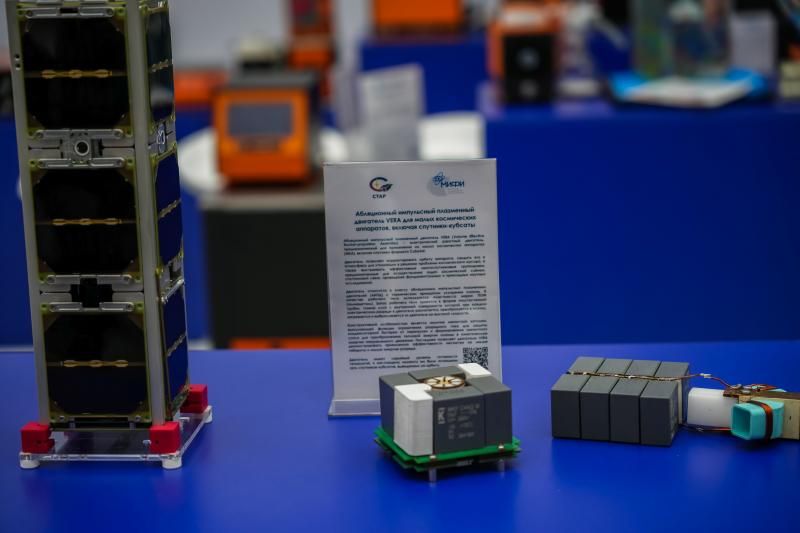
"As part of a grant from the Ministry of Education and Science, we will create the Svarog-2 cubesat satellite from scratch, with the help of students, graduate students, university staff and the industrial partner of the project. It will become the next satellite in the group of "mythical" cubesats and will also be equipped with the innovative VERA plasma engine and the NATALIA-2 gamma-ray spectrometer developed at MEPhI. The engine will be developed by the laboratory of plasma rocket engines of the Laplace Institute. The gamma-ray spectrometer is the Laboratory of Geospatial Research at INPiT (Department No. 7)," explained Evgeny Stepin, Director of the Center for Space Research and Technology at the National Research Nuclear University MEPhI.
One of the tasks of the satellite is to monitor gamma radiation of various nature, which today remains largely a mystery to scientists and is still of scientific interest.
"The appearance of the second Legacy series gamma-ray spectrometer in orbit will allow for joint data analysis of two independent instruments, which means that research on the nature of cosmic gamma-ray bursts (GRB), study the evolution of solar flare spectra, and verify millisecond terrestrial gamma-ray bursts (TGF) at a deeper level. In addition, the detectors will be able to monitor the radiation situation in near-Earth space, including observing dynamic processes in the Earth's magnetosphere. A plasma engine, also developed at MEPhI, will be placed on board, which will allow you to set the orientation of the device with an accuracy of 1 degree, which means that the spacecraft will be able to change the orbit, which gives uniqueness to the expected scientific data. The NATALIA-2 device will certainly expand the possibilities of our research, encouraging us to further develop the space science instrumentation program at MEPhI," said Andrey Mayorov, head of the Laboratory for Geocosmic Research and scientific director of the current mission.
It is important that students and graduate students will be involved in the creation of the satellite. Based on this project, they will be able to acquire the necessary skills, knowledge and competencies in the rocket and space industry, including those related to the development of spacecraft and payloads for them. "We hope to create an open ecosystem for involving talented young people in the Russian space industry and training personnel for the rocket and space industry through a practice-oriented format. Horizontal links between various scientific groups, schools, and fields will be established here. New products and developments will be created," Evgeny Stepin said.
The satellite, along with its integrated payload, will be ready by the end of December. It is planned that the launch of Svarog-2 will take place at the end of this year or the beginning of next year.
"Very often, work on space technology is delayed for a dozen years or more. And if specialists working in the industry manage to catch the moment when the results of their work will go into orbit, then a student involved in the development will receive a diploma, enter graduate school and graduate, and the device created by his hands will still be waiting in the wings - this cannot but be demotivating. Fortunately, the situation at MEPhI is completely different now: our space developments are not just going into orbit, but they are doing it quickly. A student who started working on a satellite engine in his third year will have time to see it launched into space before defending his diploma. It is hardly possible to find something that motivates you to engage in space technology better," said Igor Egorov, Chief Design Engineer of the project, head of the Laboratory of Plasma Rocket Engines at the Institute of Laser and Plasma Technologies at the National Research Nuclear University MEPhI.
The project also has an industrial partner, Geoscan LLC, whose experts specializing in space technologies will be involved in consultations and assistance in creating a spacecraft.
A new educational program will also be developed and implemented as part of the project to create a new satellite. It is expected that at least 30 students will take it. Graduates will receive advanced training documents.
"The project is big and serious. It concerns not only engineering and satellite creation, but also issues related to education and personnel policy. We will actively cooperate with the Student Scientific Society and even plan to create a specialized Student Design Bureau on space subjects. We are optimistic about the future and are convinced that all the tasks set will be completed and another MEPhI satellite will be launched into orbit, which will be fully created by the university team together with an industrial partner," added the director of the MEPhI Space Research and Technology Center.
The competition for the development of student satellites was held within the framework of the federal project "Personnel for Space". The goal is to provide measures for the development, testing and manufacture of products for the possibility of launching small student spacecraft with a payload into Earth orbit. The selection took place on a single Portal for the provision of financial state support measures. Such competitions, the Ministry of Education and Science is confident, are the first steps towards the formation of a new generation of engineers for the space industry.