At the end of March, the Preliminary Design Review procedure of the dust diagnostic system being developed at MEPhI was successfully completed at the site of the international thermonuclear reactor ITER (ITER) under construction. Alexey Airapetov, Natalia Butrova, Yaroslav Sadovsky and Evgeny Stankevich participated in this procedure in person, and part of the team participated remotely.
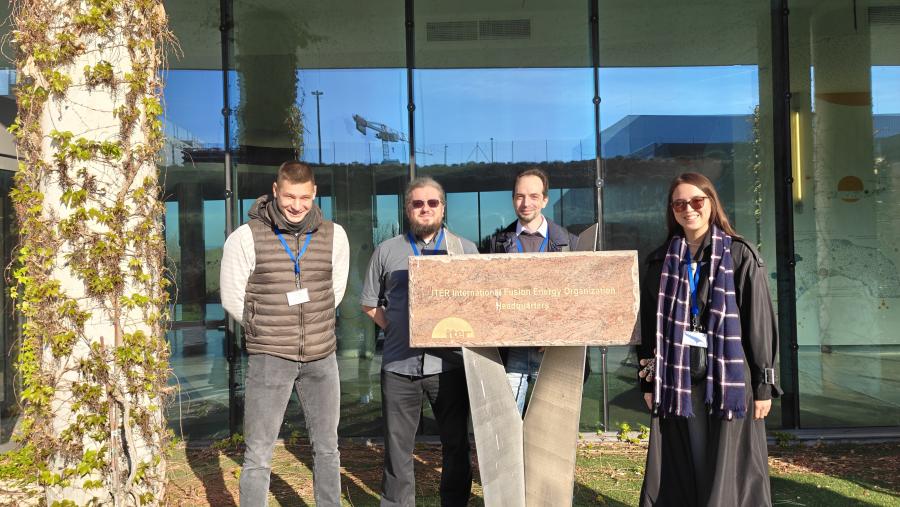
The MEPhI delegation in front of the ITER building
According to Yaroslav Sadovsky, the procedure was a serious defense before a large commission, which included both ITER experts and invited independent specialists: "We usually translate this name as a preliminary review of design solutions. In general, the protection of the preliminary design. "Each system in ITER goes through 3 stages of design development: conceptual, preliminary and final, after which preparations begin for the manufacture of the "hardware" that will stand directly in the installation itself.
The presentations and discussions lasted three days. In addition to the MEPhI team, representatives of ITER, who are in charge of this system, representatives of SPbPU, who are engaged in strength calculations of system elements, and representatives of Cosylab (Slovenia), responsible for system integration in terms of automation, spoke. The Commission was very pleased with both the technical level of the study, as well as the prompt and accurate responses of the team to questions and comments; and also separately appreciated the visual style of the presentations.
As for the technical comments (and they are divided into three categories: fundamental, those that need to be corrected for the next stage of development, and recommendations), the result turned out to be brilliant: there is only one fundamental comment (in some cases, there are almost up to 10), while the only serious drawback identified by the commission, It does not refer to the functioning of the system itself, but to the method of its attachment to the ITER vacuum chamber.
Hunting for microparticles
The development in question is unique. Unlike the everyday understanding of dust, the MEPhI diagnostic complex is aimed at "catching" microscopic particles formed when plasma is exposed to the inner wall of a tokamak. The task is complicated by the working conditions: the tokamak has a deep vacuum, a strong magnetic field, high temperature, and after a certain phase there will be a high radiation background. At the same time, the system must "climb" through a pipe with a diameter of less than 30 mm and a length of more than 15 m, collect dust from the very "heart" of the tokamak and pull it out for analysis, which will also be carried out in a vacuum. It is clear that a conventional vacuum cleaner cannot be used for this, and in principle, most solutions, methods, and materials do not meet the requirements for radiation resistance, temperature, magnetic field, or vacuum requirements. Having considered different dust collection options, the MEPhI scientists chose the electrostatic principle of operation of the dust collection probe (in fact, this is the same effect that causes an electrified comb to attract paper) and developed a probe with high-voltage electrodes based on it, which collects dust with an efficiency of 85-90% in a disposable container. This probe is the main element of the system, which is designed to ensure its movement, storage of empty and full containers, and dust analysis, all in a vacuum, without the personal presence of a person, in remote or automatic mode.
"We have to take a dust sample and take it almost 20 meters away from the central part of the tokamak. First of all, we will weigh how much we have collected, and the second important characteristic is how many hydrogen isotopes (deuterium and tritium) are in this dust," explains Yaroslav Sadovsky.
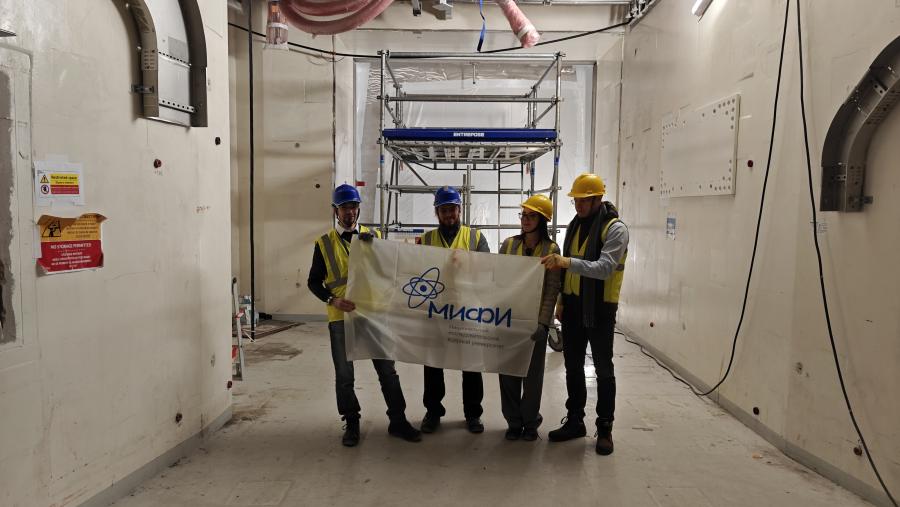
Scientists from MEPhI in the ITER diagnostic room
An inside look and plans for the future
The trip to ITER was remembered not only for the protection procedure. The team was given an excursion to the building where the elements are being prepared for assembly, shown the tokamak itself, and also led to an empty room where their system will be located in the future. "It's empty now, but we went in there and took a group photo. One of the tokamak flanges opens into this room, to which our system will be directly connected," Yaroslav Sadovsky says with pride.
Work at the ITER site is in full swing: "There are a lot of workers, everything is moving, they are also rushing us." The next stage for the MEPhI team is the Final Design Review, scheduled for the third quarter of 2028.
"It doesn't seem like it's going to happen soon, but in fact it's going to happen very soon," the physicist concluded, noting that the creation of full—scale prototypes of all elements of the system is ahead. The scientists are determined: the hot phase of the project is just beginning.
ITER representative's comment:
The project presented by the MEPhI staff was commented on by the technical responsible officer Florian Penzel, Doctor of Engineering, ITER International Organization: "A preliminary review of the design solutions for the 55.G9 Dust Monitor system demonstrated the excellent level of training and professionalism of the entire team. The documentation provided was comprehensive and well-structured, and the technical discussions clearly demonstrated a good understanding of the system architecture, design solutions, and applicable requirements. The defense confirmed that the current level of the project confidently corresponds to the maturity of the PDR level. The remaining gaps that will need to be closed by the FDR are well understood, clearly marked, and can be fully filled in by the next phase. Overall, the team demonstrated a high-quality PDR, reflecting both their technical expertise and effective collaboration. I would like to sincerely thank Yaroslav Sadovsky and the team for their excellent preparation and commitment throughout the defense. I would also like to acknowledge the lasting and significant contribution of Professor Leon Begrambekov, whose scientific legacy continues to define the entire system. His advanced work on plasma-surface interaction, together with his direct contributions to the development of the dust collection head and the shape verification of the ITER diagnostic tubes, laid the scientific and technical foundation for our 55.G9 dust monitoring system."
We wish good luck to our colleagues! For a long time, Leon Bogdanovich Begrambekov, Professor of the Department of Plasma Physics, was the head of the work. Unfortunately, Leon Bogdanovich died in January 2026 and did not witness the successful performance of his team at the PDR, which he was very responsible for preparing for. The main performers are employees of the Department of Plasma Physics, but staff and students from other institutes and departments also participate.
The MEPhI Design and Prototyping Training Center takes an active part in the design and manufacture of equipment prototypes, some of the parts are manufactured by the MEPhI Laser Center, and the help and advice of colleagues from the ITER Design Center should be noted.
It is worth wishing good luck to our colleagues who are fulfilling an important mission within the framework of one of the largest international scientific projects in the world and solving a complex interdisciplinary task.
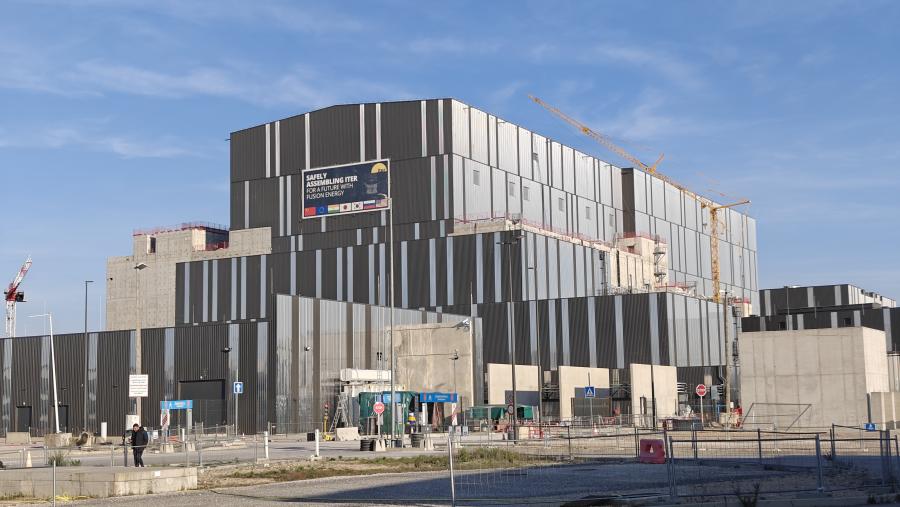
ITER is outside...
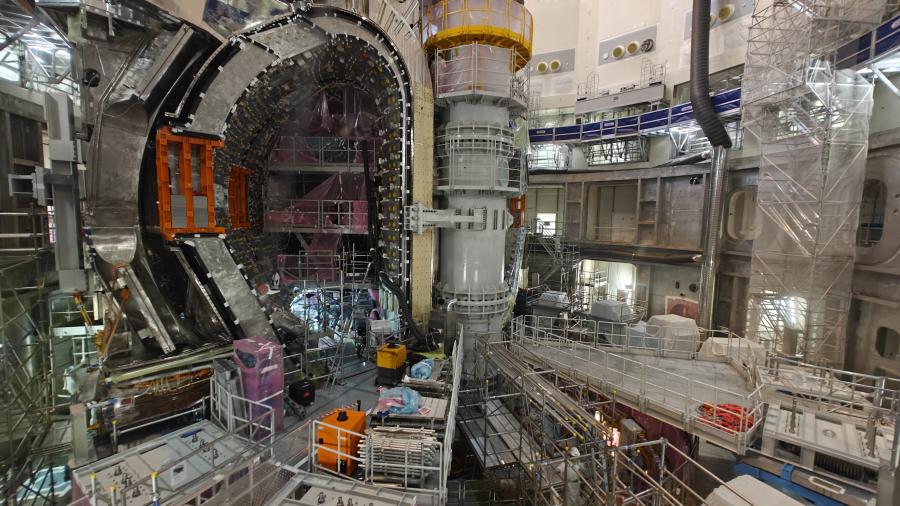
...and ITER inside