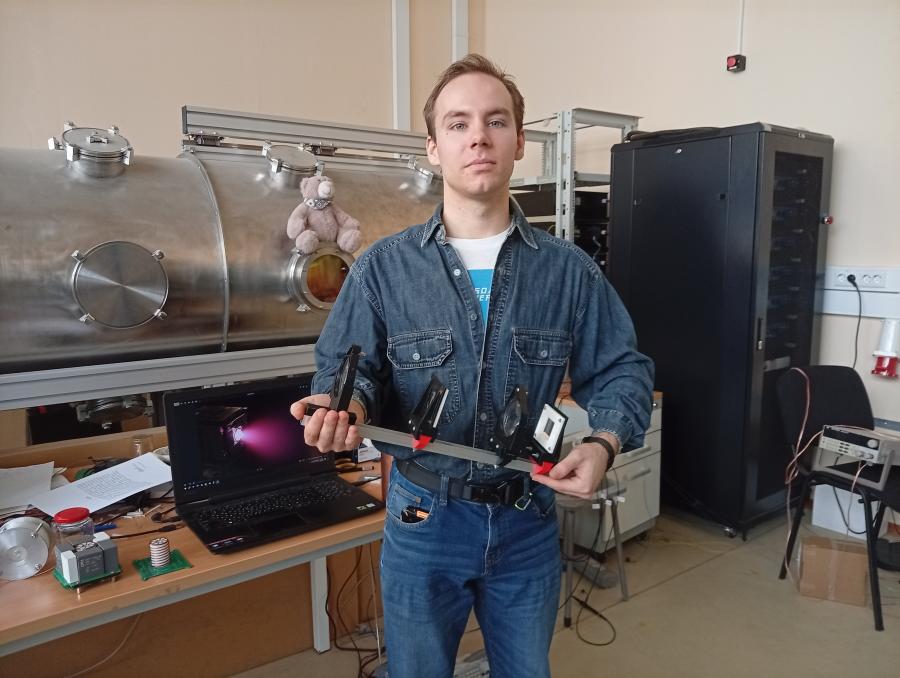
The development of space technologies at MEPhI is carried out not only by established scientists, but also by students. Among them is a first–year graduate student at the Institute of Laser and Plasma Technologies (direction "Controlled Thermonuclear fusion and plasma physics") Yaroslav Leonov. Yaroslav has been interested in everything related to space since childhood. And one day, from razor blades and a diffraction grating, a talented young scientist made... a spectrometer for a high-speed plasma diagnostic system at the output of the ablation pulse of the VERA plasma engine.
– Yaroslav, how did your cooperation with the laboratory of plasma rocket engines begin?
– Since the second year of my bachelor's degree, I have participated in the Laplasian project, which organizes specialized scientific training for students of the LaPlaz Institute, introduces them to the research laboratories and research groups of our university. At one of the meetings, I visited the laboratory of plasma rocket engines. And since I was interested in everything related to space from an early age, I began to cooperate with this laboratory. And already in my third or fourth year, I was developing a spectrometer device for a high-speed plasma diagnostic system at the output of the ablation pulse of the VERA plasma engine.
– What is the purpose of such a device and what kind of research can be carried out with its help?
– The spectrometer is needed to determine the parameters of the plasma at the outlet of the engine, more precisely, to measure the electronic temperature. This allows us to understand what processes are taking place in the plasma, which, in turn, can be used to increase the efficiency of the engine itself.
– Were there no suitable spectrometers?
– Ready-made instruments already existed to measure the spectrum of the engine. However, their time resolution was extremely low, which did not allow for sufficiently complete information. We already had a high-speed camera that could shoot at speeds of up to 10 milliseconds per frame. Existing spectrometers were taken with a much lower frequency. Since the pulse duration of the engine is only 100 milliseconds, they did not allow to measure the parameters in detail and track their dynamics. It was impossible to understand how the plasma temperature changes. Therefore, a dispersing system was needed that would decompose the existing light into spectra. The VERA plasma engine mainly glows with hydrogen. Using the Balmer series, plasma temperature can be determined in a small area, and with proper refinement of the device, the concentration of hydrogen can also be determined.
– And you managed to do it?
– Yes, as part of my bachelor's thesis, I determined the electron temperature of the plasma at the outlet of the engine nozzle with high time resolution. Now, in my master's thesis, I am researching the distribution of these parameters over a cross-section.
– Was it difficult to make a device "in metal"?
– No, it turned out to be a fairly simple task. The spectrometer was implemented almost from improvised means. In the first iteration, I used... two razor blades and a diffraction grating. I saw that the device allows me to measure some parameters well, but I realized that the system needs to be improved in the future. I added condenser and collimator lenses that collect the light coming from the plasma. The slit cuts out a thin layer of this light, and with the help of a collimator lens it goes in a parallel beam along the optical axis to the diffraction grating. It falls from the diffraction grating onto a high-speed camera. The images are detected by a high-speed video camera and recorded on a computer. Then I analyze the images on my own developed software package.
– Do you think such a device can be used outside of your project?
– Of course. The spectrometer is suitable for high-speed diagnostics of plasma with high concentrations and relatively high temperatures. It can be used, for example, on the MYTHIST tokamak, as well as on installations of other institutes and research centers.
– What are your future scientific plans? What are you going to do in the near future?
– I plan to refine the spectrometer so that it is a full-fledged design. I think it has a good export potential. I have seen similar designs abroad, but they are all very expensive – hundreds of millions of rubles!
– Do you also work for our university company "STAR"?
– After I spent several years in Igor Egorov's laboratory, I met Evgeny Stepin and became interested (both from a scientific and business point of view) in the commercialized developments he is engaged in. Evgeny Stepin invited me to join his company STAR (Satellite Technologies and Astrodevelopment). As an engineer, I do my research there part-time. I also interact with schoolchildren and students, try to interest them in space topics, and also organize student teams for competitions in which we participate.
– What can students do in MEPhI space projects?
– Children from different schools in Moscow come to us. We are especially happy for those students who already specialize in something, such as students from the microelectronics classes of school No. 17. We are very actively cooperating with them. The guys from the MEPhI Pre-University also visit us. What are they doing? What they're interested in. This may be the development of electronics for the engine or the creation of a test bench for the engine in a vacuum chamber. Students develop their competencies and at the same time do something useful for science.
– Does it look like an engineering class?
– Sort of. Every few weeks, students come in a group, work here, and then receive some specific assignment as part of a large task that they have been assigned for the school year. In their free time, they also work on certain stages of the project. Therefore, at school or at home, children should have some kind of conditions for this, devices, at least soldering irons. The students of school No. 17 are in an advantageous position in this sense – they have not only soldering irons, but whole soldering stations and even machines for working on wood and metal.
– You mentioned that you participate in various contests. Have you had any recent victories?
– Yes, MEPhI students have become winners of the International Championship of High-tech Professions "High-tech: skills of the future", one of the largest events in the field of advanced technologies and engineering competencies. The competition brought together more than 1,000 contestants and experts from 15 countries, 100 of the world's leading technology companies. The MEPhI students performed very well and showed excellent results.