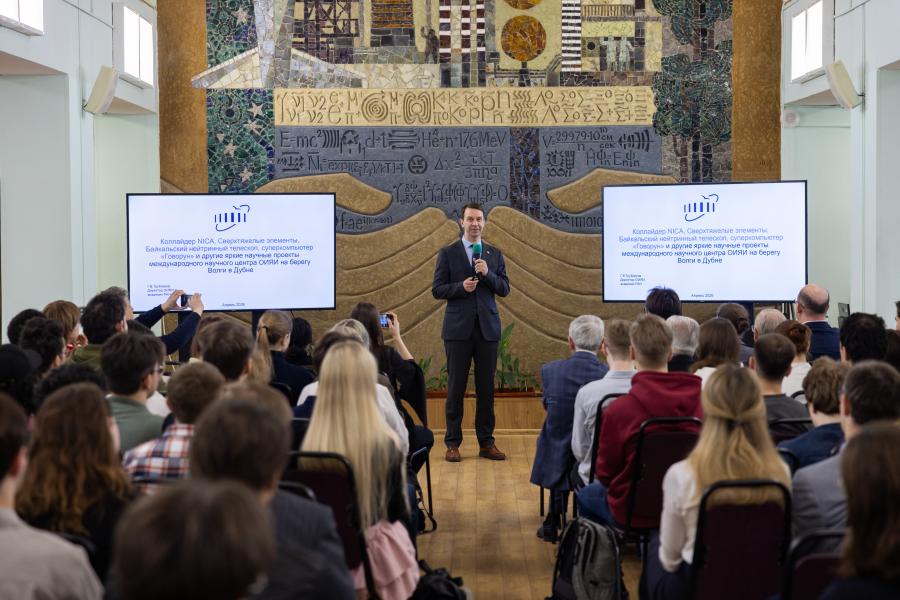
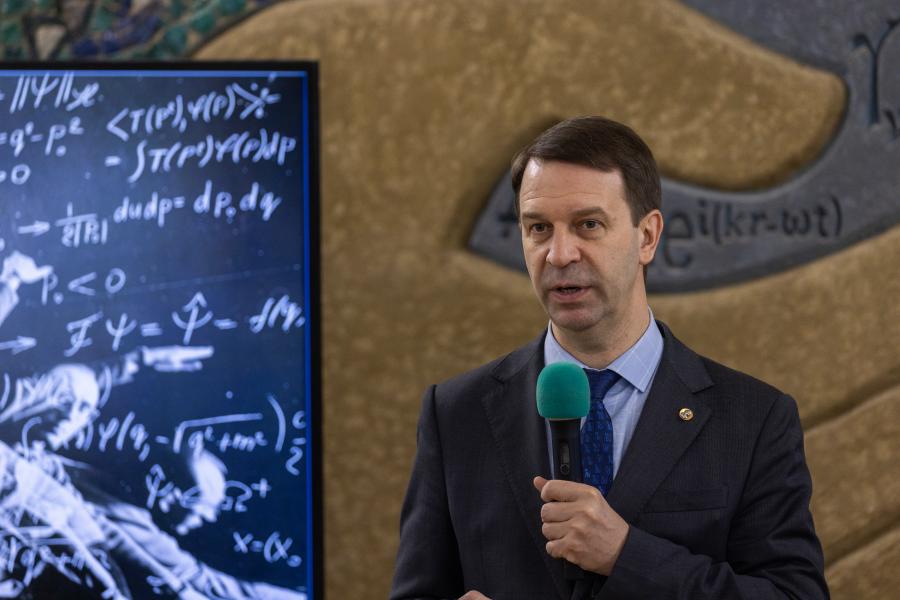
On March 2, a large delegation of employees of the Joint Institute for Nuclear Research (JINR) visited MEPhI. During the visit, JINR Director, Academician of the Russian Academy of Sciences Grigory Trubnikov delivered a lecture. The meeting, which brought together a full audience of students and teachers, was dedicated to the 70th anniversary of the Institute, its unique installations and its role in world science.
From the fundamental properties of matter to the life sciences
Grigory Trubnikov recalled that JINR was established in 1956 by eleven founding countries. The main statutory purpose of the institute is to study the fundamental properties of matter. Traditional fields include nuclear physics, particle physics, high-energy physics, and condensed matter physics. But in the future, the institute's charter, which has not changed since the 1950s, will need to be amended to reflect new areas of research developing under the umbrella of the scientific organization. First of all, we are talking about computer science and life sciences – and, given the specifics of JINR, the term "Physics of Life", which is gaining popularity in the West, is most suitable here. In the entire history of Soviet nuclear physics (from 1945 to 1991), half of all discoveries in this field were made at JINR. The remaining half are represented by dozens of other institutions.
A special place is the periodic table. Dubna has synthesized 10 out of 26 artificial elements, and four of them have names directly related to the institute: dubnium, moscovium, flerovium, and oganeson.
The flagship project is the NICA collider
The central place in the story was occupied by the NICA collider (Nuclotron-based Ion Collider fAcility) — the flagship project of the institute. The project's budget exceeds 30 billion rubles, and it employs about 2,000 JINR employees and another 3,000 external participants.
The length of the main ring of the collider is 503 meters, which is comparable to a stadium. The installation stands on 13,000 piles extending up to 30 meters deep to ensure nanometer precision beam collisions. "The diameter of the beam is less than a millimeter, the length of the clot is 60 cm. You need to get one clot into another with an accuracy of better than 5 nanometers. It's as if two snipers at a distance of 100 km were shooting bullets at each other, which should collide in the air," said Grigory Trubnikov. In January 2026, NICA obtained a stable circulation of beams of heavy nuclei with an energy of about 2 GeV/nucleon — the lifetime of the beam reached almost an hour. A full-fledged physical session with the detector is scheduled for October 2026.
The main task of the collider is to collide beams of heavy ions at those energies when a gigantic density of nuclear matter appears at the point of collision for a very short time - from pico to femtoseconds. "And it is precisely in this energy range, with heavy ions, that it is possible to achieve superdense nuclear matter at relatively low temperatures, which has not yet been achieved by any center in the world, although this physics has been practiced since the sixties," said Grigory Trubnikov.
In experiments at the collider, it will be possible for quark-gluon matter to arise when quarks are released from nucleons, overcoming the "confinement", and then the reverse process will occur when quarks form nucleons again – either those from which they came out, or, and this is more interesting, some new ones. All this will be measured by a large detector weighing 1,300 tons and with a diameter of about 7 meters.
The factory of superheavy elements and the neutrino telescope on Lake Baikal
Grigory Trubnikov elaborated on the Flerov Laboratory of Nuclear Reactions (scientific supervisor — Yuri Oganesyan), where the newest cyclotron, the Factory of Superheavy Elements, operates. Searches are underway there for the 119th and 120th elements of the periodic table by irradiating berkeley atoms. "The main task of the laboratory is not to put the first flag on the next peak, but to study the physical and chemical properties of superheavy elements. Once you have a chemical element's lifetime that is not microseconds, but at least milliseconds, then you can explore its chemical properties on the fly, for example, to find out if Mendeleev's law works for superheavy elements or not. Ohaneson (Og) is now the heaviest element, it stands in the same column with noble gases: xenon, radon, argon, neon, and so on. We don't know anything about it yet, because its lifetime is microseconds. But for those elements that are next to it in the periodic table – Moscovia, flerovia, copernicus, which have been living for tens or even hundreds of milliseconds – Mendeleev's law does not work," explained JINR Director.
And there is also a rich program of applied research, for example, the study of track membranes, it is JINR that makes filters for the medical procedure of plasmapheresis, and now an interesting project is being discussed with the Ministry of Transport to create a membrane for cleaning air from infections in airplanes and trains.
In search of neutrinos and antineutrinos
JINR's important project outside Dubna is the Baikal Neutrino Telescope, the largest in the Northern Hemisphere. It consists of a grid with a volume of slightly less than one cubic kilometer and a height of about a kilometer. The installation is trying to catch neutrinos flying into the Earth from the South Pole, from the side of the active galactic core, which, having flown through the Earth, fly out in the Baikal area. Those of them that do encounter a hydrogen atom in their path, which is part of the Baikal water, generate muons, and the detector catches the tracks of the Cherenkov radiation generated by the muons. "Maybe in a couple of years we will overtake the Americans with their detector in Antarctica," promised Grigory Trubnikov, because there are ambitious plans to "increase" the volume of the neutrino telescope from one to 30 cubic kilometers.
In parallel, tests of the antineutrino detector at the Kalinin Nuclear Power Plant are underway. This detector is located literally 10 meters from the reactor boiler, it catches a stream of antineutrinos and, using their energy spectrum, allows you to find out the chemical composition of the fuel in the reactor, which is of great practical importance, since it allows you to specify the timing of an extremely expensive fuel replacement procedure.

From submarines to tardigrades
The lecturer spoke fascinatingly about technical solutions: for example, the cryostats of the collider have a diameter that matches the torpedo tube of nuclear submarines, and bellows (flexible connections) are made using the technologies of compensators for torpedo tubes of submarines, which can be made in only two places on the planet — at one of the shipyards in the UK and at Compensator JSC in St. Petersburg.
A separate section of the lecture was devoted to radiobiology. JINR studies cognitive changes in primates after radiation exposure, which is critically important for modeling long—term space flights (to Mars or Venus). And as part of the Healthy Longevity project, tardigrade proteins (extremely resistant to any harmful effects of invertebrates) are being studied, and these proteins are grafted onto fruit flies.
A large laboratory that deals with information technology, it has at its disposal the largest data warehouse in the country — it is 4 times larger than the information repositories of Sber, Yandex, MSU and Mail.ru taken together.
How to get into JINR: opportunities for students
In conclusion, Grigory Trubnikov listed the formats of access to the Institute's facilities:
- student internships (summer and semester);
- term papers and theses under the supervision of JINR scientists;
- Postgraduate studies (more than 500 graduate students from 30 countries);
- International collaborations (NICA, Baikal-GVD, experiments at CERN and Japan).
"We have 23 partner countries, 36 nationalities on staff, and more than 900 partners worldwide. And we are open to you," JINR Director addressed the audience.
FOR REFERENCE
There are 15 JINR members today: the Republic of Azerbaijan, the Republic of Armenia, the Republic of Belarus, the Republic of Bulgaria, the Socialist Republic of Vietnam, Georgia, the Arab Republic of Egypt, the Republic of Kazakhstan, the Democratic People's Republic of Korea, the Republic of Cuba, Mongolia, the Russian Federation, Romania, the Slovak Republic, and the Republic of Uzbekistan. Brazil, China, Germany, Hungary, Italy, Mexico, Serbia, and South Africa are associate members and partner countries of the Institute.