World Meteorologist's Day was celebrated on March 23. Although MEPhI does not actually conduct meteorological research, the university's research on muon fluxes (unstable elementary particles formed in the atmosphere when interacting with cosmic rays) can tell a lot about weather phenomena. We are talking about this with Igor Yashin, Professor of the NEVOD Scientific and Educational Center at the Institute of Nuclear Physics and Technology at the National Research Nuclear University MEPhI. The interview was conducted under the heading "Voice of Science".

Professor of the National Research Nuclear University MEPhI Igor Yashin
– Igor Ivanovich, is it possible to judge the state of the atmosphere by the state of the muon flux, which is being studied at the SEINE center?
– In a sense, yes! We are interested in the possibility of using muon flux data to determine the probability of detecting catastrophic atmospheric phenomena such as powerful thunderstorms, hurricanes, cyclones, tornadoes, and so on. Why is this possible? Because muons, which are born at altitudes of 15-20 kilometers, are sensitive to the characteristics of the atmospheric layer through which they pass before hitting the detector. For example, the air temperature. If the temperature drops, the atmosphere subsides, and the muon generation zone becomes lower, which means that the probability of muons reaching the Earth will be greater. If the atmosphere heats up, the generation layer rises and, accordingly, muons travel a longer distance.
– Is it the distance from the ground that matters, and not, say, the density of air, which decreases with heating?
– The effect of atmospheric pressure is somewhat different. There is a so-called barometric effect: if the pressure at the observation level increases, it means that the column of air becomes denser because there is more matter in it, and in this case fewer muons will arrive at the detector. In general, the process of muon generation and their passage through the atmosphere is quite complex, but it can be evaluated, as well as the influence of atmospheric processes on muons. The corresponding variations in muon fluxes have been measured since the middle of the last century. After muons were discovered, it was immediately realized that they are a penetrating component of cosmic rays, and it is possible to study their variations related to processes in the atmosphere and near-Earth space.
– And if there is a powerful thunderstorm, what happens?
– Imagine a hot day, you have powerful convection, turbulent removal of moist hot air into the upper atmosphere. There, at an altitude of 10 km, minus 40 degrees, there is a sharp condensation and freezing of small droplets, which form a certain volume of frozen water in the clouds, there are millions of tons of it. And if you point your detector in this direction, then your muon flux will change. Not much, but nevertheless measurable. Moreover, if very fast upward convection processes occur, then some waves appear, like waves on the surface of water when you throw a stone. They are called internal gravitational waves (not to be confused with gravitational waves from cosmic collapses), since the elements of matter in question oscillate under the influence of gravity. These waves propagate at high altitudes, in the troposphere and lower stratosphere, and modulate the muon flux. If we register muons in real time from all directions, we can isolate the frequency modulation and see how it correlates with atmospheric processes.
We have developed several methods for detecting muon fluxes, including in the aspect of wave processes. Stanislav Timakov, a graduate student at the NEVOD Research Center, is currently preparing to defend his dissertation on azimuthal scanning of the muon flux. This is when we can identify sectors in which the properties of these fluxes are evaluated, and using various methods of frequency response analysis, we can determine from which direction the power of muon modulations is greater. In general, we cannot predict the weather, and this task is not facing us. But our goal is to try to develop methods for the identification and early detection of catastrophic atmospheric phenomena.
– Have studies been conducted on the SEINE in recent years that took into account atmospheric catastrophic phenomena?
– We do it all the time. We analyze the state of the atmosphere in an area of about 10,000 square kilometers in the Moscow region in real time. Moreover, we build muonograms, that is, patterns of changes in the muon flux density over this area, and we see from which direction the deficit zone in the angular distribution of muons is formed and analyze its relationship with powerful atmospheric phenomena.
To test the muonography method, work was carried out to compare the results obtained with Doppler radar data.
– And where do you get meteorological information from?
– There are worldwide databases of meteorological data on the state of the atmosphere, including dynamic maps of Doppler radars. We have two weather stations on the NEVOD, mounted in different locations. They allow you to obtain reliable information about wind strength, humidity, pressure, and temperature above the MEPhI.
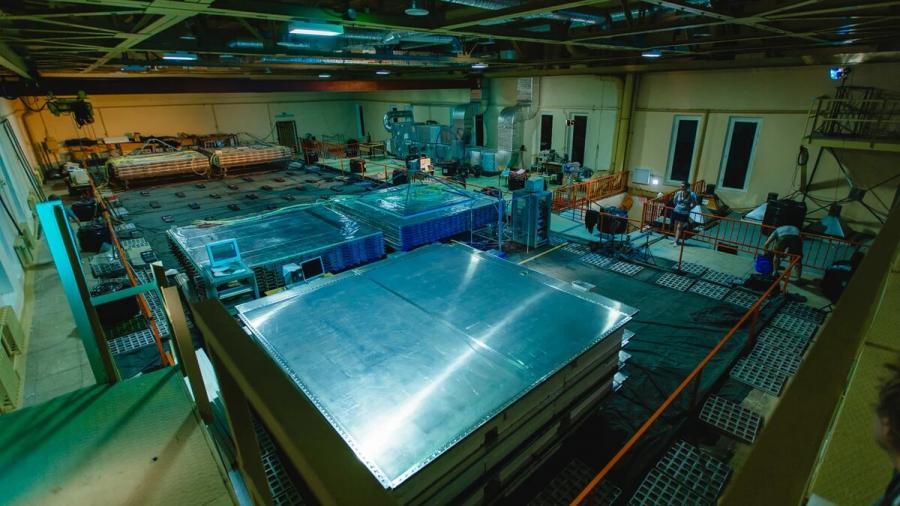
Scientific and Educational Center NEVOD (Neutrino-water detector)
– Have meteorologists been interested in your research or other similar studies of cosmic radiation?
– Meteorologists have a fairly simple approach: give us a ready-made forecasting technology and we will use it. Nevertheless, interest in the methods of muonography of the Earth's atmosphere and near-Earth space has grown significantly recently. For example, in Japan, work is underway to monitor typhoons, which happen very often there, and this is a big problem for Japan. They are trying to detect and classify powerful atmospheric phenomena by monitoring muon fluxes, just like we do.
An important advantage of our method is that we can estimate the water supply in thunderclouds, since the more water there is in powerful turbulent thunderstorm regions, the fewer muons pass through these regions. Another important parameter affecting muon variations is the air density gradients associated with the baric frontal zones. We can distinguish between warm and cold fronts because they have different dynamics, and muon fluxes are also sensitive to this dynamics. Nevertheless, the formation of forecasts is not included in our tasks. To do this, there are a large number of ground and space stations, information from which is processed using powerful supercomputers. Our task is not to predict what the temperature will be in three days, but to develop an approach that could later facilitate the early detection of, say, the same tornadoes. Of course, tornadoes rarely happen here, but this is a very important problem for the United States, and they are also trying to do this.
– Which of the detectors within the NEVOD is the most informative in terms of atmospheric conditions?
– First of all, this is the URAGAN installation (an installation for recognizing Thunderstorm Anomalies). These are four precision track detectors with a total area of about 45 square meters, which register every muon coming from any direction within the angles of "visibility" - the aperture. Based on the recorded tracks, we construct matrices of angular distributions of muons that have passed through the detector over a certain period of time in real time. The sequence of such v muonogram matrices (by analogy with X-ray images) makes it possible to study the dynamics of the muon flux anisotropy regions associated with their generation processes. We project these muonograms onto the muon generation layer (15 km). It turns out that within the aperture of the detectors, we constantly monitor the atmospheric layer with a height of about 15-20 km above an area of 10,000 square kilometers.
URAGAN was specially created in order to analyze variations in the muon flux associated with various events, both in the atmosphere and in the heliosphere, for example, with high-energy events caused by solar flare activity. Such events can generate various negative phenomena when interacting with the Earth's magnetic field. What's the problem here? Events such as Coronal mass ejections on the Sun are clearly visible using coronographs, including those located on satellites located at Lagrange point 1, where the gravity of the Sun is balanced by the gravity of the Earth. But in the space between the orbits of Mercury and Earth, this cloud of high-speed plasma is very difficult to detect. When interacting with the Earth's magnetic field, powerful magnetic storms can be generated, posing a danger to both the public and industrial structures, especially for the crews of space missions and satellite groups. Cosmic ray fluxes, crossing the shock waves of the propagating clouds of solar plasma, are modulated and quite quickly, compared with the movement of solar plasma, reach the Earth's atmosphere in about 10 minutes and carry predictive information about dynamic disturbances in the heliosphere. Interacting with the atmosphere, they generate muons, which we register and receive information about the anisotropy of cosmic rays in the heliosphere, on the basis of which we can estimate the probability of a magnetic storm. This approach has been implemented in a worldwide network of neutron monitors, but muonography methods have been rapidly developing recently.
The second installation that we have created for near–Earth muonography is a track scintillation muon hodoscope (22 square meters. m.) located relative to the URAGAN at a distance of 100 m. It has a different muon detection principle, which provides some advantages in terms of cross-data analysis. However, one location of the detectors does not make it possible to localize a powerful atmospheric phenomenon. We are currently promoting the idea of creating a network of muon hodoscopes, which would be located, say, along the Dubna-Protvino line, that is, from north to south, because atmospheric events mainly go from west to east. The three detectors located along this line represent a kind of antenna, and we will be able to build a spatial picture.
– You said that you calculate the correlation between the dynamics of the muon flux and atmospheric events. As I understand it, there is a causal dependence from the atmosphere to the muons, but there is no feedback?
-You are right, atmospheric disturbances affect the intensity of muons. But our research is aimed precisely at solving the opposite problem – using data from muon detectors to assess the likelihood of a potentially dangerous process developing in the Earth's atmosphere or in near-Earth space. Let's say you can see a thunderstorm in 2 hours. This task is, in principle, solvable. But as long as we have one detector location, we can only measure it indirectly. But to see the dynamics of atmospheric processes in a complex requires further development of the muonography method. But our main achievement is that we have developed a method for studying the atmosphere that is radically different from research using radars and other meteorological methods.
Interviewed by Konstantin Frumkin