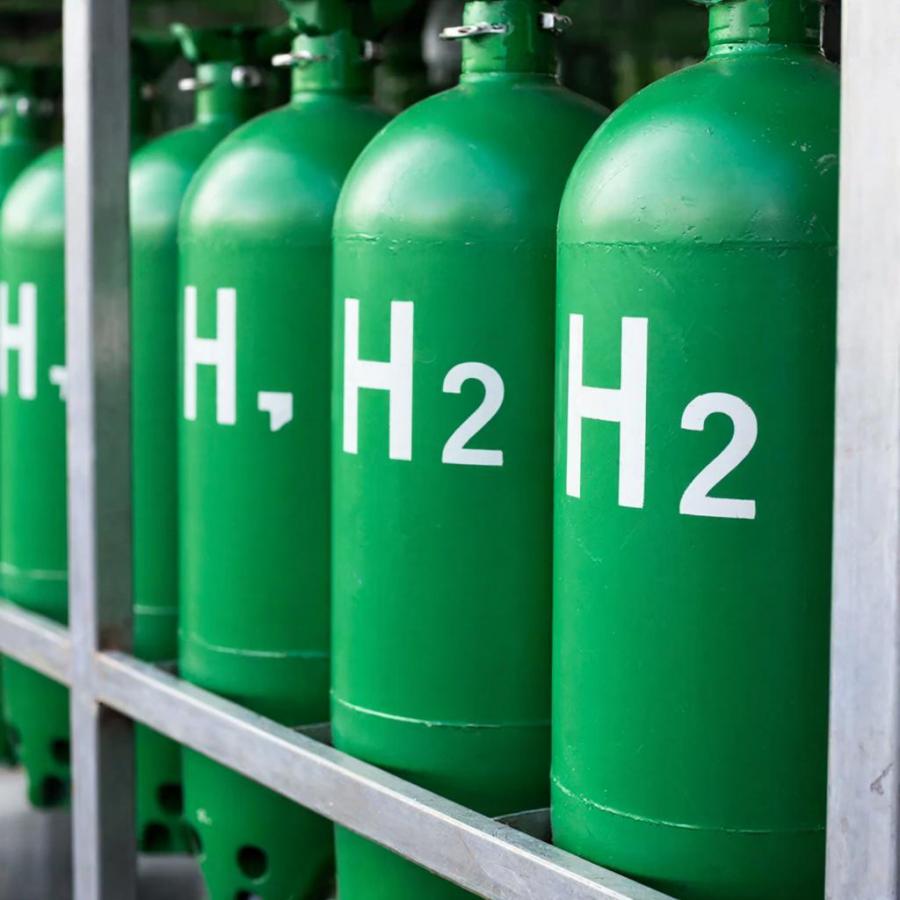
Hydrogen energy is considered one of the promising areas of technology development. Hydrogen does not emit harmful emissions, there is a lot of it, it is light. But there is a problem: how to store it? To store hydrogen, heavy cylinders are needed under enormous pressure or at temperatures close to absolute zero. Neither is suitable for an airplane or a car. What should I do? Materials scientists and physicists all over the world are looking for the answer. One of the promising solutions was proposed by the staff of the National Research Nuclear University MEPhI, graduate student Alexander Yakovlev and Professor Konstantin Katin. They researched how to trap hydrogen molecules using lithium. The study was published in the prestigious scientific journal International Journal of Hydrogen Energy.
Lithium is the lightest metal. And this is its main advantage. If we want to accumulate hydrogen, we need a material that doesn't weigh much on its own. After all, a fuel tank is a part of the weight of an airplane or car. Previously, scientists tried to "pour" lithium atoms onto the surface of various materials — graphene, silicon carbide, and others. But there is a problem here: the metal atoms do not want to be evenly distributed over the surface. They clump together like mercury, and the efficiency drops. At the heart of Sucheny MEPhI's research is the idea of using lithium not as an additive, but as a base in which lithium atoms are perfectly arranged due to the crystal structure?
The researchers selected five candidates — flat, just one atom thick, lithium-based materials. Such crystals have a huge surface, so the hydrogen has a place to fit. Four of them were eliminated one by one.
In lithium "soda" (LiOH), in practice, hydrogen molecules hardly stick to it. Gravity is seven times weaker than required. If it was possible to "glue" the hydrogen, it was so tightly that it did not come off again — instead of hydrogen, water was obtained.
Lithium oxides performed better, but they were also not an ideal option. One of the forms (H-Li₂o) turned out to be unstable — contact with hydrogen destroyed the material. The other form (T-Li₂o) behaved decently, but the binding energy with hydrogen was below the required threshold. The scientists tried to stretch and compress the material, adding extra lithium atoms for better interaction — nothing helped.
When hope was almost extinguished, lithium carbide, Li₃c, came on the scene. Its atomic structure is a flat lattice where carbon atoms are surrounded by lithium atoms. And then what happened happened: the hydrogen molecules stuck with the right force — not too weakly so as not to escape, and not too tightly so that they could then be used as fuel.
The optimal binding energy for storing hydrogen is about 150-300 MeV (electron—volt, the unit of energy measurement in the world of atoms). LI₃c got 228 MeV. Perfect!
But the main thing is weight. The material contains a lot of lithium and not much carbon, so it is lightweight. For every kilogram of such a "spongy" sheet, almost 60 grams of hydrogen can be accumulated. And if you try, it's 80. For comparison, modern high-pressure cylinders produce about 40-50 grams per kilogram of system weight.
From the point of view of physics, lithium in Li₃c works as a "Velcro". The lithium atom has free orbitals that happily accept electrons from hydrogen. Hydrogen is a modest donor, but still it is divided by electron density, and a weak electrical connection occurs. Not a chemical bond, as in a molecule, but physical adsorption, like a dewdrop on a leaf.
Scientists have verified this using quantum mechanical calculations. It turned out that the lithium atom receives a part of the electron density upon contact with hydrogen, which means that charge transfer is actually taking place. Hydrogen is polarized and attracted to lithium.
The most interesting thing is the temperature. Hydrogen must escape from the "trap" when heated. For Li₃c, the temperature of desorption (hydrogen release) turned out to be close to room temperature. This means that a tank with such a material will work without additional heating or cooling. Just open the valve and the hydrogen comes out.
Scientists have calculated how the material will behave at different pressures and temperatures. The graphs showed that at a pressure of 10-20 atmospheres and a normal temperature, Li₃C retains almost all of the hydrogen. If you reduce the pressure, it releases. Ideal for the fuel tank.
The authors of the study modestly call Li₃c "a promising material for hydrogen aviation." That's where every kilogram counts. Perhaps in 10-20 years, the tanks of passenger liners will be filled not with kerosene, but with such "lithium sheets".