What is the special feature of an education in economics and management that can be obtained at MEPhI at the Faculty of Business Informatics and Integrated Systems Management? How does the university's natural science profile combine with economics subjects? Why do future managers need to know the basics of physics? What kind of scientific research are MEPhI economists doing? We are talking about all this with Vladimir Kharitonov, Professor of the Department of Business Project Management at the National Research Nuclear University MEPhI, head of the educational program "Managing the Digital Transformation of High-tech Business".
Vladimir Kharitonov
– Vladimir Vitalievich, can we say that educational programs in the field of economics are something new for MEPhI?
– Back in 1996, the Economic and Analytical Institute was established at MEPhI. Since then, professional economic education has begun at MEPhI. Then we received licenses for three economic specialties – national economy management, applied computer science in economics and mathematical methods in economics. Then, gradually, all this developed, the Economic and Analytical Institute turned into the Faculty of Business Informatics and Integrated Systems Management.
– What are the fundamental differences between the physico-economic education provided at MEPhI?
– It is based on three principles. It is known that the triangle is the most stable figure in the copromat. In economics, I think everything is based on natural science. All material values are natural sciences in the broadest sense of the word. There's physics and chemistry involved. Next comes a financier who has to estimate how much it costs. But then a politician appears who makes a decision: yes or no, it may not be very profitable, but from some strategic point of view it is absolutely necessary for the state. If you're throwing something out of this triangle, it's not economics. Therefore, our training necessarily includes fundamental natural science elements, since you must be familiar with the subject area.
– And an economist or a manager should know physics?
– If you manage nuclear energy, you should know the fundamental principles of the fuel cycle and reactor operation. It is pointless to build a nuclear energy economy without understanding this. It is no coincidence that all the first books and textbooks on the economics of nuclear energy were written by teachers and graduates of MEPhI. But the same thing happens if you sell flowers and you don't know how they grow, how long they are stored, and what they need to be fed with, then you won't have a good business. But, of course, we are not focused on flower beds (although there are also many interesting things there), but on high-tech businesses. For some reason, some students are afraid to study economics at MEPhI, since we are the basic university of Rosatom, we have nuclear physics here, the basics of which are known only by a small part of the world's population. But few people realize that in fact, absolutely all technologies are born as a product of extreme physics. Let's take a thermonuclear. They have been trying to get it for 60 years, and they still haven't, but as a by-product of these studies, we have obtained and are using superconductors, ultra-high vacuum, in which ultra-pure chemical materials are made, and ultra-high-voltage technology that physicists have developed to pass a current of 10 million amperes through a tokamak, thanks to which there are power lines. at one and a half million volts and so on. That is, extreme physics generates a lot of technologies, which, in turn, generate new businesses and have nothing to do with nuclear physics.
– So physics is directly related to business?
– Here is another example. In nuclear power, it is necessary to separate uranium isotopes. To do this, the centrifuges must spin at a speed of Mach 3. When it spins at this speed, it has tensile stresses, and it can burst if it is spun too much. And the harder it turns, the better the separation effect. So, physicists had to come up with lightweight but durable materials. This is how composite materials were born, which, it turns out, are needed in aviation. And we have received a composite wing for the newest Russian MS-21 airliner, and we make a number of other elements of modern aircraft from composite materials that were born here at Rosatom. For example, propellers for wind turbines – and this is not nuclear energy at all. Wind turbines have the same problem, they spin, their propellers stretch, and they can burst if the wind blows too hard. This means that a lightweight but durable material is needed – again, the same composite. And so it is everywhere. The high-tech industry generates a lot of technologies, which naturally spread throughout the national economy and create completely new businesses. And they can't teach this anywhere except MEPhI, which is close to such high-tech technologies, extreme physics, accelerators, nuclear and thermonuclear reactors, and space research. A new business is born out of all this, and a person needs to be taught this.
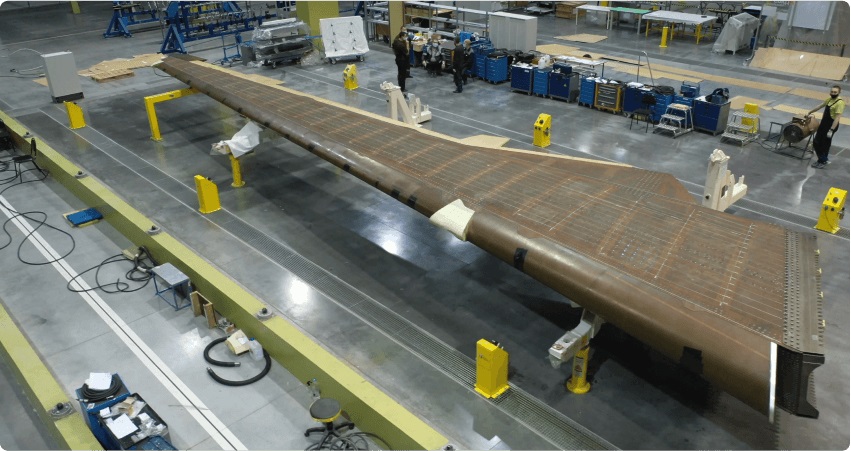
Соmposite wing for the newest Russian MC-21 airliner
– Do you think the same approach applies to the study of digital technologies?
– Who is the parent of digital technology? Again, physics. How was the Internet born? The physicists had to interact. An experiment was conducted, for example, at CERN, at a powerful accelerator. There are billions of data in there. And the physicists are sitting in different countries. Do they have to go to CERN all the time? They need to receive information, and communicate it remotely to CERN. That's how the Internet was born. What is the digital economy? At first, physicists developed the same reactors, weapons, and space systems. To do this, they needed very powerful mathematical calculation methods. Very complex physical equations were used there, numerical methods were needed to solve them, and it was pointless to count them manually. Arithmometers appeared first, then computers. Who knows how to make them best? Those who can count complex mathematical problems. And then, of course, it went into the national economy and compact computers appeared. Again, in the 1990s, who beat even Gray, the most powerful American supercomputer at that time? Our mathematicians use parallelization of calculations on personal computers. And now the whole world is running on parallel computing. So a lot of things, including those related to digitalization, were born in our industry. The strongest mathematicians and the strongest programmers were here.
– But now digitalization is on the agenda not so much of physical processes as of business processes.
– In a certain sense, it may be easier to digitize physical processes, because nature is there, experiments can be reproduced, repeated and calculations can be refined, but in society the main element is man, he is like this today, tomorrow he is different, difficulties arise, serious algorithms and highly qualified specialists are needed in order to properly digitize business processes. And who can do it? MEPhI, the birthplace of cybernetics and computing machines, is the only place to teach this properly. There is a theory of control in technical systems, whether it is the control of a reactor, fighter, spacecraft, and so on. A powerful mathematical management theory has been developed for them. Then mathematics was removed from this management theory, psychology was added, and what remained was called management. But at MEPhI we try to give the basics of the initial theory of management. Our wonderful teacher, G.N. Aleksakov (unfortunately, now deceased), often demonstrated impressive experience from management theory. He placed the pencil point on a small circular platform that could move in a plane. Laser beams observe the upper tip of this pencil and transmit information to a motor that controls the movement of the platform so that the pencil stands on the tip and does not fall. Why? This is because the management of the platform is based on a feedback system. That's what advanced management theory can do – keep unstable systems stable. We train management specialists who know the elements of the theory of management of technical systems, because there the entire conceptual framework is formulated in the best way, strictly and consistently.
This is how the application "Masterpiece" depicts the concept of "Extreme physics"
– And students should be able to apply management theory to business?
– Naturally, this theory applies to different business models from different fields of activity. In the second year, each student receives an independent assignment for a research paper, the topic of which is transformed into his graduation thesis. The topic, of course, is chosen in accordance with his interests, for example, he wants to develop wind turbines, and so he will do educational and research work on wind turbines for two and a half to three years, and it will eventually result in a graduate thesis. Along the way, he will make a couple of publications and comes out as a fully trained specialist.
– Is scientific research conducted at your department?
- Of course. For example, I work more on the economics of nuclear energy. For example, students and I are evaluating the economics of nuclear icebreakers. Question: are we paying off the icebreaker or not? When you built a nuclear power plant, you earn money by selling electricity. When you have built a bakery, you earn money by selling French rolls. And what does the icebreaker earn? He earns money by conducting trials. There are several ships following him in the caravan. Some carry oil, others liquefied natural gas, others containers, and so on. And they pay. What is the task? It is necessary to combine all the factors so that the icebreaker's activities are profitable. And what are the costs of its construction, and what is the cost of operation, and what should be the tariff, how much should it charge for each ton of cargo that the caravan transports, and then how many round trips should it make to pay for itself as quickly as possible? Two people at our department have written good articles in leading journals on the economics of the icebreaker fleet.
Rosatom has now agreed with Uzbekistan to build nuclear power plants with low-power reactors there. A modern reactor with a capacity of 1,200 or even 1,700 megawatts can supply two million cities with electricity alone. But they are very expensive, and businesses are not very willing to finance them. They take a long time to pay off, but business needs to move faster. There is a lot of talk in the world press about how and where to build low-power nuclear power plants (ASMM). They can be mass-produced in factories and assembled on the NPP site faster and cheaper than large reactors. That's all good, but why are we flying long distances not on a Corncob, but on a Boeing? Because it's cheaper and faster on a large liner. There is an economy of scale effect. The less, the more expensive. The question arises: how can we make this small reactor profitable? There are a lot of nuances here. For example, we make an economic assessment of a reactor in which fuel will run not for a year and a half, as in large reactors, but for six, seven, ten years, that is, the reactor has been operating continuously for ten years without fuel overload. And how will this affect the economics of the fuel cycle and ASMM? Our undergraduate students defend such papers.
– Probably, it's just that the economics of an ordinary nuclear power plant have been well studied for a long time…
– Something new appears all the time. For example, the production of hydrogen. Hydrogen is not an energy source, it is an energy carrier. To get hydrogen, you have to spend more energy than you get when you burn it. Burning coal or burning gas for this is nonsense. Therefore, there seems to be no better source for producing hydrogen than nuclear power. And what would the cost-effectiveness of such a cogeneration (two-product) installation look like? It produces electricity, and it can also produce heat and hydrogen. The task of evaluating the cost-effectiveness of such a complex object is very interesting.
A lot of seawater desalination plants have been built in hot countries such as Saudi Arabia and the United Arab Emirates. True, there is no nuclear power yet, but a 4-block nuclear power plant has already been built in the United Arab Emirates, which, among other things, will use electricity to desalinate seawater. The process of obtaining fresh water from seawater is extremely energy-intensive, it is necessary to push water through super-thin membranes, and nuclear energy can be one of the elements of such systems. By the way, the world's first desalination plant was built in the Soviet Union on the shores of the Caspian Sea, from Kazakhstan, where the first multipurpose reactor was built, and on sodium-cooled fast neutrons, which produced electricity, heat and desalinated water for the city of power engineers and for local industry. And desalination of seawater produced a variety of salts used in medicine.
– To summarize some of the results of our conversation. In your opinion, is nuclear energy a potential source of new businesses and startups?
- Of course. More than 80 new businesses are currently developing in the industry. Businessmen have long known that it is better not to invest money when you have reached saturation in production, because in order to increase the efficiency of existing and developed production, investments need to be increased in the square. And a new business requires less money and can become profitable faster. Therefore, we need to teach people how to find new technologies, develop them quickly and turn them into a useful business. Moreover, we are now facing a very acute problem not so much of import substitution as of technological sovereignty. That is, we must be able to do everything ourselves. Over the past 30 years, we have lost a lot of skills in Russia. Only our industry survived because it was closed and you couldn't take too much from someone else. Thanks to this, the nuclear industry is able to do almost everything by itself.
Interviewed by Konstantin Frumkin, MEPhI Press Service