A team of young scientists has created a Multi–purpose Muon Detector (MDM) in the experimental complex of the MEPhI Nuclear Research Institute, a large-scale facility for studying cosmic rays in a wide range of energies and zenith angles.
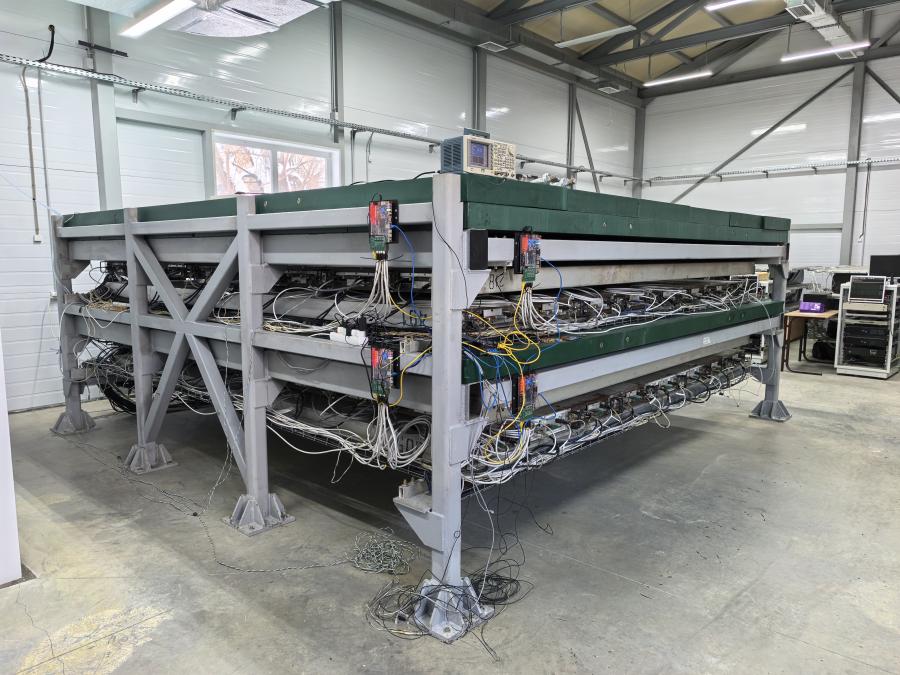
The detector consists of 32 multi-wire drift chambers forming two coordinate planes shielded by a 31.5 cm steel absorber. The area of each plane is 13 m2, and the mass of the absorber is over 50 tons, making the installation one of the most massive in the experimental complex. A multicomponent MDM recording system has been created, including unique time-digital converters and amplifiers for low-current drift camera signals, time synchronization and data preprocessing systems.The detector consists of 32 multi-wire drift chambers forming two coordinate planes shielded by a 31.5 cm steel absorber. The area of each plane is 13 m2, and the mass of the absorber is over 50 tons, making the installation one of the most massive in the experimental complex. A multicomponent MDM recording system has been created, including unique time-digital converters and amplifiers for low-current drift camera signals, time synchronization and data preprocessing systems.
The detector allows you to register single and groups of muons formed in the atmosphere during the passage of cosmic rays – charged particles of ultrahigh energies. When such particles move through the air, wide atmospheric showers (SHAL) are formed – cascades of secondary particles capable of reaching hundreds of square kilometers in cross-section.
The energy of cosmic rays can be hundreds of millions of times higher than the energy of particles in the Large Hadron Collider at CERN. Therefore, the study of such showers allows us to look into processes that are inaccessible on man-made particle accelerators. One of these processes is the formation of the fifth state of matter, the quark-gluon plasma, which, among other things, will be studied at the new NICA accelerator in Dubna.
"The very name of the installation indicates a wide range of tasks that can be solved with its help. Not only fundamental, but also purely applied. The project of our team of young scientists is interesting, large–scale, promising and, importantly, financially supported – it is being implemented under a grant from the Russian Science Foundation," said Vladimir Shevchenko, Rector of MEPhI.
Indeed, studies of the anisotropy of single muons can tell a lot about the current state of the Earth's atmosphere, and the high angular and coordinate accuracy of the installation makes it possible to use MDM as a precision testbed for studying the band characteristics of charged particle detectors. MDM has been commissioned and registers events together with other large–scale detectors of the NEVOD complex - the Cherenkov water detector with a volume of 2000 m3 and the world's largest coordinate detector of cosmic ray muons TRACK, also created by a team of young scientists of the project.
The project is being implemented under a grant from the Russian Science Foundation. "The Russian Science Foundation supports both fundamental and applied research. 73% of the project executors are young scientists," said Andrey Blinov, Deputy Director of the Russian Science Foundation, who recently visited the scientific laboratories of MEPhI and met with students.