Professors of the National Research Nuclear University MEPhI Alexander Fedotov and Maxim Malakhov, together with scientists from the Skolkovo Institute of Science and Technology (Skoltech) and the VNIIA named after Dukhov, proposed a new method for creating compact gamma radiation sources that are simultaneously brighter, clearer and capable of emitting several "colors" simultaneously. This opens up opportunities for more accurate medical diagnostics, improved material control, and even the creation of isotopes for medicine right in the laboratory.

Gamma rays produced by lasers and electron beams are a promising technology, but until now they had a serious drawback: the radiation spectrum was too "blurred". This reduced brightness and accuracy, which limited their use where clarity is important, such as in scanning dense materials or in medical imaging.
In the new work, the authors do not suppress nonlinear Compton scattering, as was done before, but, on the contrary, purposefully use it, opening the way to more advanced tools for nuclear photonics, materials science and medicine. The team has shown that the "docking" of multiple short laser pulses into a precisely formed zug (train) of pulses makes it possible to suppress spectral broadening, which has limited sources on nonlinear Compton until now, and even generate multicolored gamma rays in a single interaction.
When a high-energy electron beam collides head—on with an intense laser pulse, the electrons scatter the light and re-emit X-rays or gamma rays, a process known as reverse Compton scattering. Such laser-electronic sources can be compact, energy-tunable, and much more spectrally "pure" than traditional sources based on braking radiation, which makes them attractive for:
- Nuclear photonics and non-destructive testing of dense objects,
- Advanced medical imaging and isotope production,
- Research on nanostructures and materials, • diagnostics of high-density matter.
At very high laser intensities (the so-called nonlinear Compton mode), electrons experience strong light pressure and emit at higher harmonics of the laser frequency. This should make it possible to obtain bright, narrow-band gamma lines, but in practice, a change in intensity along a real pulse leads to a ponderomotor broadening of the spectrum — the lines are "smeared" and the brightness decreases.
The published work solves the problem of spectral broadening by engineering the temporal profile of the laser field. Instead of a single smooth Gaussian pulse, the authors propose to coherently "dock" many identical short pulses with specified delays, forming a total envelope much closer to the ideal pulse with a flat top (rectangular envelope).
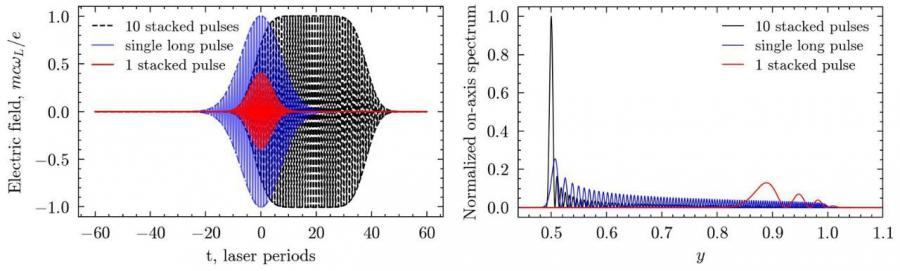
Comparison of different forms of laser pulse and their effects on radiation. The left shows what the electric field looks like in time when 10 short Gaussian pulses are docked (summed) compared to one short pulse and a single Gaussian pulse of the same amplitude and total energy as the docked pulse. On the right are the corresponding normalized spectra of reverse Compton scattering: you can see how the choice of pulse structure changes the distribution of radiation energy.
As shown in the image, the coherent coupling of ten moderately strong Gaussian pulses gives an almost flat top of the electric field (black curve). Such a docked pulse produces about three times as many photons in the range ± 1% of the spectral peak as a single long Gaussian pulse, which is a direct indicator of an increase in spectral brightness.
In addition to narrowing the spectrum, the coupling of pulses allows for multi-color radiation. In another configuration, the researchers divide the train of pulses into three groups with different amplitudes, forming a "stepped" (ladder) envelope — in fact, three flat levels of intensity over time.
When an electron beam interacts with such a stepwise pulse, the resulting gamma spectrum naturally splits into three well-separated peaks, each corresponding to its own intensity level. In other words, a single laser-electron interaction can generate several well-defined gamma "colors" at once. It is fundamentally important that these several colors are a direct imprint of the nonlinear Compton regime: each intensity step leaves its own spectral line, a phenomenon that simply does not occur in the linear (single-photon) scattering limit.
The work is directly related to the design of the intensive Compton source at the National Center for Physics and Mathematics (NCFM) in Russia, where it is planned to create a new generation gamma-ray source with a narrow spectral line. Numerical calculations were performed on Skoltech's Zhores supercomputer with the support of a national grant in the field of AI research.