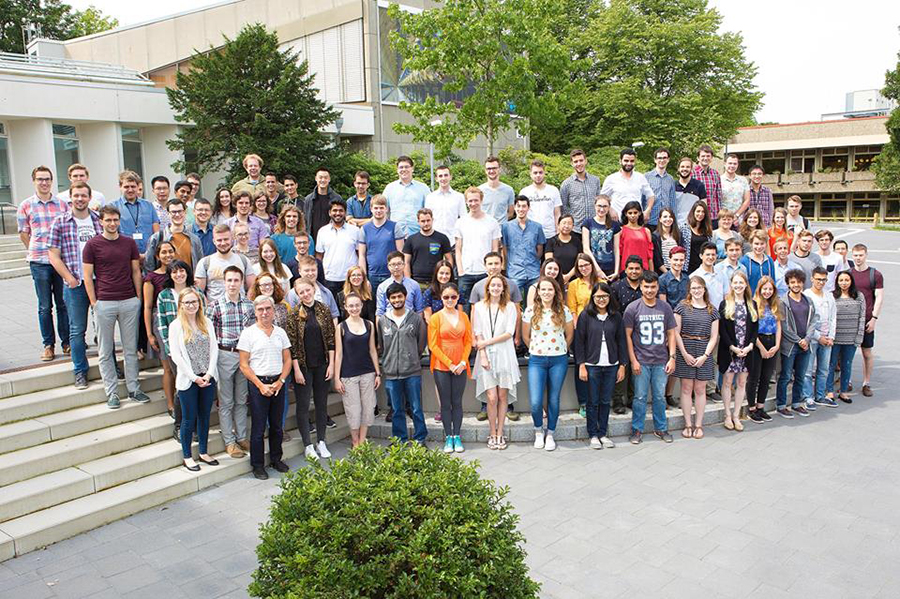
Students of the Institute of Laser and Plasma Technologies have had an internship in DESY (Deutsches Elektronen-Synchrotron), Germany. It is a scientific center, whose activities are mainly focused on the synchrotron radiation, acceleration of particles, but also covers a wide range of research conducted in the areas of laser physics, astrophysics, biomedicine, and solids.
Sergey Ryabchuk: I found a summer program at DESY by myself. I found out that in addition to lectures, students are encouraged to join one of the research groups and work with staff on the current experiment for seven weeks. I chose the direction “Lasers and Optics”, because it coincides with my specialization I’m getting at MEPhI.
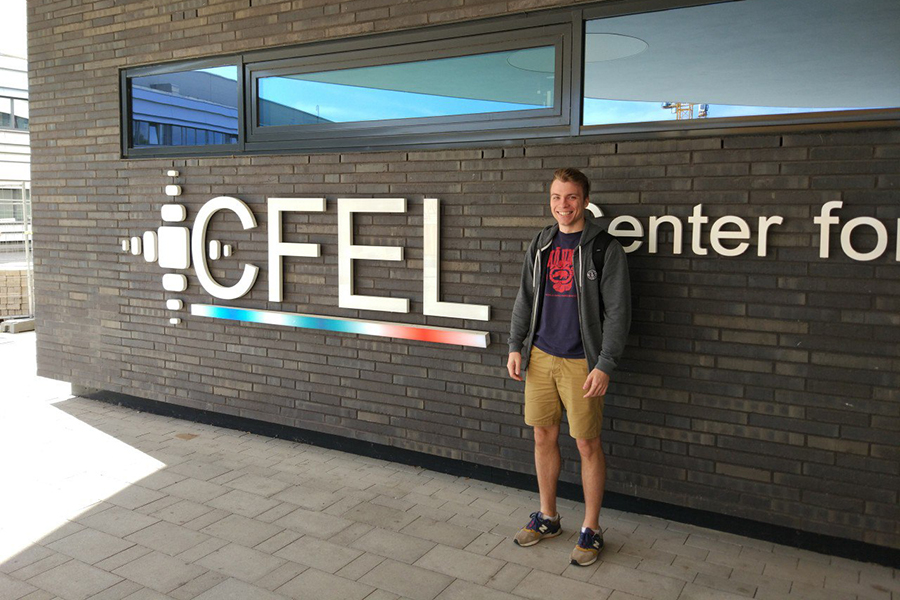
I was assigned to a Ultrafast Optics and X-Rays laboratory, located in the Center of Free Electron Laser (CFEL). I was supervised by a postgraduate student from Italy who is working to obtain pulses of very short duration, shorter than 10 femtoseconds (10-15 s).
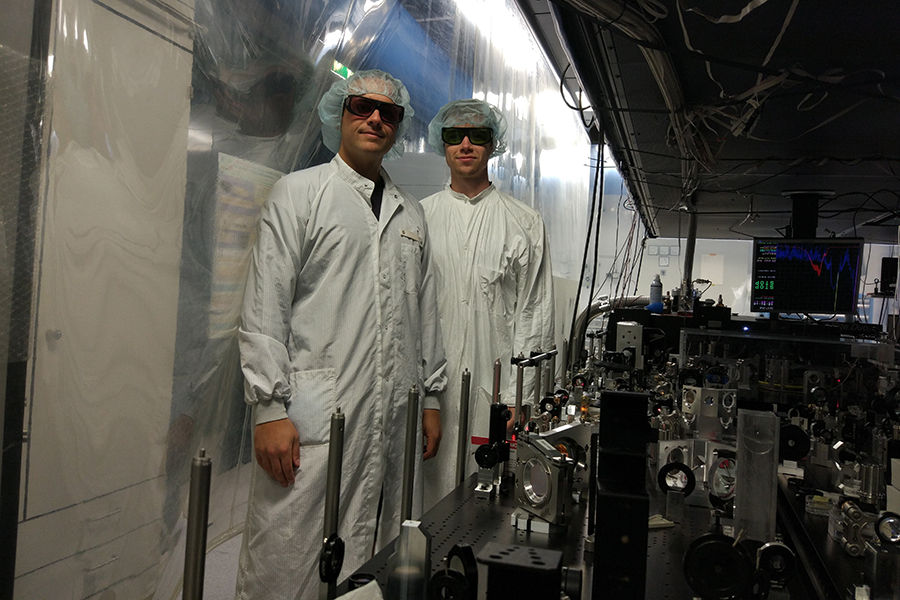
The first phase of the experiment, in which I participated, produced the generation of supercontinuum with a spectral width of 1.2 – 2.2 micrometers and an energy of 1.5 µJ. Then, the radiation was amplified using the technique of optical parametric amplification in three stages. My immediate task was the optimization of the third stage. As a result of our work we managed to achieve energy of 850 µJ – that is, to strengthen the momentum for more than 500 times. After compression of the pulse in time we obtained a duration of 7.6 fs in the optical compressor, which corresponds to less than two oscillation periods of the light wave at the central wavelength of 1.6 µm.
DESY is a small scientific town with its infrastructure, which creates all the conditions for fruitful scholarship. Summer school has allowed me to work in an international group of scientists on an urgent task to obtain great experience in the field of laser physics. The organizers also arranged a variety of activities, such as barbecue or boat ride in the port of Hamburg. It was great!
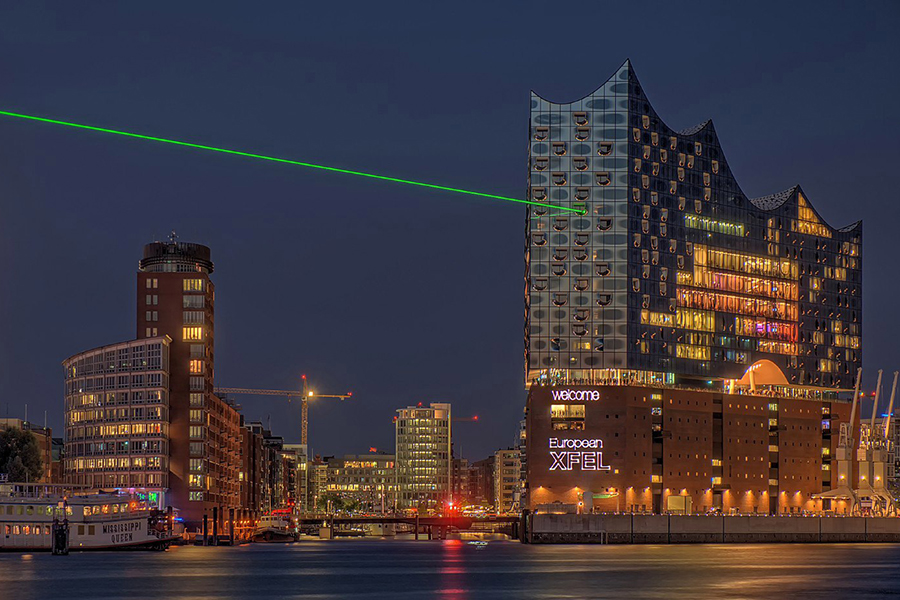
Dina Farrakhova: I interned at the European XFEL. It is the world's most powerful x-ray free electron laser, and it is necessary to study different biological structures, very fast processes and extreme states.
I just got to the opening of the laser. The share of Russia is the second largest after Germany, and this event was dedicated to Russian culture. There was vinegret (traditional salad) on the table, we drank “Tarragon”, listened to Russian music and played games.
The Sample Environment group, where I’ve interned, develops modern methods of samples’ delivery for all instruments of European XFEL. We mixed the crystallized protein with various substances and examined the changes of its structure. I measured the mixing time of the streams to calculate when it is needed to bring x-rays to detect its structure. Based on my experiments, colleagues will be able to display the data value and bring the x-ray radiation.
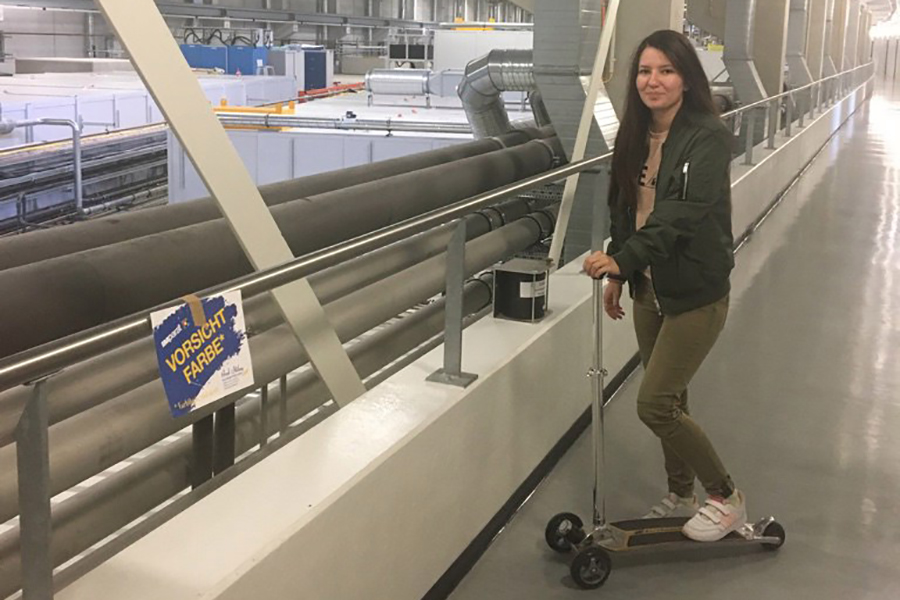
I liked both the internship at the European XFEL and the country itself. Everything in Germany is on the minute. Public transport runs exactly on schedule. This is their strong point.
Semen Goncharov: I undertook internship at the laboratory of Ultra fast Optics and X-Rays in the Center of free electron lasers (CFEL).
I was appointed to the scientific group that deals with high-energy lasers. To obtain radiation with the required energy it is used Yb:YAG amplifier, which is used for multi-pass amplification of laser radiation usually from 2-3 µJ to 100 MJ, and later up to 1 J, which in turn is used further, for example, for the generation of higher harmonics for x-ray lasers, terahertz radiation, etc. The main problem of this scheme is that the crystal is heated during the repeated passage of the laser radiation, which causes the occurrence of the thermal lens effect, which in turn spoils the beam quality.
My main task of the internship was to simulate and experimentally implement a simple optical device that would be able to compensate for the resulting effect of the thermal lens. Simply speaking, it is a small vacuum chamber with a deformable mirror. If you change the pressure inside the vacuum chamber, the mirror will bend (depending on the pressure inward or outward) and behave like a parabolic mirror. Thus, it is possible to align the curvature of such a mirror with the curvature occurring in the crystal due to the heating, thereby compensating for the effect of the thermal lens, and to prevent the deterioration of the quality of the beam.
I was offered to verify experimentally the theoretical model after performing calculations. We measured curvature of the mirror, bending under the pressure depending on the pressure inside the vessel, by interferometric method, and the results correlated well with the theoretical calculation.
The problem of compensation of the thermal lens effect is not new, but my method is simple and cheap to implement and very flexible in practice, which is an important factor in experimental physics.
My supervisor and the laboratory staff provided comprehensive assistance throughout the stay period in DESY. The situation in the laboratory is always relaxed, allowing you to join the team very quickly and dive into workflow. The program is organized in such a way that you don’t have time to get bored in the free time. The organizers tried to fill the leisure time in many different ways: from visiting the most interesting places in Hamburg to travelling to other German cities.