Turbulence at clear sky is the most unpleasant kind of vortex drifts, which unexpectedly occur in cloudless space with perfect visibility. The plane gets between air flows, which differ a lot in direction and speed of movement, temperature and density. This is the kind of turbulence the air flight SU-270 Moscow-Bangkok of “Aeroflot” company faced, as the result of which 27 people suffered: 24 Russian people and 3 Thai people. They got injuries of varying severity.
Turbulence at clear sky is impossible to be detected in advance; on-board equipment can not feel the approaching of the dangerous zone. The majority of injuries, which passengers and cabin crew members get, are connected mostly with the fact that pilots don’t have time to warn about upcoming bumpy air and the necessity to buckle up.
Scientists have long been working out methods of distant detection of turbulence when the sky is clear. Russian physicists from MEPhI suggest to use a “muon hodoscope”, which allows trace muon trajectories in atmosphere, for detection of zones of possible turbulence. Muons are elementary particles, which appear as the result of interaction of space articles (protons and nuclei) with the Earth atmosphere. Going through the atmosphere, muons lose energy, and their flow changes. The quantity of lost energy depends on characteristics of the atmosphere substance where a muon flies. Electromagnetic fields, temperature, air rarity, water vapor content impact losses. It is possible to trace, describe, and predict atmosphere processes by the character of changes of the muon flow.
The principle of work of the facility was explained by Professor of MEPhI Scientific-educational centre NEVOD Igor Yashin: “The hodoscope records changes of each muon, and we get a picture of atmosphere, which is similar to X-Ray one. Currently, we have a working stationary hodoscope HURRICANE, and a mobile version of the detector.”
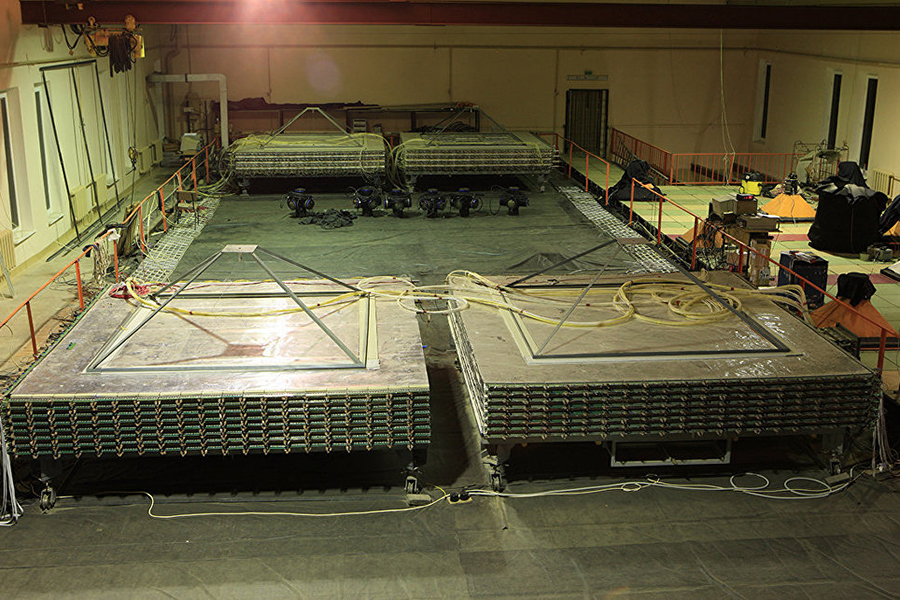
Muon hodoscope HURRICANE
Characteristics of the device allow transfer it to any place on Earth, a small electronic generator or a domestic socket can be its power source.
“The facility has been developed especially for analysis of variations of muon flow, including tracing atmosphere processes, and we have great expectations that research of the turbulence of clear sky will be in demand. The main question for us is the device calibration at real events,” Igor Yashin explains. “We can trace any processes in atmosphere where there are large-scale changes of the density gradient. In the incident above Thailand it has been reported about a 700-meter “air pocket”: it means that in this zone there has been very high air rarity, and we would definitely see it with the help of a hodoscope. Using muon diagnostics, we can see the atmosphere in the real-time mode, research and predict the development of powerful atmospheric phenomena at heights of up to 15 km. It is necessary just to create a network of similar devices.”