Scientists from MEPhI have presented a detector that is able to distinguish smells better than a service dog.
A small device, remotely resembling a projector because of the round hole on the front panel, is a real pride of the Department of Physics of Micro- and Nanosystems (№ 81) of MEPhI. Its creators, physics scientists Alexander Chistyakov, Gennady Kotkovsky and Artem Akmalov, are proud to demonstrate the development they have been working at for more than ten years. And yes, they have something to be proud of, because there is no analogue to this development in any country in the world.
"It's a detector for detecting explosive vapors and identifying them," explains Gennady Kotkovsky. “But we call it an electronic nose.”
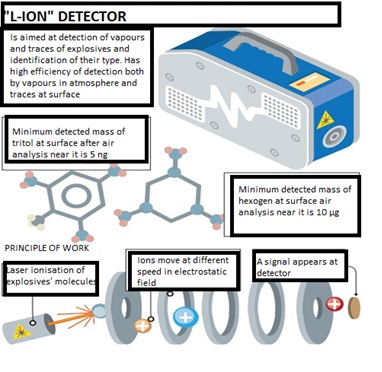
The electronic nose is able to sense and recognize traces of almost all types of explosives - from saltpetre to hexogen. And the latter is not always determined by even the most advanced American technology, although, it would seem, someone, and the US special services are professionals in fighting against terrorism.
"Trotil is identified by virtually all spectrometers," Kotkovsky says. “It's all about the concentration of fumes.”
TNT has a large concentration of it, the fumes are volatile. Therefore, it is easy to determine even by not too sensitive technique.
And the hexogen concentration of fumes is much less. Therefore, until now the instruments could not catch the fumes of this substance. Even the dogs gave a crash in the determination of hexogen! So, if the substance is specific, a special detector is needed.
A round window resembling a projector lens is nothing more than a hole for a laser beam.
"The outgoing beam evaporates the molecules of substances, thereby increasing their concentration," Kotkovski explains. - And after that they are easy to recognize.
The scientist brings a small metal jar to the hole.
"It's a simulator of fumes," he comments. “There is a very small amount of hexogen.”
The device became agitated. A red line appeared on the screen above the green chart. Near the schedule, the inscription "Alarm" was displayed, and the cause of the alarm appeared.
- RDX, - the scientist reads the inscription. - This is the chemical name of hexogen.
According to physicists, US intelligence agencies use similar spectrometers, but without laser ionization. In addition, they determine most substances in a rather conservative way.
“The police are wiping the surface with a cotton napkin, which is then injected into the heater of the appliance,” Kotkovsky says. “Thus, everything that is on a napkin, evaporates and is recorded. But this is very long, and a dangerous way!” “If to talk about recognition of drugs and alcohol, at first you need to get a license to work with drugs," the scientist continued. “And alcohol is a very volatile substance, so registering it with an electronic nose is like chipping nails with a microscope. There is more simple devices to determine it.”
However, the peaceful potential of the spectrometer is also quite large.
“It can be used in biochemistry to detect pathogens in the air. If it is reformatted, it will be able to detect viruses from a distance," Kotkovsky assures. “And we are already doing this work.”