A postgraduate student of the TU Dortmund University (Germany) Alexander Sandrock has conducted a two-month internship at the Scientific-educational center NEVOD, where he worked with calculations on energy loss by muons. The internship was the result of the meeting of Alexander and MEPhI representatives at a conference, where scientists had discussed current achievements in this field.
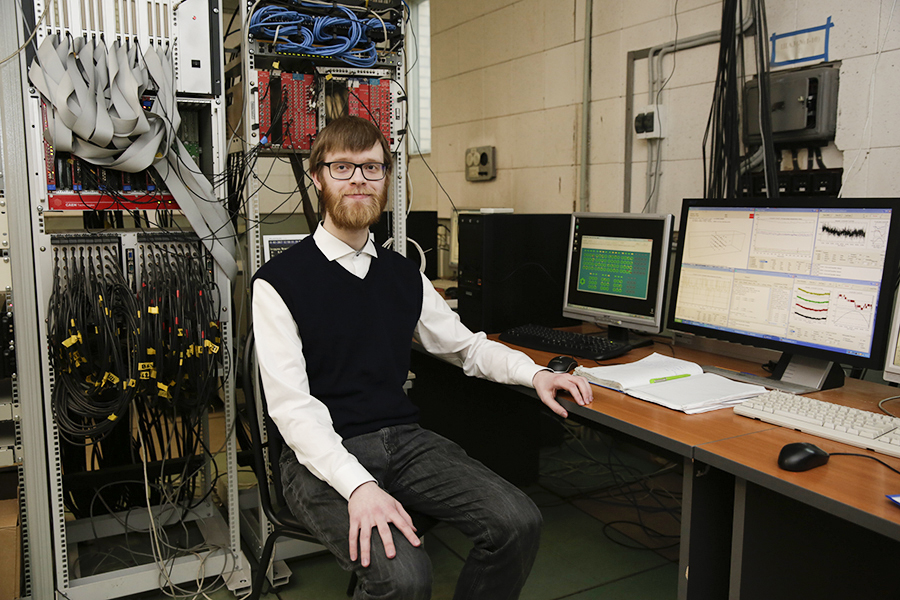
Finishing the internship, Alexander agreed to answer a few questions and share impressions about his staying in MEPhI:
– What was the aim of your internship in MEPhI?
– I have calculated the energy losses more accurately. This is important for underground detectors, similar to NEVOD, such as, for example, the IceCube, which is located 1500 meters beyond the surface of the Antarctic ice. When muons from the atmosphere travel through the ice to the detector, they are high-energetic; if they have energies in the petaelectronvolt range, they can travel several kilometers so they can undergo many energy loss processes and therefore it is necessary to calculate it accurately. Here I have been calculating the next-order corrections in the basic theory for one of the most important process by which muons lose energy. Currently we are writing an article to publish these results. I hope that the data obtained here will assist in the modelling, undertaken in the analysis of data collected from detectors such is the IceCube.
– What are the results and impressions of the internship?
– I managed to do calculations I came for; I get acquainted with interesting people. By the way, I started to learn Russian language before the trip, but still there are difficulties with listening comprehension, so it was a very interesting experience to be in a country where you are not perfectly fluent in language. People speak too fast, but I can't constantly interrupt them: “Wait a moment! I have to look up in a dictionary what you’ve just said.” People here are very helpful and responsive, speaking Russian with me more slowly and repeating what they said. For instance, I was talking to a man I met in a greenhouse for half an hour in Tsaritsyno or a woman in a laundry.
Sometimes I lacked words, so I was using a dictionary, but had no problems with mathematics and physics, as I read such articles on a regular basis.
There was an interesting experience in the canteen: there is a menu and bowls with food, and it was difficult for me to correlate what is what. In Dortmund I was accustomed that the menu is available through the Internet so one could look it up before going. If I could have done it here I could have translated it. Food is not a vocabulary that I’ve been learning. Now, for example, I can talk a bit about the weather.
– What can you tell about the weather in Russia?
– It's cold. When I wrote messages to my colleagues in Dortmund, they envied me because the snow has already gone in Germany.
– What places did you visit in Moscow?
– I didn’t visit the Kremlin, as I was there about 12 years ago. But I visited the Tsaritsyno Park, the Historical Museum, the St. Basil's Cathedral. One day I spent visiting the most beautiful subway stations, for example, Komsomolskaya and Belorusskaya. And I would like to mention the Cathedral of Christ the Saviour – it is particularly nice.