One of the relevant tasks of nuclear power is enhancement of the NPP operation time from 4-5 years to 18-20. Many organisations work on increasing of the lifetime of fuel elements, but it is also necessary to create regulatory organs of new generation with compact radiation-resistant absorbent irons, having high physical efficiency. Currently, water-cooled reactors work on thermal neutrons, where power is regulated by the movement of neutron-absorbing elements, the material for which is boron carbide.
But nuclear-physical properties of boron suppose 4-5 years of exploitation, after which it is necessary to replace power control rods, containing it, and to stop NPPs for that.
The necessity of the enhancement of the operation time of NPP reactors stimulates search for new effective neutron-absorbing substances, which should answer to very high requirements. Such requirements include high efficiency of neutron swallowing during exploitation; high radiation stability; compatibility with construction materials up to the temperature of 800о С; corrosion resistance, and, the most important, long service life (up to 20 years).
One of the most perspective neutron-absorbing materials for usage in absorbing elements of reactor control and safety system is dysprosium hafnate, which corresponds to all the announced conditions (research in this sphere was conducted by employees of JSC "Ssc Riar").
Although dysprosium is quite an expensive rare earth element, in the long term it is more advantageous than boron. This is due to the fact that under the swallowing of neutrons new neutron-absorbing isotopes are formed. Hafnium also absorbs neutrons, but with dysprosium, it forms a dense ceramic material - hafnate dysprosium, preserving its properties at high temperatures and high mechanical stress.
However, the usual coarse-grained powder of hafnate dysprosium is poorly compacted, occupies a large volume, and is uncomfortable to work with in the reactor core. The team of scientists from MEPhI research laboratory under the supervision of Professor V.F.Petrunin proposed to use this material in the nanostructured state to solve the problem. It was necessary to develop a method of producing hafnate dysprosium nanopowder and method of its compaction.
A two-step chemical method, based on obtaining of oxyhydroxides or hydroxides of the corresponding metals, followed by calcination to obtain a precursor of oxides, was chosen for the synthesis of nanocrystalline powders of hafnate dysprosium.
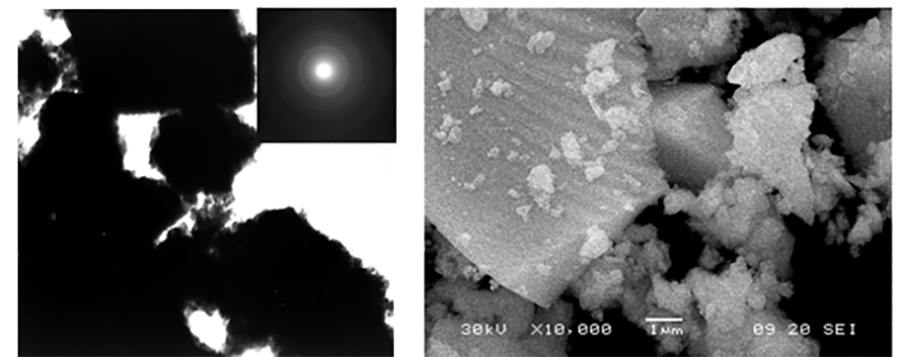
Electron microscopy of the precursor powder and the synthesized nanocrystalline hafnate
In the process of work a technological process for getting single phase of low aggregated hafnate dysprosium nanocrystalline powders by chemical vapor deposition from solutions of salts was developed, constructed and verified by experimental batches of hafnate dysprosium powder, having a crystallite size of not more than 10 nm and specific surface area of at least 10m²/g.
Our specialists used uniaxial compaction of nanocrystalline powders with subsequent isothermal annealing compacts as a method for producing ceramic tablets. The density of the ceramic tablet was very high - close to the theoretical (95-98%), that is a unique result, which has not yet been reached in the world.
As a result of studies conducted by state order SC "Rosatom", the patent of the Russian Federation №2565712 for the invention "Method of getting nanocrystalline powders of hafnate dysprosium and ceramic materials on their basis", by which to obtain a finer powder and to reduce the duration of the process of obtaining hafnate dysprosium the stage of drying and calcining a mixed hydroxide of dysprosium and hafnium is first performed not in a muffle furnace, but under the action of microwave radiation.
The invention of MEPhI scientists can be used for the production of neutron-absorbing control rods of materials management systems of new types of reactors with long life operation.