Engineers of the European x-ray free electron laser (European-XFEL) have launched first electrons into the cool main accelerator complex of the device. Electrons, which left the injector, have flown their first accelerative zone, a beam-squeezing section and finished their way in 150 m. Tests became possible after full cooling of superconductive microwave resonators of the accelerator complex by liquid helium.
Acting Deputy Head of the Department of Physics of Solid Body (№70), Professor Alexey Menushenkov spoke about peculiarities of the free electron laser and highlighted the role of Russia in the construction of the European x-ray free electron laser.
- European x-ray free electron laser is an absolutely different kind of laser in comparison with the ones we are used to. Radiation in it, as well as in orbital accelerators, synchrotrons, is created by ultrarelativistic charged particles, moving along distorted paths in the magnetic field. Unlike synchrotrons x-ray free electron laser is a linear accelerator, in which electrons pass rather long distances in so-called undulators, devices, consisting of a large number of magnetic poles, opposed to each other. As a result, the movement of an ultrarelativistic electron, i.e. practically at the light speed, goes along serpentine path of travel. In the process of travel electron at each curve radiates synchrotron radiation, which, thanks to the self-amplification effect of spontaneous emission (SASE) and a large length of the undulator leads to the fact that radiation at the output of undulator becomes coherent.
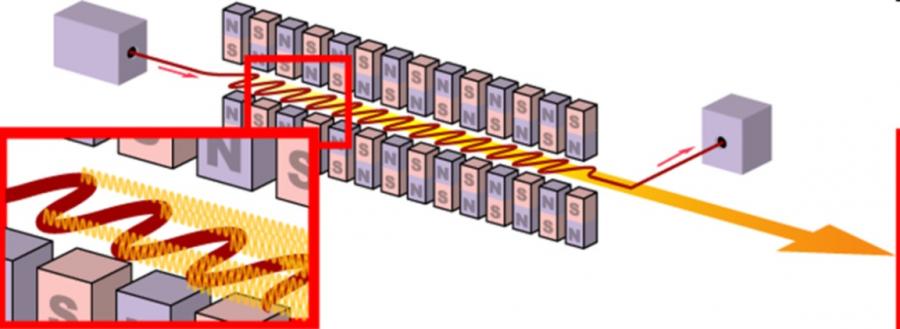
Schematic representation of electron travel in undulator
Free electron lasers can be subdivided into three groups of usage in different fields of photon energy. For example, a laser, recently constructed in China, works in the field of ultraviolet radiation and soft x-ray. First ultraviolet free electron laser in the soft x-ray region FLASH started working in 2005 at the Center for Synchrotron DESY (Hamburg, Germany). In terms of the intensity of the radiation brightness the Chinese analogue might have as well surpassed it, but it is not the most important achievement in this area.
In addition, there are lasers in the infrared region, i.e. with large wavelengths with low energies of quantums. They are very important for the study of the interaction with living matter. In Russia, such a laser is successfully working in BINP (Novosibirsk).
The third type of laser operates in the hard x-ray radiation. The first X-ray free-electron laser, LCLS, was built in Stanford (USA) in 2011.
Currently, the construction of the European XFEL (Hamburg, DESY center) is coming to an end. The laser length is three kilometers in a tunnel under the ground. The share of the Russian participation is the second-largest after Germany, and is 25% of its total cost.
Currently, there is a discussion and creation of experimental stations at different levels. The working group on the development of Russian proposals, created at NRC "Kurchatov Institute", includes several MEPhI representatives: Associate Professor at the Department №70 Valery Nosik, Professor at the Department № 32, DESY employee Ivan Vartanyants, Assistant Professor of Department №21 Pikuz Sergey and me.
The X-ray laser radiation exceeds in the brightness by 10 orders of magnitude the brightness of the most powerful synchrotron radiation source. The feature of XFEL is a very short pulse width, consisting of spikes with femtosecond duration. As a result, it is possible to observe the impact of coherent X-ray radiation with matter down to the atomic and molecular level, study the chemical and physical processes of the nanoworld, biophysics and medicine. Now a large part of the research team is preparing experiments on laser.