Most often, when we think of the human brain, we can think about the electrical pulses or neurons. But, perhaps, there is a thought we can not avoid: the brain is like a huge and complex enterprise, in which hundreds of thousands of processes are performed every second. The enterprise is striking in its scale: about 100 thousand chemical processes takes place in the brain in a second, the human brain has up to 100 billion neurons.
Neuron is an electrically excitable cell that processes, stores and transmits the information with the help of electrical and chemical signaling. Neurons form the brain’s structure such as the cerebral cortex, cerebellum, medulla oblongata. It can be said that the brain structures are highly organized colonies of neurons that "communicate" with each other. Inside the colonies neurons also "communicate" with each other, via an extensive network of appendices - axons - the neurons are connected with the sense organs, muscle cells, etc.
How do neurons "communicate"? This goes on via synapses. Synapse is a contact area for nerve impulse transmission between two cells, both between two neurons and between the neuron and the target cell. Pulses are transmitted electrically or chemically with the help of special substances - neurotransmitters: an excited neuron "throws" a neurotransmitter into the synaptic cleft and impacts receptors, located in the membrane of an "attacked" neuron.
So, how does a neuron deliver a neurotransmitter from the site of generation to the synaptic cleft, and then "throws" it? A neuron is not a rubber bulb but a nerve cell! It turns out that for this "at the service" of the neuron there is a special transport - as well as on a normal large enterprise, the interaction between of whose parts may occur through, for example, trucks. In case of neurons "trucks" are walking molecular motors, protein complexes whose parts are able to move relative to each other.
Molecular motors are in the basis of any active movements, made by living organisms, from the movement of chromosomes during cell division to muscle contractions. Circulation of neurotransmitters and waste molecules at synaptic connection are carried out by walking molecular motors of three families: kinesin, myosin V, and dynein.
Apart from neurotransmitters walking motors deliver from a cell nucleus to its periphery mitochondria, in membranes of which molecules of adenosine triphosphate (ATP) are produced. ATP is a universal energy source for all biochemical processes in living systems. It acts as fuel for kinesin and other molecular motors-transmitters.
Scientists of MEPhI Department of Mathematics of and Physics Department of Moscow State University on the basis of the analysis of works on walking molecular motors (kinesin, myosin V, dynein) have constructed and investigated mathematical models of their functioning.
"Models are a system of two coupled equations,” says Associate Professor of MEPhI Mathematics Department Vladimir Trifonenko. “Model parameters are determined by the functional circuits of motors that are based on experiments using X-ray diffraction analysis, cryogenic electron microscopy, laser tweezers, and high-speed methods of video microscopy with the use of dot labels (Q-DOT).”
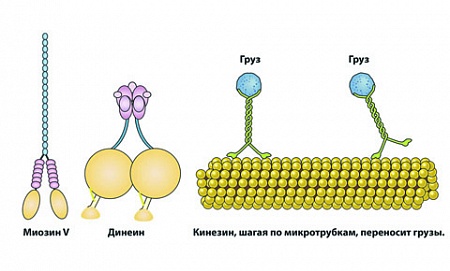
The operating principle of a molecular motor. Picture by Vyacheslav Polezhaev
The results of scientists’ work this year have been published in the journal "Advances of Physical Sciences". According to Trifonenkov, the value of their work is mostly "theoretical and ideological". However, such studies may find practical application in medicine. "Some of the disease and the effect of toxic substances is connected with the abnormality of transportation between neurons," explains the researcher.
Experts in nanorobotics are interested in studies of biological molecular motors. One of the areas of their work, the creation of nanorobots, capable of moving inside the human body, is also associated with the medicine. A powerful nanomotor you need to make such medical nanorobot move.
Biological molecular motors are quite good from a technical point of view, the characteristics (ratio of the size, the mass, generated mechanical movement, and energy consumption) and in mass production, which modern techniques of genetic engineering and biotechnology allow, can become cheaper, than their artificial analogues.