High electroconductivity and optical transparency of graphene have determined its reputation of the silicone successor in integral microcircuits. Although it has been speculated long that graphene is a material for nanoelectronics of the future, there is a lot of unknown for scientists about this carbon modification and how it will act in microscopic devices.
Meanwhile the development of the modern technology of computer processors’ production is likely to reach its limit. According to Moore's empirical law, the number of transistors, placed at the integrated circuit crystal, is doubling nearly every two years. The new technology uses semiconductor elements of size of one 100-thousand size of a millimeter.
“Until the recent time practically all the technologies in electronics were based on so-called single-electron physics, i.e.physical phenomena, which can be modelled by so-called system of independent electrons,” says MEPhI theoretical physicist Boris Narozhniy. “This approach stops working when the size of a system becomes too small. Then electrons start to “hustle in the tightness”, i.e. interact. We want to find out how the materials are arranged, in particular, graphene, and how they act as components of different devices, usually, with sizes, measured in nanometers, in the conditions of electrons’ tightness.”
The Coulomb entrainment helps researchers understand the microscopic structure of materials and their behavior in nanodevices. It was first predicted by a Soviet scientist M.B.Pogrebinskiy in 1977. Currently this physical effect is used by scientists of many leading world laboratories.
Imagine a sample composed of two close to each other, but electrically secured conductors. Passing the electrical current through one of them, scientists measure electrical response, current or voltage, appearing in the second conductor. It seems that electrical insulation should exclude this electrical response. But electromagnetic fields, energized by charges, moving in one conductor, influence charges inside another conductor, entraining them, provoking to start moving or change their movement. This effect is called Coulomb entrainment.
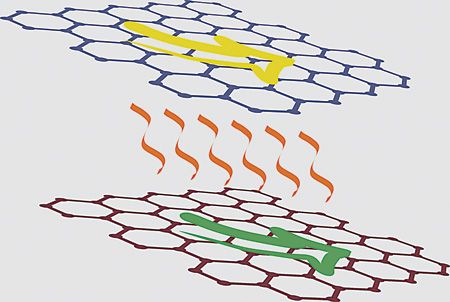
If the electric current comes through one of the layers, i.e. charge carriers are moved, charges in the second layer automatically start moving, following their “partners”
Unique graphene properties allowed scientists suppose that Coulomb entrainment will be special in this unusual material. It really turned out that it is easier to achieve perfect Coulomb entrainment in graphene in comparison with other semiconductor systems. Extremely low temperatures are not necessary for it, but very high magnetic fields are required. Perfect entrainment appears because of exciton condensation in the sample (an exciton is a bound state of an electron and a hole, in other words, two free carriers of the opposite sign: an electron is negatively charged, and a hole is charged positively).
In two-layer systems one of two carriers belongs to one layer, the other-to another one. If electric current passes through one of the layers, i.e. charge carriers are moved, the charges in the second layer will automatically start moving, following their “partners”. The charge movement in one layer will not just slightly change the charge behavior in the second one, they will start dancing a “couple dance”, fully synchronizing.
For the first time, perfect Coulomb entrainment in a system, composed of two graphene sheets, was observed by Harvard scientists. Boris Narozhniy works in this field, not practically, but theoretically.
“Our last calculations are dedicated to graphene properties under high, close to room temperatures,” says Narozhniy. Evidence suggests that in this temperature mode exciton effects can play an important role in the Coulomb entrainment, although the temperature of the exciton condensation is very low in one graphene sheet. From the practical point of view the most interesting are material properties under the room temperature.” Previously, he together with colleagues many times theoretically predicted or explained the results of experiments, connected with the Coulomb entrainment. Narozhniy was also one of the first to suggest study this effect in graphene early in 2007, and this year he published a review on this topic in the Reviews of Modern Physics journal.
If we once again return to the perfect entrainment, described above, we can notice, that it reminds of so-called quantum entanglement, which scientists used for quantum teleportation. According to MEPhI researcher, the Coulomb entrainment phenomena is very important both as an experimental instrument for the research of interacting electronic systems in solid bodies and for potential applications, based on noncontact energy transfer.
In the macroworld nowadays radiowaves are now used for noncontact energy transfer. They conduct the information transfer at the moment when you set a noncontact key or a credit card to the scanning machine. Narozhniy thinks that in the macroworld and, in particular, in electronics of the nearest future the noncontact energy (charge, information, etc.) transfer can be accomplished because of a physical mechanism, responsible for the Coulomb entrainment. And, possible, the studying of graphene and its unusual properties will allow such electronics appear faster.