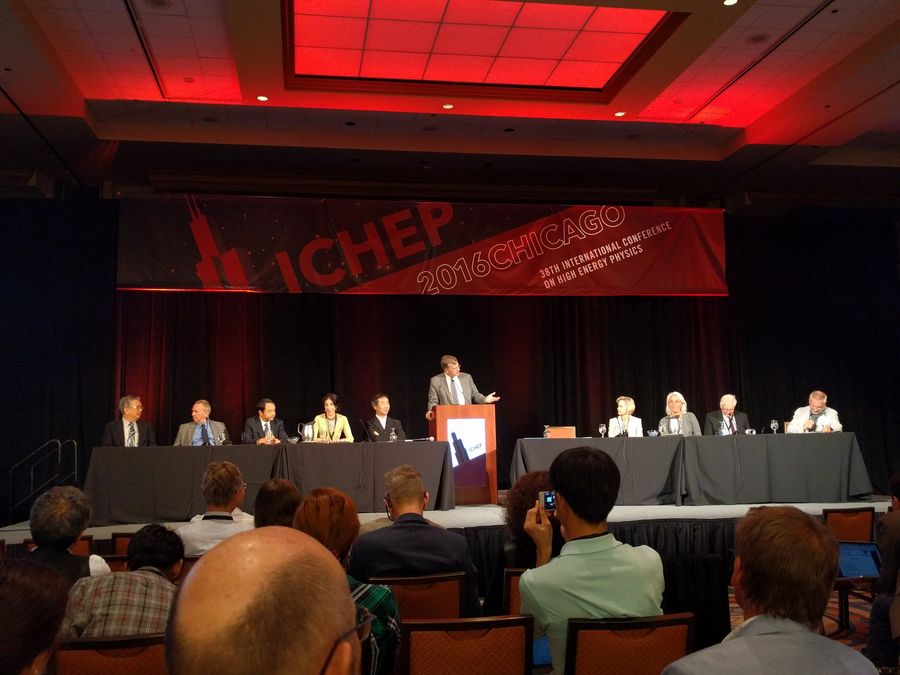
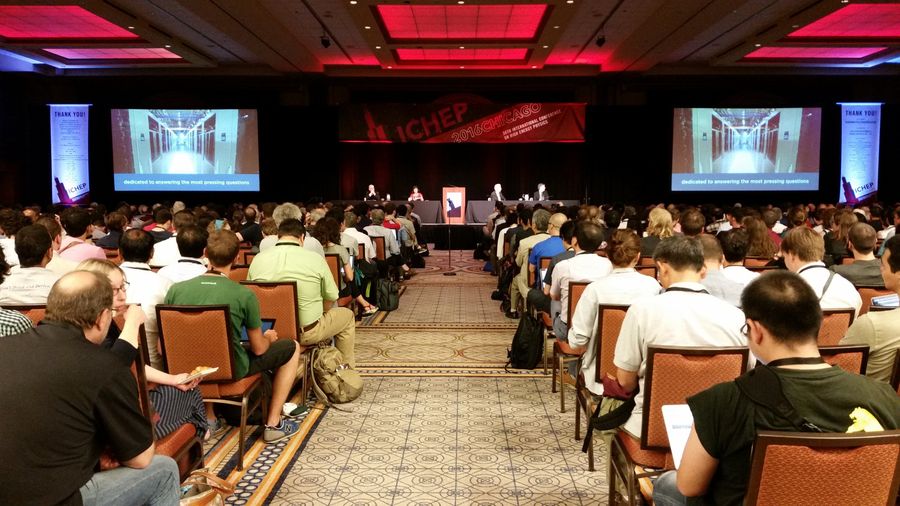
Physicists have represented a wide range of results from the Large Hadron Collider (LHC) experiments at CERN at the ICHEP 2016 conference in Chicago (https://home.cern/topics/large-hadron-collider).
Now, with a bulk of new data, the experiment collaborations can continue last year’s research at the unprecedented energy level of 13 TeV. The scientists have represented more than 100 different new results, including many analyses based on 2016 data.
Physicists in preparation for the ICHEP 2016 conference (Image: CERN)
Thanks to the high performance of the LHC, experiments have already obtained about 5 times more data in 2016 than in 2015, in just a few months of operations. The LHC exceeded its design luminosity in June (a parameter measuring the number of collisions per second). The peak luminosity reaches about 1 billion collisions per second – in such conditions even the rarest processes at the highest effective energy could occur.
So, the LHC is exceeding all the expectations and the final objective of 25 inverse femtobarn of proton–proton collisions is practically fulfilled.
The Worldwide LHC Computing Grid has surpassed all previous records, with more than 25 PB of data stored and processed since the beginning of the year.
“The LHC has reached its nominal luminosity, now exceeded by 20%,” said CERN Director for Accelerators and Technology, Frédérick Bordry. “It’s a major achievement and we can be confident that we will go beyond planned for the full second run of the LHC.”
Physicists have worked hard in the past months dealing with the huge amount of data recorded by the LHC experiments. With a larger data set now analysed, it is possible to conduct more precise measurements of the Standard Model processes and more sensitive searches for the direct production of new particles at the highest energy. As an example, the 125 GeV Higgs boson, discovered in 2012, has now also been observed at the new energy of 13 TeV with higher statistical significance. In addition, both ATLAS and CMS experiments have made more precise measurements of Standard Model processes, especially looking for abnormal particle interactions at high mass, a very sensitive but indirect test for physics beyond the Standard Model.
“This is one of the most exciting times in recent years for physicists, as we dig into the unknown in earnest: the particle physics at an energy never explored before,” said CERN Director for Research and Computing, Eckhard Elsen.
ATLAS and CMS have also looked for traces of the direct production of new particles predicted by Supersymmetry and other exotic theories of physics beyond the Standard Model, but there has been no compelling evidence of new physics yet.
In particular, the intriguing news about a possible resonance at 750 GeV decaying into photon pairs, which caused considerable interest from the 2015 data, has not appeared in the much larger 2016 data set and thus appears to be a statistical fluctuation. LHCb collaboration has presented many interesting new results, in the domain of flavour physics.
The most important is the discovery of the decay mode B0->K+K-, the rarest B-meson decay into a hadronic final state ever observed, as well as studies of unprecedented sensitivity of CP violation, a very subtle phenomenon explaining nature’s “preference” for matter over antimatter. LHCb have also obtained data that could help to reveal some new phenomena such as the first measurement of the photon polarisation in radiative decays of Bs mesons and determinations of the production cross-sections of several key processes at collision energy of 13 TeV – some of which, at first sight, are at variance with current predictions.
All four experiments have represented results from heavy ion collisions at the LHC. Amongst these, the ALICE Collaboration is presenting new measurements of the properties of quark-gluon plasma – a state of matter that existed a few millionths of a second after the Big Bang. ALICE physicists are studying how the nuclear forces are modified in this primordial state of matter. Researchers also measured the viscosity of the plasma at the new energy and found out that it flows almost like an ideal liquid, the same behaviour is observed at lower collision energies.
“We're just at the beginning of the journey,” said CERN Director-General, Fabiola Gianotti. “The superb performance of the LHC accelerator, experiments and computing bodes extremely well for a detailed and comprehensive exploration of the several TeV energy scale, and significant progress in our understanding of fundamental physics.”
“This time MEPhI scientists have not represented their reports at the conference”, said Department №40 “Physics of elementary particles” scientist Dimitriy Krasnopevtsev, “But in the report of one of our colleagues from China, dedicated to the Z-boson production with associated photons, there are results, obtained by a group of researches of our university. The thing is that the policy of representation of results among large corporations in CERN is built in a way that each participant should at least once represent the results of the whole collaboration (3000 people for ATLAS). Our employees have made a lot of reports this year at large international conferences on behalf of collaboration ATLAS: Moriond2016, LHCP2016, QCD@WORK2016 and ICNFP-2016, not it’s other’s turn to go. However, new results in large collaborations appear regularly, and I hope that people of MEPhI will again soon represent our university at such honorary events.”
Based on the materials of the article.
Photos are taken from the conference website.