Unipolar arcs are a negative phenomenon, appearing between plasma and the first wall in modern thermonuclear facilities. The formation of arcs will lead to the destruction of reactor walls, pollution and cooling of plasma, which is unacceptable in conducting of controlled thermonuclear fusion. However, with all the importance of the solution of this task, the mechanism of arc initiation has not been thoroughly studied yet, that is why the research, connected with this problem, is considered upfront.
Department of Plasma Physics employee Dmitriy Sinelnikov, conducting internship in Nagoya University, Japan, while studying initiation of the arc striking, has found craters on tungsten nano-undercoat from arcs, which look like snowflakes. This data will help move forward in studying of the mechanism of arc striking and, as the consequence, prevent the striking.
New structure, tungsten nano-undercoat, has been detected in experiments on helium plasma interaction with tungsten as a plasma-facing thermonuclear facility material. In such interaction the tungsten surface is covered with a large number of hairs with diameter of tens of nanometers and length up to a micron.
Tungsten undercoat can appear in the divertor field of international experimental thermonuclear reactor ITER, that is why it is important not only to thoroughly study new structure, tungsten nano-undercoat, but also detect problems, connected with its presence, in advance.
To understand the mechanism of arc striking scientists of the Plasma Physics Department have placed a sample, covered with nano-undercoat, into a tube diode – a device, which allows create electric high-intensity fields between a researched sample and a metal anode. After a current break (rupture) has happened under some field intensity in a vacuum gap, the surface emissivity has changed sharply.
The reason for this change, as the electronic microscope measuring has shown, was these craters-“snowflakes”. Craters of that type have not been observed on the metal surface before.
“As we can assume, the craters are traces of the arc, which appeared in a microrupture. Isolated traces are visible in the structure of the “snowflake” crater – craters from cathode spots, barely distinguished on other materials,” Dmitriy Sinelnikov commented, “So, apart from the outer beauty, craters-snowflakes can help better understand the mechanism of the arc movement along the surface. The fact that after the crater formation emissive currents increase significantly allows think of the possibility of the development of cold sources of new-type electrons.”
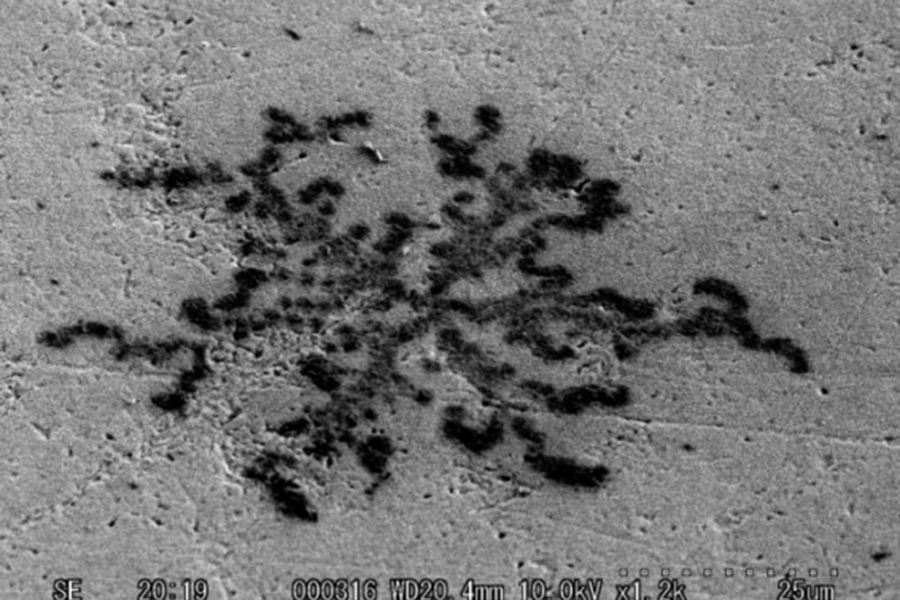
“Snowflake” crater at nanostructured tungsten surface after the rupture