Scientists of MEPhI Institute of functional nuclear electronics together with their Ukrainian colleagues of the Laboratory of magnetic sensors of the Lviv Polytechnic National University have worked out a high-precision sensor cartographer of the magnetic field for accelerators of the charged particles. An article «Experimental evaluation of stable long term operation of semiconductor magnetic sensors at ITER relevant environment» has been published in Nuclear Fusion journal following the results of the work (2015. – 55 (8), V. 55, № 8).
Magnetic field in modern research complexes of megascience level is one of the key tools of charged particles’ flow management. It is used in different accelerator complexes (CERN, NICA etc.), in free electron lasers (FEL) and in complexes of the research of thermonuclear synthesis conditions (TOR, ITER, JET). In managing systems for magnetic field tasks the feedback principle is applied with the required precision, in which values of magnetic field induction are traced by automatic equipment in the dynamic regime with high precision. Magnetic field precision sensors, which should have good linearity in a wide range of magnetic field, temperature stability of the sensitivity coefficient and resistance in a wide range of temperatures, from cryogenic to high ones, are required for it. Additionally, sensors should be compact in size. For a series of experimental complexes stable the long-lasting work of sensors in conditions of impact of charged particles, neutrons and gamma-quantums is an additional requirement. Traditional silicone can’t hold such operating conditions.
Sensor’s detecting element works on the basis of Hall effect, i.e. the transverse stress registration in a semiconductor, which is proportionate to the magnetic field induction. MEPhI Institute of functional nuclear electronics has worked out a technology of Hall sensor chips, from the growth of sensitive material – heterostructure of alloy InAs on GaAs substrate to chip making with the help of microelectronics technologies on the research line in MEPhI Nanocentre. The heterostructures have been grown by the method of molecular-beam epitaxy at Riber Compact 21 facility.
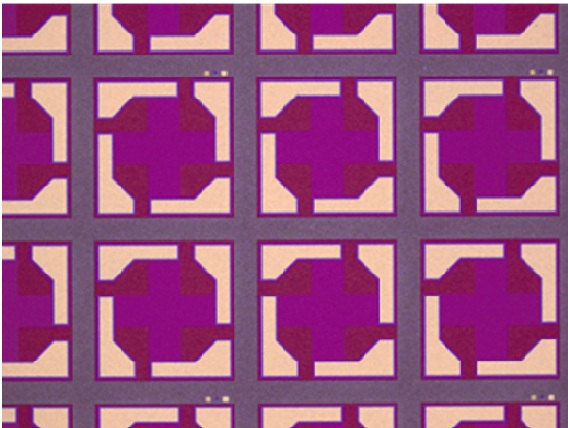
Magnetic field sensors worked out in MEPhI
The developed technology is unique because researchers A.N. Vinichenko and I.S. Vasilievskiy have managed to grow high-quality layers of alloy InAs nearly 100 nm thick on GaAs substrates without using thick transition layers of variable composition InAlAs, which are usually used for the growth on GaAs substrates. Low surface abrasion has been saved, good crystal quality of the active layer has been provided, and distortions, which can put thick transition layer InAlAs in the work of sensors in severe experiment conditions, have been avoided. The sensitivity of the set of constructed devices with heavy doping has been from 18 to 40 Ohm/T. The relative temperature sensitivity coefficient for the best options of heterostructures has been less than 1,5х10-5 К-1.
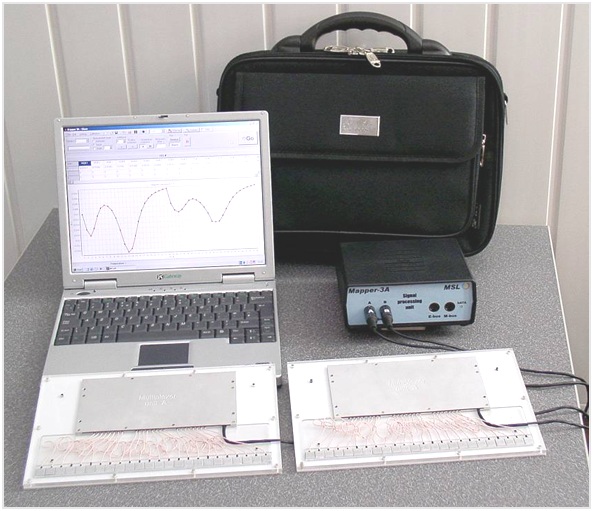
The cartographer
The device accuracy grade is 0.1 mT, the device fractional error ranges from 0,01% to 0,1% depending on the value of maximum measured field.
The parametres of the developed sensitive elements exceed the analogues of large manufacturers, such as Lake Shore (USA) and MetroLab (Switzerland).
The original principle of the periodic in-situ graduation of the cartographer’s sensitive sensors by incorporated calibrated spools is used in the device, which allows conduct magnetic field measuring of high accuracy and mitigate the drift of sensors’ characteristics under the influence of radiation fields.
The cartographer is aimed at the power voltage of 9V or 5V and draws current of less than 0,5А, and works with UART and USB interfaces. The device provides relative measurement error of the magnetic field less than 0,01%.
The magnetic field cartographer has been successfully tested in the National Institute of Radiological Science Japan, M. Kumada for the mapping of the magnet of the medical cyclotron accelerator.