On July, 4th the First International Summer School on Engineering Computer Modelling has started its work in MEPhI, held in the Institute of Nuclear Physics and Technologies (INPT) under the supervision of G.V. Tikhomirov.
For two weeks 13 students fr om Belarus, the Czech Republic, Italy, Russia, Slovakia, Ukraine and Vietnam will be attending specialized lectures and conducting practical tasks on mathematical modelling of physical processes with the usage of Russian program codes. The participants will work out the question of simultaneous modelling of different physical phenomena (multiphysics). The first half of the school will be dedicated to theoretical tasks on MCU, FlowVision and Fidesys programs, which will be followed by the second part where participants will be solving multiphysical individual tasks.
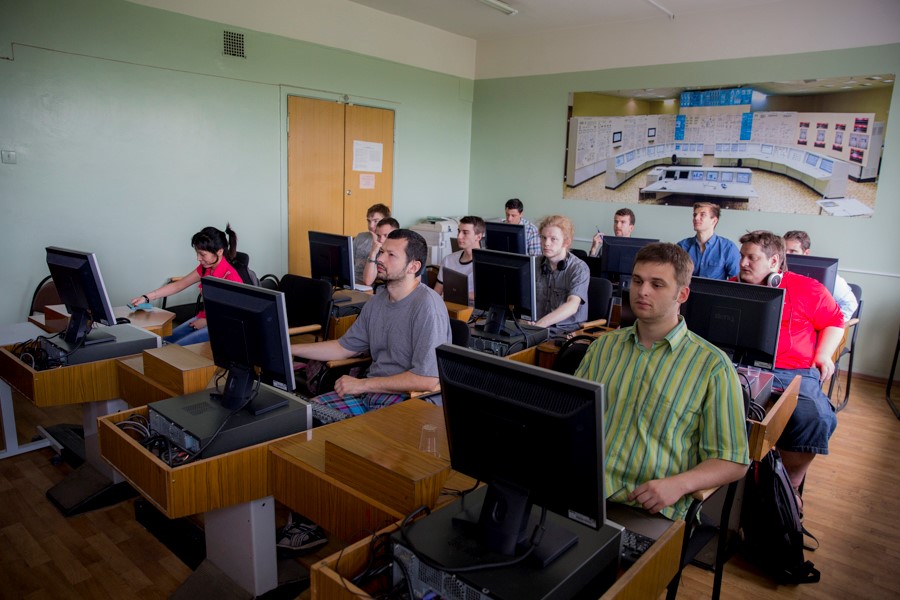
The first program, with which the participants got acquainted, was MCU, created in the Kurchatov Institute. For this purpose one of program developers Denis Shkarovskiy came to the First International Summer School on Engineering Computer Modelling.
It should be mentioned that for some participants the School will be the end of their 2-month internship in MEPhI, conducted on the basis of the INPT Laboratory of Engineering Computer Modelling. During their stay in the university they were working out test tasks for verification of programs of physical processes’ modelling in active zones of nuclear reactors. Three PhD students – Alessandro Tassone from Italy, Filip Osuský from Slovakia and Adrian Filip from Romania – have told why they came to Russia and shared impressions about MEPhI.
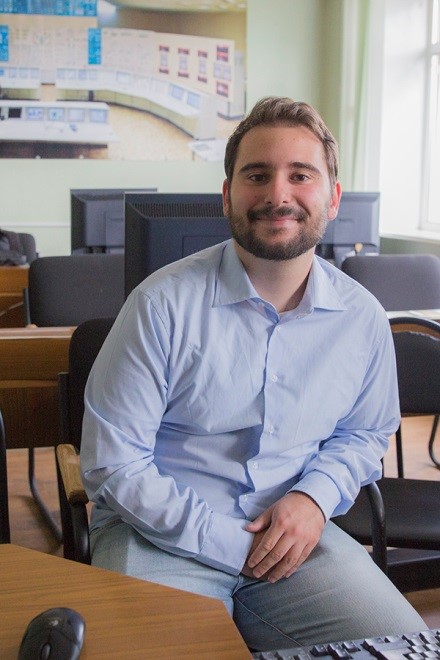
Alessandro Tassone, Italy: I was offered to go to Russia by my university (Sapienza University, Rome), which is a member of the ENEN (European Nuclear Education Network) consortium CIRTEN, and I decided to apply. And I would like to say thanks to both universities because I always wanted to visit Russia.
My research is dedicated to the development of benchmarks for the fourth generation Fast Reactor for coupled neutronics and thermal-hydraulics calculations, so this internship is helpful for me.
I received good life experience, although sometimes things get hard. You have a very difficult alphabete, and I practically did not know it before I came here. So it wasn’t that easy, especially at first, even in the supermarket. But I think I’ll come again to Russia.
It’s the seventh week (out of 9) of my internship, and I feel that it’s been a nice opportunity to expand my knowledge, and great personal experience. As for the university, there has recently been a discussion with representatives of Thermal Physics Department, and they were positive about future cooperation between our two universities, even though of signing an agreement.
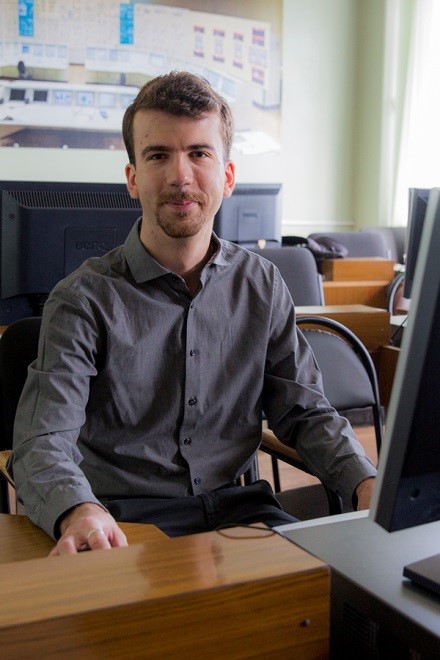 Filip Osuský, Slovakia: It is not my first time in Russia. Last year I was in Obninsk, wh ere possibilities of the internship were discussed. One of my supervisors was among the participants of the discussion so he proposed me to take part in it.
I think Russia is pretty much like Slovakia, our mentality is similar. But for me it is hard to judge because my mother is Russian.
My overall impression of MEPhI is quite good. You have a reactor which is not in operation, but you can do some physical experiments on it. It is a good opportunity for people involved in industry. My work is connected with neutronic analysis of gas fast reactor during the transient states, so I have a lot of things for my research there.
I think I’ve been pushed forward in my knowledge here; it is a great life experience. Besides, I’ve managed to meet my distant relatives like my half cousin. With these guys (pointing at Alessandro and Adrian) we’ve been on the Red Square, in Kremlin, VDNKH, Park Pobedy, Astronaut Museum, the Bolshoi Theatre. We mainly go together there, when we have time on the weekend.
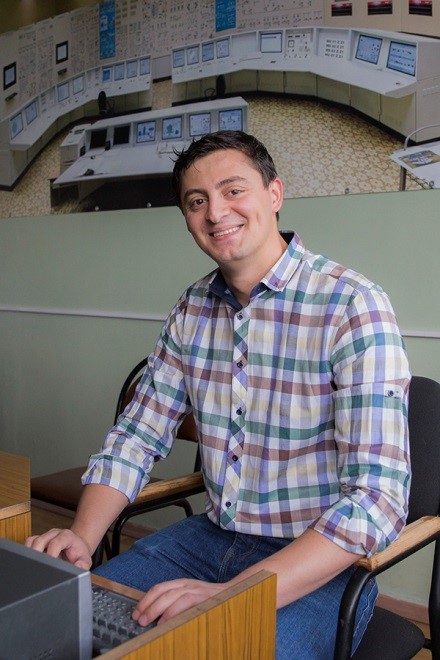
Adrian Filip, Romania: It all started when my Professor from Bucharest who needed to find students for the internship program asked me if I wanted to go to Russia, and I agreed.
In MEPhI I got pretty much information about the reactor which I need for my PhD study on ALFRED thermo-hydraulics. In MEPhI my research is more about benchmark for ALFRED reactor. I can say that educational systems of our countries are similar but at my university only 20 students study nuclear physics. We have no experiment facilities, and in that way your university provides many more opportunities to study.
Before I went to Russia the only thing I had learnt about this country was information from the Internet, and there it was not always good [smiling]. It turned out to be a fun place, although it rains a lot. When we came here it rained pretty much every day.
The only thing I do not like is that signs are not in English. The names of the streets, the map of the city, the museums – here everything is in Russian! Also we went to Yuriy Gagarin’s museum, but we can’t go sightseeing every weekend because we do not have enough time.
I‘d like to come back here, but as a tourist, with a guide. I’d recommend foreign researchers coming to Russia to be open-minded and have a dictionary with them. They should also learn Russian, at least alphabet.