June 15, 2016. It is 10 years since the launch of Russian spacecraft Resurs-DK-1, carrying a PAMELA detector on board. This unique magnetic spectrometer was created at the Institute of Cosmophysics MEPhI, whose main task is to measure the spectra of high-energy antiparticles in cosmic radiation. The experiment is conducted in an international collaboration of scientists from Russia, Italy, Sweden, Germany as part of a Russian-Italian Mission (RIM).
In an interview with RIA Novosti, Russian co-chair of the project and Director of the Institute of Cosmophysics MEPhI, Professor Arkady Galper, talked about the results of this project.
Mr Galper, what were the key objectives of the PAMELA project?
Arkady Galper: The main objective was to study the fluxes of cosmic antiparticles (positrons and antiprotons) that are part of the primary cosmic radiation on the near-Earth orbit. As we know, these particles result from various processes happening across the Universe. However, it is also possible that these antiparticles result from the annihilation of dark matter. Let me explain. The word "dark" in this context does not refer to the color of the matter, but to the fact that it is invisible, does not create electromagnetic rays, cannot be detected and is unintelligible. We can only detect it from its gravitational effects.
That said, it is crucial to understand the nature of dark matter. Why? We now know for sure that dark matter accounts for 25 percent of our Universe and therefore knowing its nature and composition is important for understanding how the world came into being and evolved.
How was the search for antimatter organized?
Arkady Galper: Research was carried out using PAMELA, a precision magnetic spectrometer installed on a Russian Earth observation satellite in a special pressurized container. During measurements, the main axis of PAMELA pointed to a zenith, which enabled us to continuously monitor cosmic radiation throughout the presence of the satellite in orbit. It was for the first time that we were able to study within almost 10 years the energy spectrum of antimatter (positrons and antiprotons) in space using a single device with only minor methodological and statistical errors.
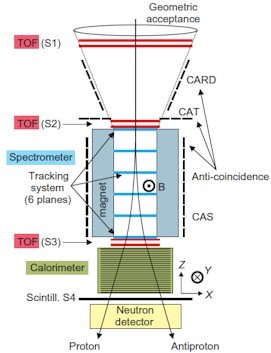
The detection complex “PAMELA”
What are the key outcomes of these efforts?
Arkady Galper: Since June 15, 2006, we have been constantly measuring the characteristics of cosmic particles (electrons and positrons, protons and antiprotons, as well as light nuclei). By carefully analyzing data obtained on the project's first stage we discovered that positrons did not act the way theoretical models predicted. The share of positrons in cosmic rays turned out to be higher compared to ordinary particles, electrons. This is when we realized that this could be due to the so-called wimps, hypothetical particles that form dark matter. When wimps collide they can annihilate themselves, i.e. disappear, transforming into particles we actually can recognize, such as protons or antiprotons, electrons and positrons. But using the PAMELA magnetic spectrometer we understood that wimps can also disintegrate by themselves and also become particles we know.
This is what scientists called the PAMELA anomaly. The American Physical Society called our research the most important discovery of 2008 along with the launch of the Large Hadron Collider.
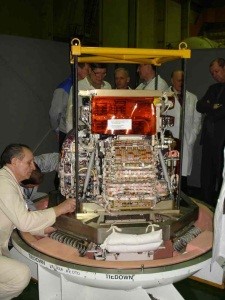
The spectrometer “PAMELA” – the last check before launching
As strange as it might seem, when the research team that worked on the project submitted an article on their discoveries to Nature, the oldest and most respected scientific magazine, the article wasn't published for almost a year and appeared only in 2009. The article has since been cited by our peers several thousand times. This is an extraordinary scientific and technical achievement. Data obtained by the PAMELA magnetic spectrometer were later confirmed by two space experiments: the Fermi Gamma-ray Space Telescope and the AMS-02 magnetic spectrometer. As for the Resurs-DK-1 satellite, it stopped working in February 2016, having served three times maore than initially expected. Research on dark matter continues to this day as part of the Gamma-400 project by researchers from the Lebedev Physical Institute and National Research Nuclear University MEPhI.
Participants of the collaboration “PAMELA: at the Baikonur cosmodrome