The tendency of modern electronics’ development is connected with the raising of energy efficiency of devices of electronic component base. To solve this task, large industrial enterprises in Russia and abroad have relied on the usage of new semiconductor materials such as gallium nitride, silicone carbide and their compounds instead of traditional silicone, which lead to the significant growth of power of received devices.
Scientists of MEPhI Institute of functional nuclear electronics together with their colleagues fr om Belarusian State University of Informatics and Radioelectronics have put their effort into solving of the task of raising of power of semiconductor materials on the basis of gallium nitrides by using graphene films for heat dispersion.
“For the first time, as a part of hydrodynamic model, including continuity equations, Poisson's equations and equations for electron temperature the task on the influence of heat distributing layer on temperature and volt-ampere characteristics of gallium nitride transistors with high mobility of electrons has been solved, commented one of the participants of the project, the Head of the Laboratory of Microwave Instrumentation and Design of MEPhI Institute of functional nuclear electronics Roman Ryzhuk. – The mechanism of origin of peaks of electronic and lattice temperatures has been researched, so called hot spots. It has been detected that the introduction of the heat distributor allows significantly lower maximum temperature for 100-200 °С and improve volt-ampere characteristics”.
As the result of the conducted work the technology of forming of graphene film according to its thermal conductivity dependent on the size of graphene corns has been optimised. It has been shown that the film thermal conductivity does not depend much on the corn size and varies from 100 to 1000 W/m-1K-1.
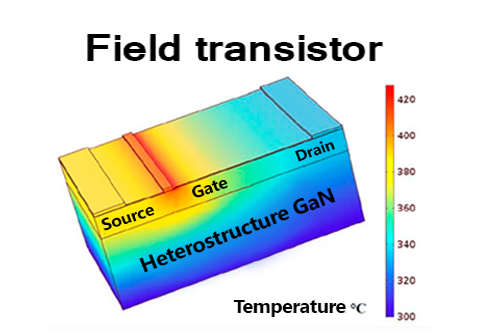
Temperature distribution in the structure of transistor
According to the expert’s words, “as the result of fruitful cooperation between MEPhI and Belarusian State University of Informatics and Radioelectronics a new fundamental-applied direction of microwave electronics has been formed on the basis of wide-area materials and graphene nanostructures. Such devices are aimed at usage in radiolocation stations, air-borne equipment of space vehicles, lines of wireless connection, passages of base stations, safety systems and advance warning”.
The results of our scientists have been represented at scientific sessions, international scientific-practical conferences and exhibitions wh ere they were welcomed by scientific society. The work has been published in three scientific journals, indexed by international databases «Web of Science» and «Scopus».