Nowadays there is a huge progress in the sphere of development of atomic and ionic frequency standards which can be explained by the contribution of the method of high-precision measuring of time and frequency to the development of fundamental science, technology and economics. In atomic clocks, which are widespread now, the transfer of electrons, revolving around an atom, from one energy level to another one, is fixed, i.e. the frequency of their orbit change.
Russian physicist, Doctor of Physical and Mathematical Sciences, the Head of SINP MSU laboratory, Professor of MEPhI Department of Physical and technical problems of metrology (№78) Evgeniy Tkalia has offered to use nuclear transitions, screened by an electronic shell, instead of atomic ones. They are a way less sensitive to external disturbances, and it would allow increase the precision of measuring several orders. The unique low isomeric level in thorium isotope-229, the energy of which is 7.8±0.5 eV, is in the field of vacuum ultraviolet radiation, and is nowadays available for laser sources. The precise measuring of energy of isomeric transition will allow develop optical nuclear frequency standard with the precision up to 10^ (-20), which will open wide prospects of its usage in many spheres of science, technology and economics.
The principle of work of atomic clock is based on the countoff of time periods with the help of regular changes of nucleus ions of radioactive isotope of thorium-229. Its advantage is that the nucleus inside the atom is protected by electrons revolving around and is less subjected to the influence of external factors. This makes the clock more reliable. Apart from the Russian group of scientists, scholars from Germany and the USA have come quite close to the creation of atomic clock. A gamma laser of optical spectrum can be created on nuclear transition in thorium-229 except for the clock. These two developments are quite close to each other.
Laser cooling of atoms and ions localized in traps of different types is one of the most widespread methods of getting and research of quantum properties of separate ultracold atoms and ions. A certain progress has been reached with the help of these physical systems not only in traditional laser spectroscopy of ultrahigh resolution but also in such new directions as spectroscopy and quantum logics, and optical standards of time and frequency. Experiments conducted with the atomic clock have already provided for a more accurate check of the relativity theory, and have set stricter restrictions to the range of possible temporary deviation of a series of fundamental constants.
Two leading research groups have started solving experimental task on laser cooling and optical spectroscopy of thorium ions: Georgia Institute of Technology (the USA) and PTB (Germany). In the US laser systems for spectroscopy of electronic thorium transitions and ion trap for getting ionic crystals Th3+ have been created; first coulombian crystals, containing up to 10^4 thorium ions Th3+, have been received and detected. In Germany laser systems for spectroscopy of electronic thorium transitions and ion trap for getting ionic crystals Th3+ have been created; first coulombian crystals, containing up to 10^3 thorium ions Th+, have been received and detected. Laser cooling of assemblies of thorium ions in a trap is an inevitable initial stage for conducting spectroscopy of nuclear isomeric transition.
The task of launching of isomeric transition is more complicated from the point of view of experimental realization because direct launching of transition is hampered because of huge uncertainty of the energy range of the transition and the life period of necessary state. Different mechanisms of launching of nuclear transition are offered to measure energy of isomeric level.
Our university has already created a trap for atomic clock. The next step is the development of a laser for cooling of an assembly of ultracold thorium ions in the Paul linear trap. This is what MEPhI scientists of Departments №37 and №78 are doing together with employees of VNIIFTRI and LPI RAS.
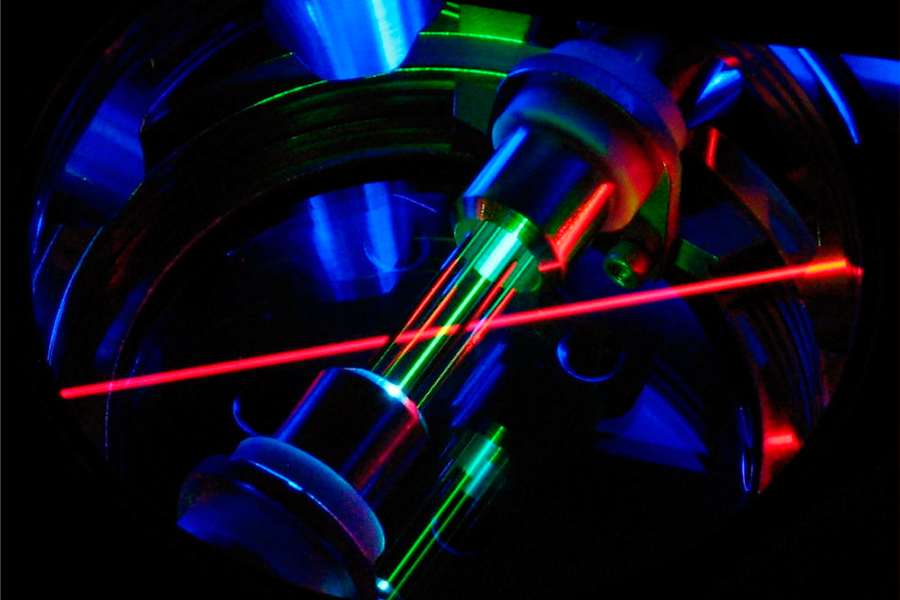
Above: Nuclear Clock - Ion Trap (Photo: GIT)
Nowadays there are no experiments conducted in Russia on realization of laser cooling of thorium ions in traps, but they are a principal stage in creation of a nuclear frequency standard. As the result of the project completion, a system of laser cooling of ions of thorium-229 will be created which will allow research absorption and exciton spectrums in atomic, molecular and nuclear transitions.