For successful completion of reaction of thermonuclear synthesis it is necessary to solve the problem of protection of the reactor wall which will be subjected to extremely high thermal loads and radiation by high flows of particles, and high level of neutron radiation. Erosion of the material which is in contact with plasma in a thermonuclear reactor leads to the development of admixtures in plasma, which lowers the time of its existence, and limits the time of the material usage. The capture and the permeability of hydrogen isotopes in the material lead to the lowering of tritium in plasma, making thermonuclear reaction impossible, and complicate the procedure of tritium extraction from the refrigeration system. Moreover, tritium accumulation and permeability are one of unsolved problems of safety for the abuilding international thermonuclear reactor ITER and for future first demonstrational thermonuclear power reactor-tokamak DEMO. Hydrogen brittleness and helium swelling in thermonuclear reactor are important issues defining the adoptability of the material.
Ferrite-martensite steels have been considered as one of candidates for materials of fast-neutron reactor camera, and little activated ferrite-martensite steels become prior structure materials for a thermonuclear reactor. For work at relatively high temperatures little activated steels Eurofer97, F82H and Rusfer have been worked out in Europe, Japan and Russia. New generation steels, improved because of oxide disperse hardening by adding nano-particles Y2O3, have shown developed high-temperature strength and lowering of radiation-induced microstructure changes. Nowadays their mechanical and physical properties, the influence of alloyage and corrosion are well learnt. But quite a little is known about interaction of plasma and gas with these steels, namely: migration and capture of hydrogen and helium and erosion of these steels under the influence of plasma.
In existing tokamaks ASDEX Upgrade (AUG) and JET tungsten, its alloys and coverings are used for the protection of areas of walls with maximum thermal load (divertor). Tungsten is also supposed to be used as divertor material for ITER and DEMO. Its main areas of application are radiation embrittlement, raising of hydrogen and helium accumulation as the result of radiation damage and high losses of power because of tungsten admixture in plasma. The alternative solution as plasma-facing material is nano-structured tungsten coverings on steels which allow lower the speed of material erosion.
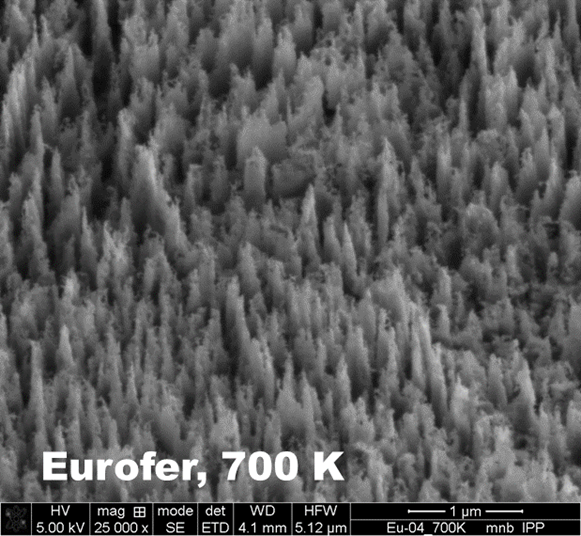
Above: modification of steel surface after radiation by deuterium plasma with 200 eV energy
MEPhI Department of plasma physics (№ 21) under the supervision of senior research fellow Olga Ogorodnikova has started the realization of the project “Fundamental aspects of hydrogen and helium interaction with the new generation of little activated ferrite-martensite steels and nanostructured tungsten coverings on steels”. It is concentrated on studying of a wide range of processes including erosion, diffusion and capture of hydrogen and helium in low activated ferrite-martensite steels and nanostructured tungsten coverings on steels, change of microstructure, contents and morphology of complex materials in a long period of radiation by plasma and under radiation of high thermal flows.