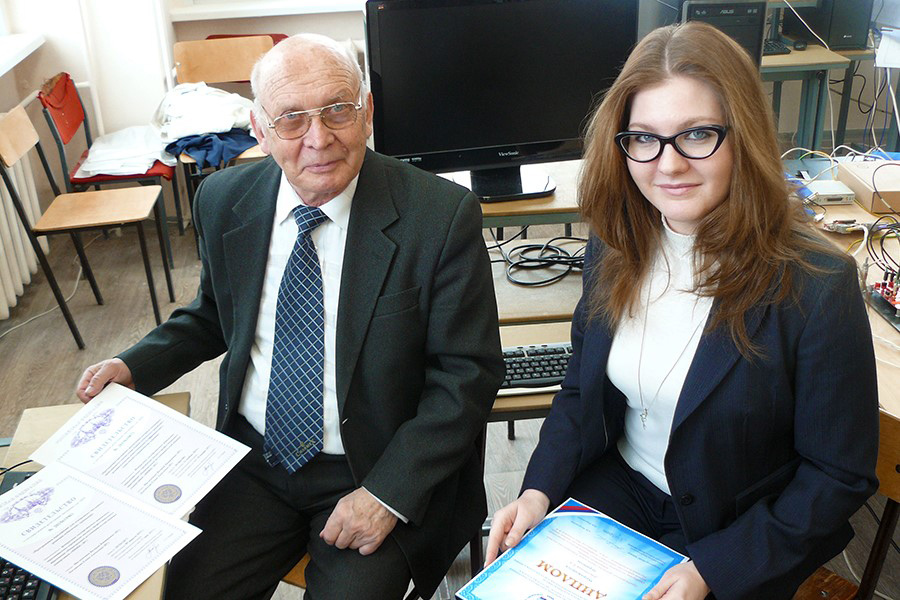
A new numerical method of solving nonlinear algebraic equations has been realized at the Department № 26 “Electronic measuring systems” headed by Doctor of Sciences Maslennikov Valeriy, which surpasses existing analogues in its key characteristics: speed, exactness, and convergence.
At first the task appeared under the creation of modern measuring devices out of the necessity of analysis of active filters’ behavior, development of perspective element base and choice of an existing one. It has been formulated the following way: it is necessary to work out a new approach to solving of nonlinear algebraic equations, convenient for direct analytic calculations and evaluation of scheme parametres in a polyvalent search.
Bearing in mind standard mathematical system models in physics and technics, expressed by integro-differential equations and Laplace transform, reduced to algebraic, it has been decided to take the results of initial task solution as the basis for a new numerical method.
The new offered method is based on the refusal from traditional artificial setting of initial values. The first starting approximation is figured out on the basis of the coefficients of the equation which is precised later by the iterative way of making adjustments to certain coefficients. For cubic equations there is only one coefficient of that kind. The received method supposes unconditional convergence to an exact solution which excludes the necessity to check correctness of the result. It allows to lower the waste of time, machine and human sources.
The programs developed at the moment can be used in any systems of engineering and mathematical calculations including systems of open-end projection. It is planned to apply received results for solving continuously differentiable nonlinear tasks, integro-differential equations together with operational method of Laplace transform, eigenvalue problems. The developed formulas which allow to get the first approximation can be applied in approximation and interpolation with iterative adjustment, and raising of the quality of graphic interfaces under element drawing. Code building up and creation of a convenient user interface will allow to develop the concept up to a full system of modelling and calculations.
Above: project developers Maslennikov Valeriy and Dovgopoloya Elena (Department № 26 “Electronic measuring systems”)